Biography of Arnulf Rainer
For more than seven decades, Arnulf Rainer repeatedly tested the limits of painting, uncompromisingly and in defiance of every convention. The chronology below traces the key stages of his life and work, from his birth in Baden bei Wien in 1929, through the Übermalungen (Overpaintings) and Face Farces, to his death in Upper Austria at the end of 2025.
1929 – 1959
1929
Born in Baden near Vienna.
1944
Realistic landscapes in watercolour in Kärnten.
1947/48
First contact with international contemporary art through periodicals at the British Council in Klagenfurt, exhibitions organised by the French Cultural Institute in Villach and at the Künstlerhaus in Klagenfurt.
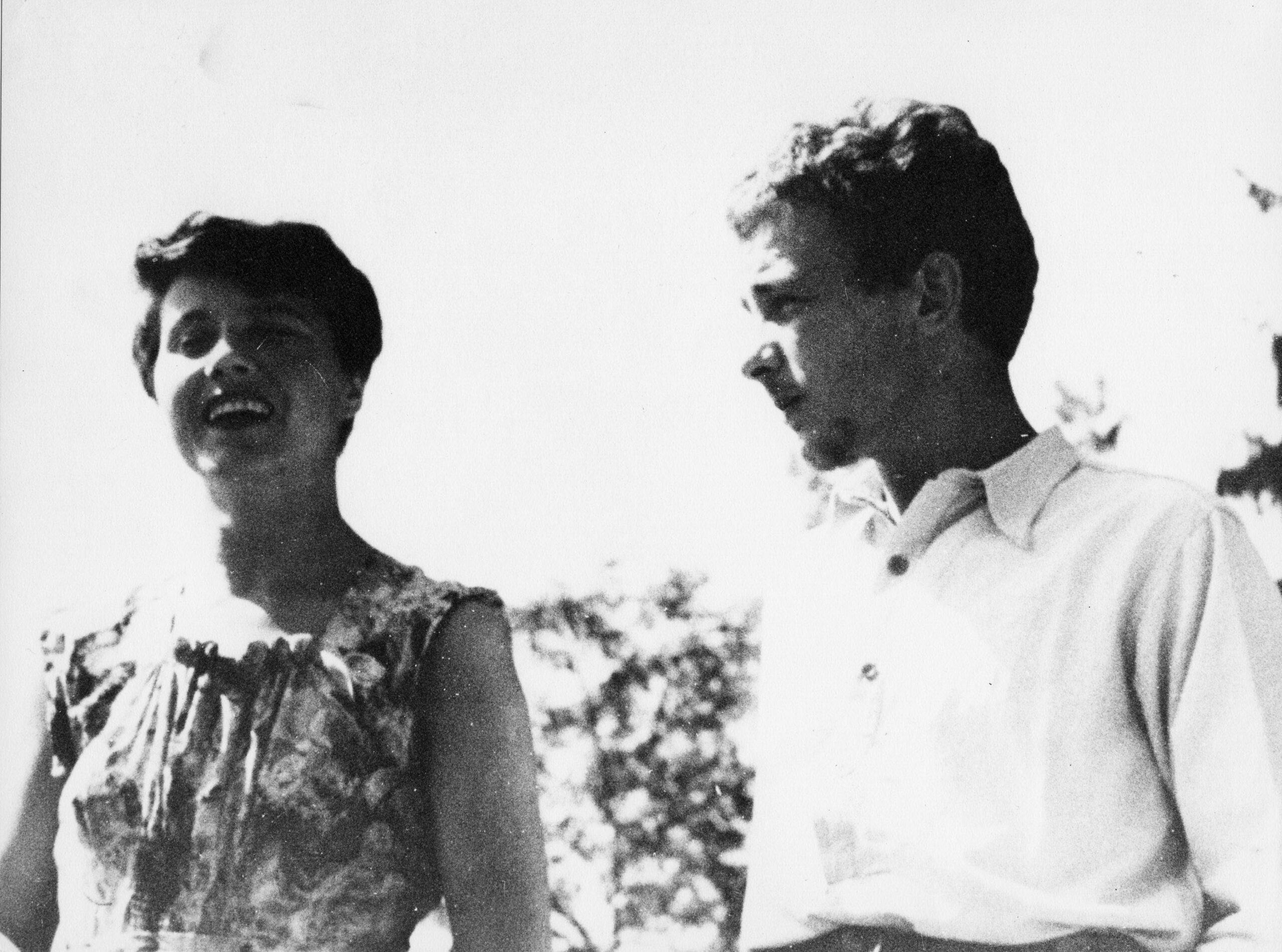
Meets Maria Lassnig.
Inspired by surrealist publications in Klagenfurt, he paints his first surrealist portraits (e.g. Portrait of Maria Lassnig, Schweber und Steher).
1949
Having passed the entrance exams, he stays just one day at the Hochschule für Angewandte Kunst in Vienna and only three days at the Akademie der Bildenden Künste in Vienna. Rainer Dying.
1950
Lives and works in Gainfarn in Bad Vöslau.
Founding of the Hundsgruppe (Dog Group) with Maria Lassnig, Ernst Fuchs, Arik Brauer, Anton Lehmden and others.
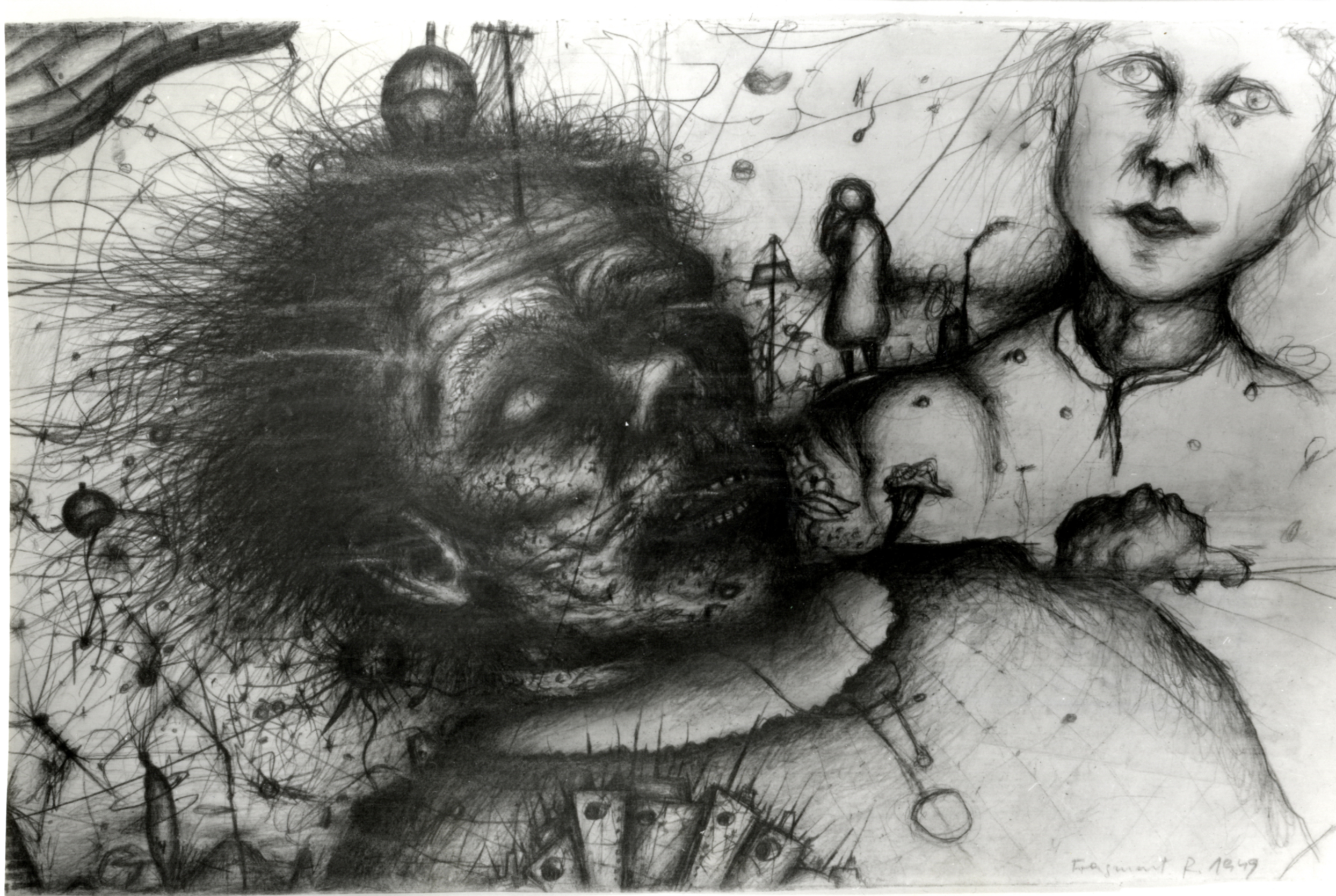
Creates a series of intensely condensed surreal drawings (Anfüllung der Welt, Winnetou, My World with twenty).
1951
Visits Paris with Maria Lassnig. Has a disappointing meeting with André Breton. Visits the exhibition Véhémences confrontées with work by Hans Hartung and Wols. Impressed by this, he finds his way to the pictorial forms of the Mikrostrukturen (Microstructures) and Atomisationen (Atomisations).
First attempts at drawing with closed eyes: ‘Painting blind is painting without any (visual) consideration, for instance only based on the sense of touch. It was an important period for me. In the process, I discovered the concepts of Zentralisation (Centralisation) and Vertikalgestaltung (Vertical Design).’ (A.R. 1973)
Exhibition of the Hundsgruppe at the Gesellschaft für Wissenschaft und Kunst in Vienna. Spontaneously starts to insult the audience when disappointed with the opening speech by Ernst Fuchs. Graphic portfolio Cave Canem. Rainer call himself ‘TRR’ which refers to the growling of a dog and also signs his paintings with ‘TRR’ of ‘TRRR’.
First exhibition at the Galerie Kleinmayer in Klagenfurt.
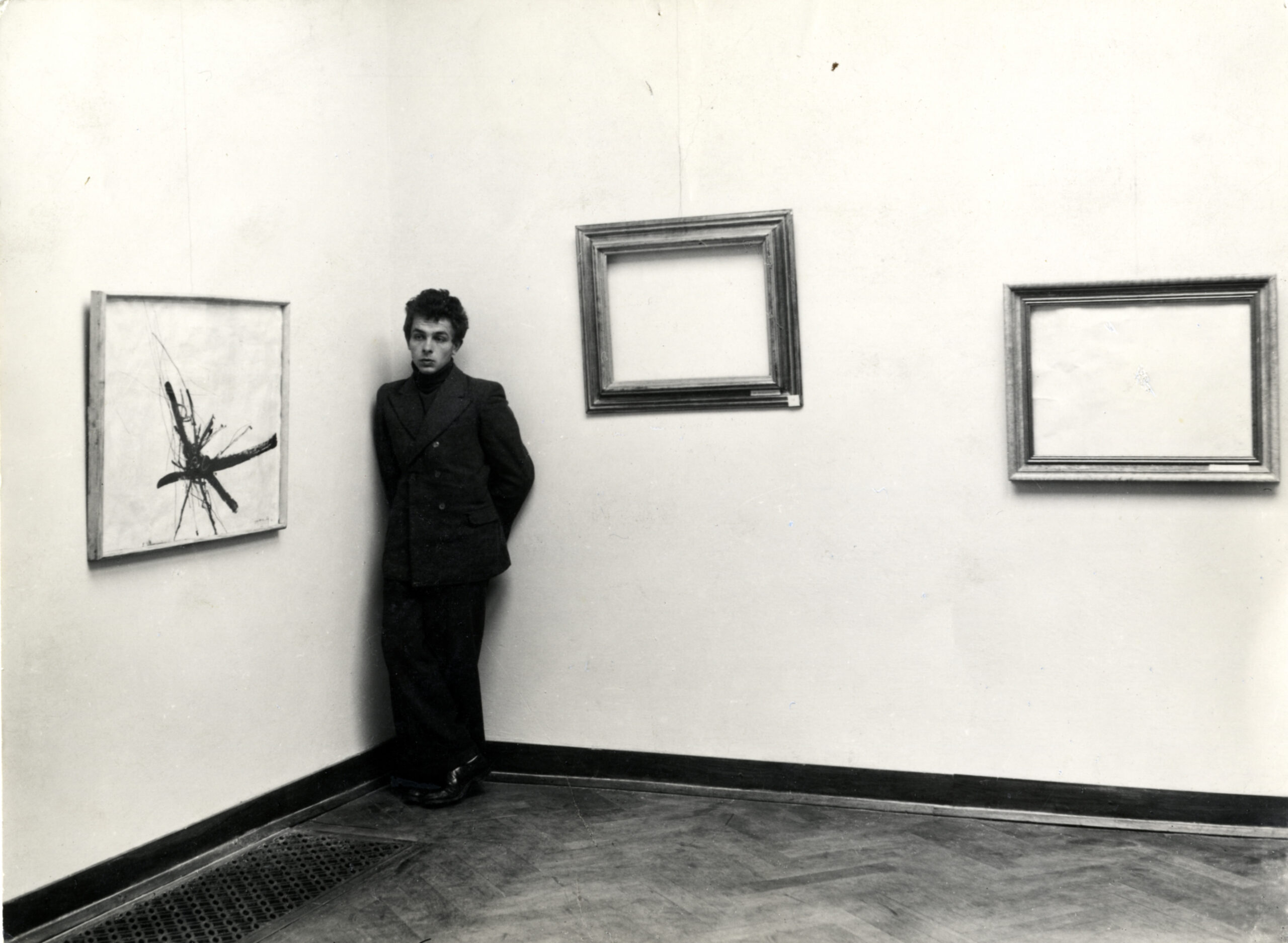
Organises an exhibition of recent nonfigurative art at the Künstlerhaus in Klagenfurt with Maria Lassnig. Using the pseudonym ‘Zuzlu,’ in addition to atomic paintings and blind paintings, he exhibits Nadamalerei (empty picture frames hung on the wall).
1952
Exhibition TRR. Automatic, optische Auflösung, Blindmalerei, Zentralgestaltung at the Zimmergalerie Franck in Frankfurt. The exhibition catalogue contains his texts Malerei, um die Malerei zu verlassen (Painting to abandon painting) and Ausblick: Das Einzige gegen das Andere (Outlook: the one against the other).
Collector Ottomar Domnick buys a collection of drawings. Exhibition of his collection (first informal exhibition in Germany) at the Württembergische Staatsgalerie in Stuttgart.
1953
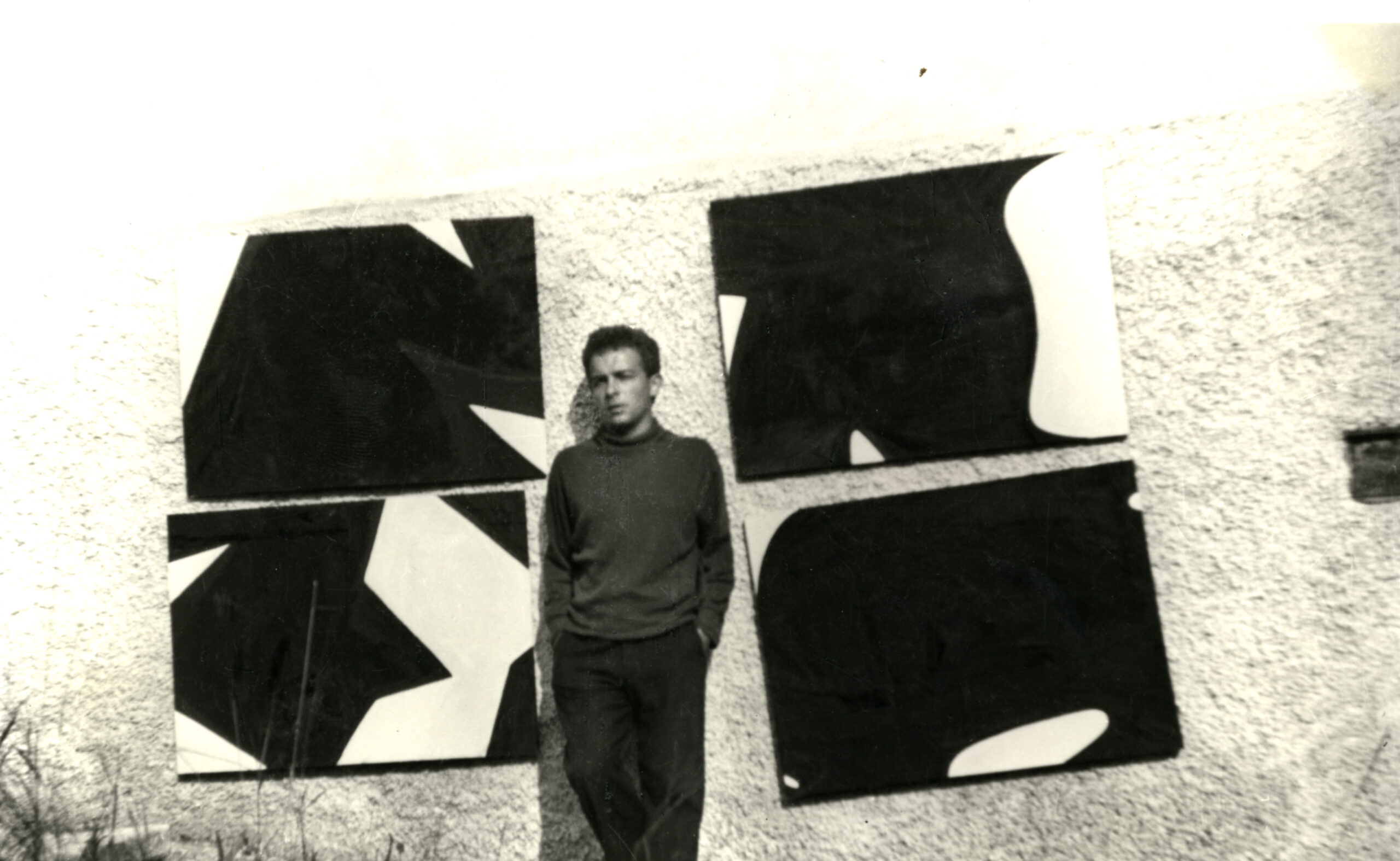
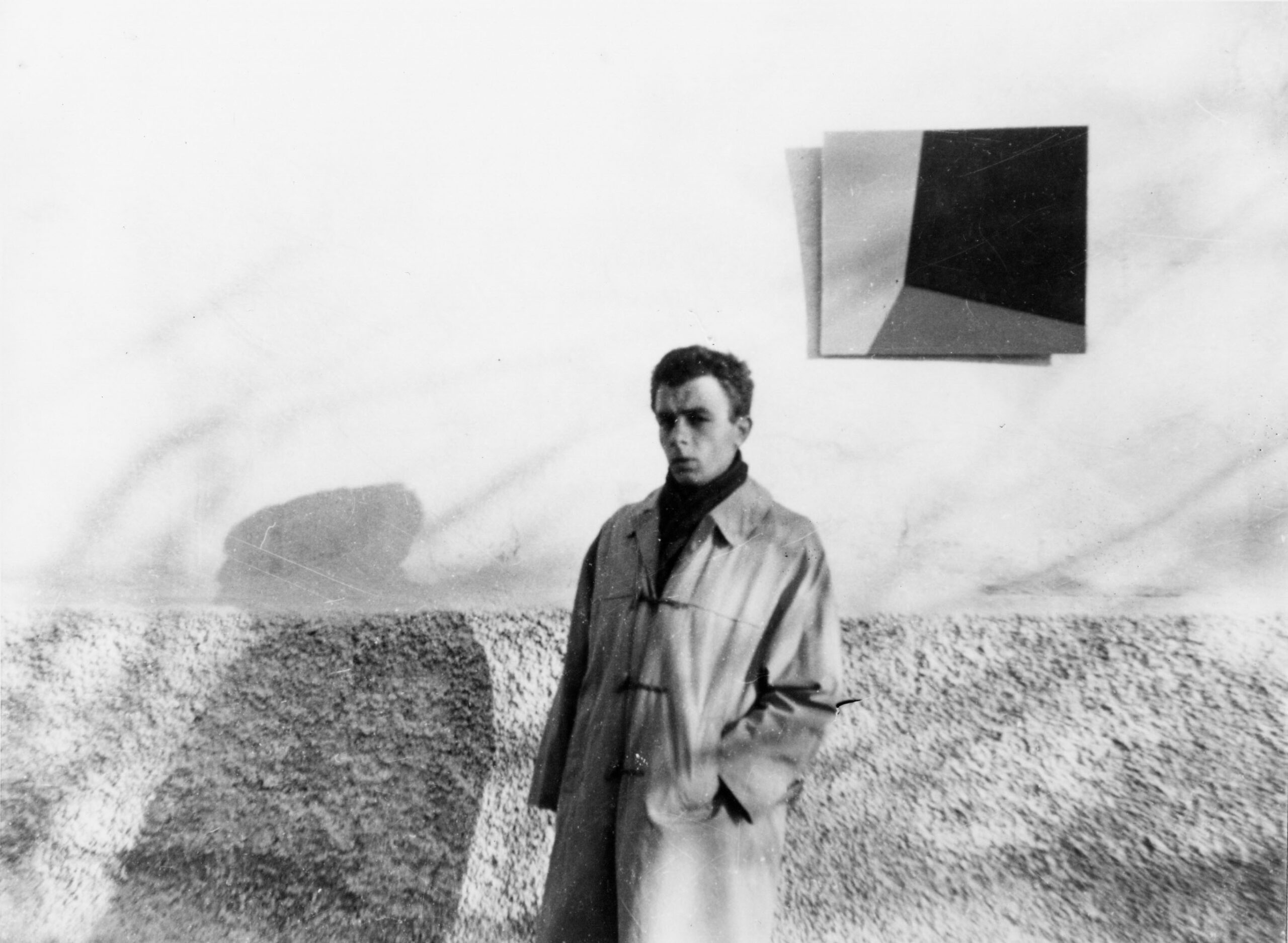
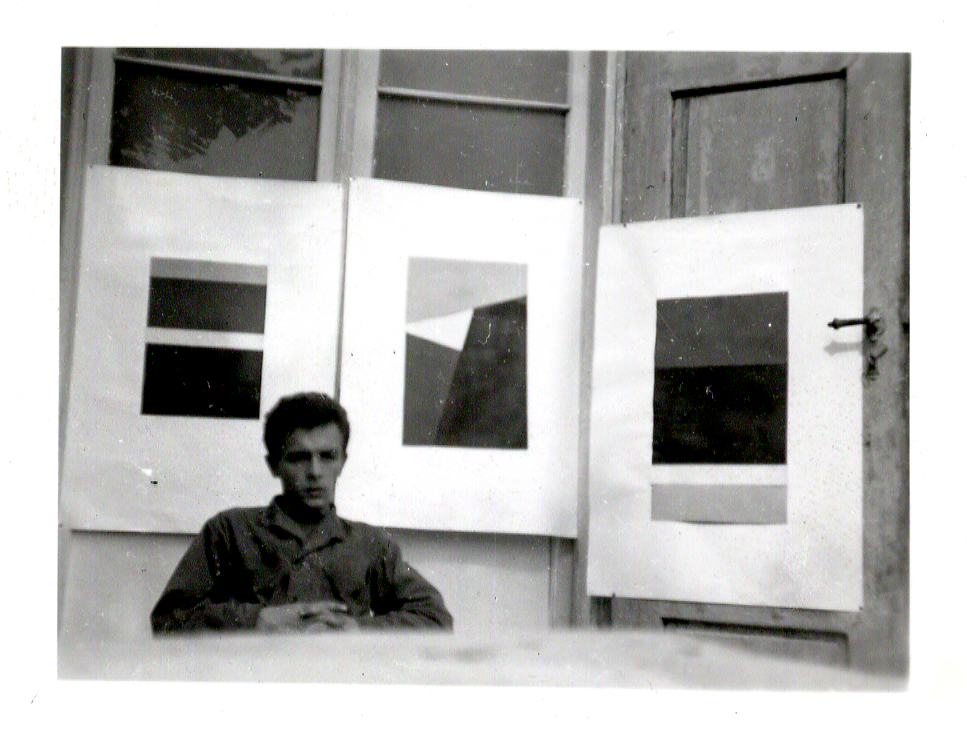
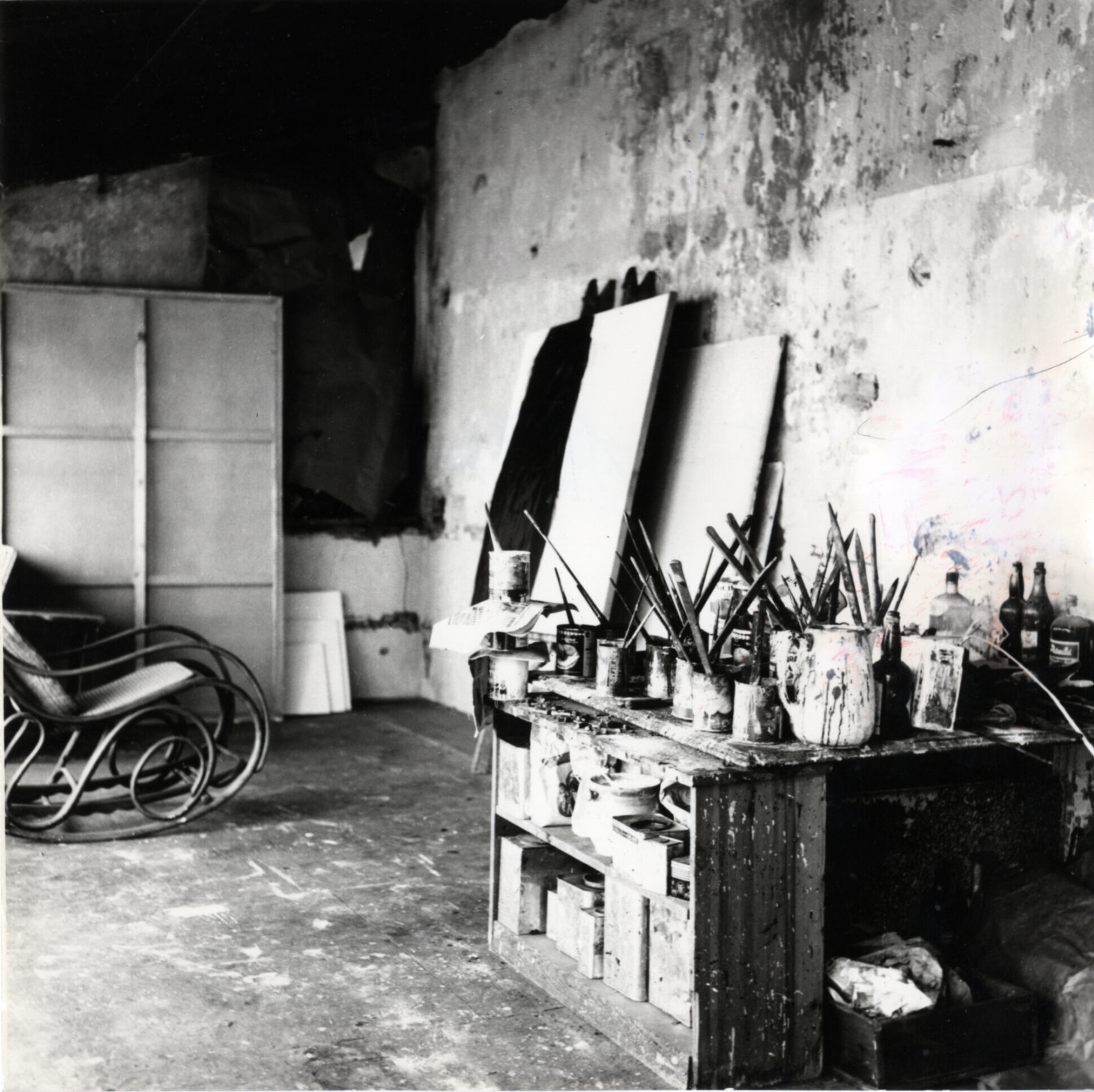
Reduktionen (Reductions) are created in Gainfarn (black monochrome pictures with delimited white areas), which step by step develop into Übermalungen (Overpaintings).
Rainer start to work on Proportionsstudien (Studies of Proportion), colour collages with dyed papers which are created ‘through parallel shifts’. ‘This work is cold, sober and focused on balance of form. It is the only possible point of view.’ (A.R. 1954) Later, some of the works are burnt because of ‘storage problems’.
Meets monsignor Otto Mauer, founder and leader of the Galerie St. Stephan in Vienna (after May 1964, Galerie nächst St. Stephan).
1954
Galerie Würthle in Vienna (artistic leader Fritz Wotruba) exhibits Proportionsordnungen (Proportional Arrangements).
1955
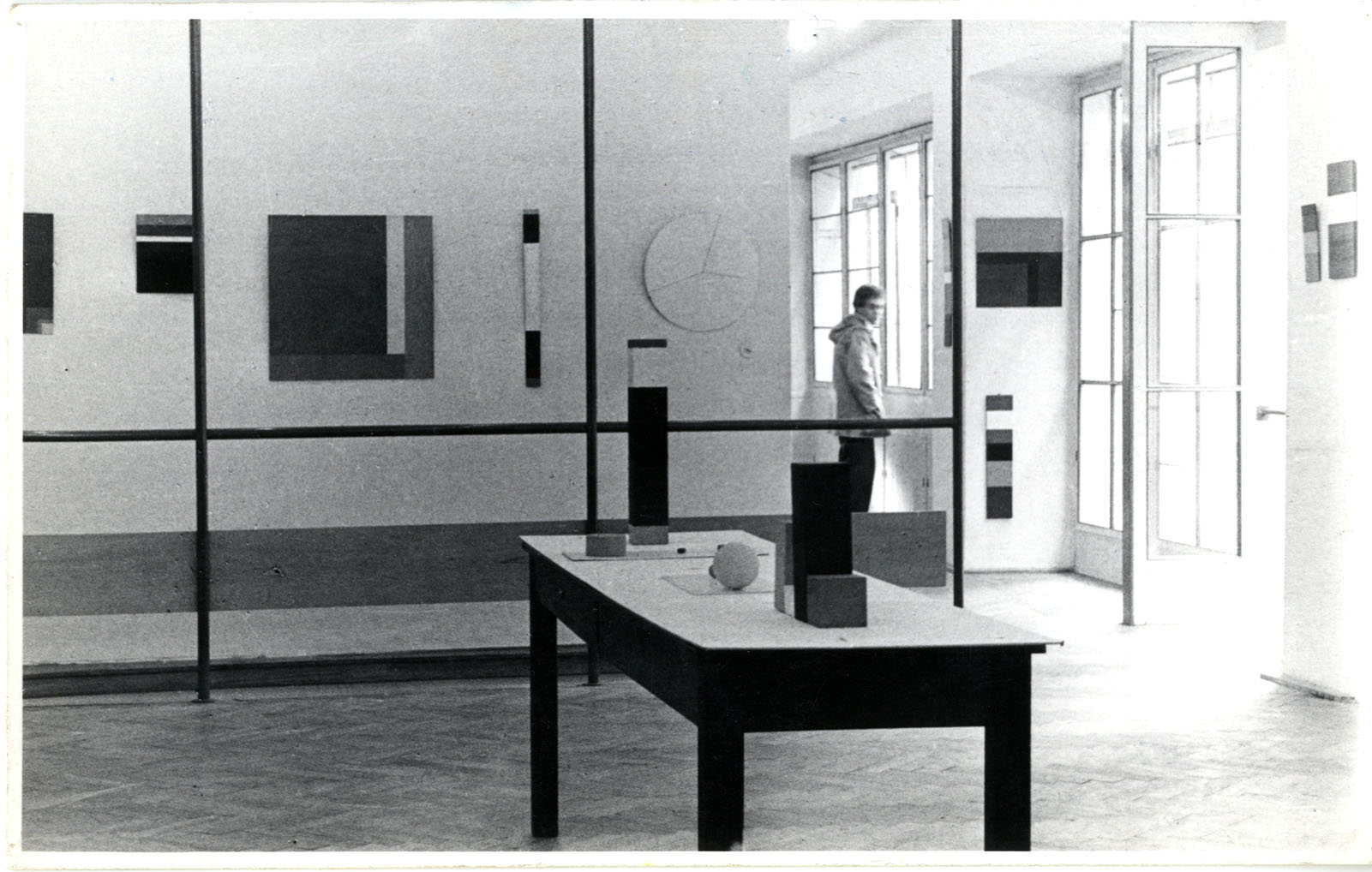
Rainer’s text Die Form ist Physiognomie (The Form is Physiognomy) is printed on the poster for his first solo exhibition Kreuzbilder und Proportionsstudien (Crosses and Studies of Proportion) at Galerie St. Stephan in Vienna.
1956
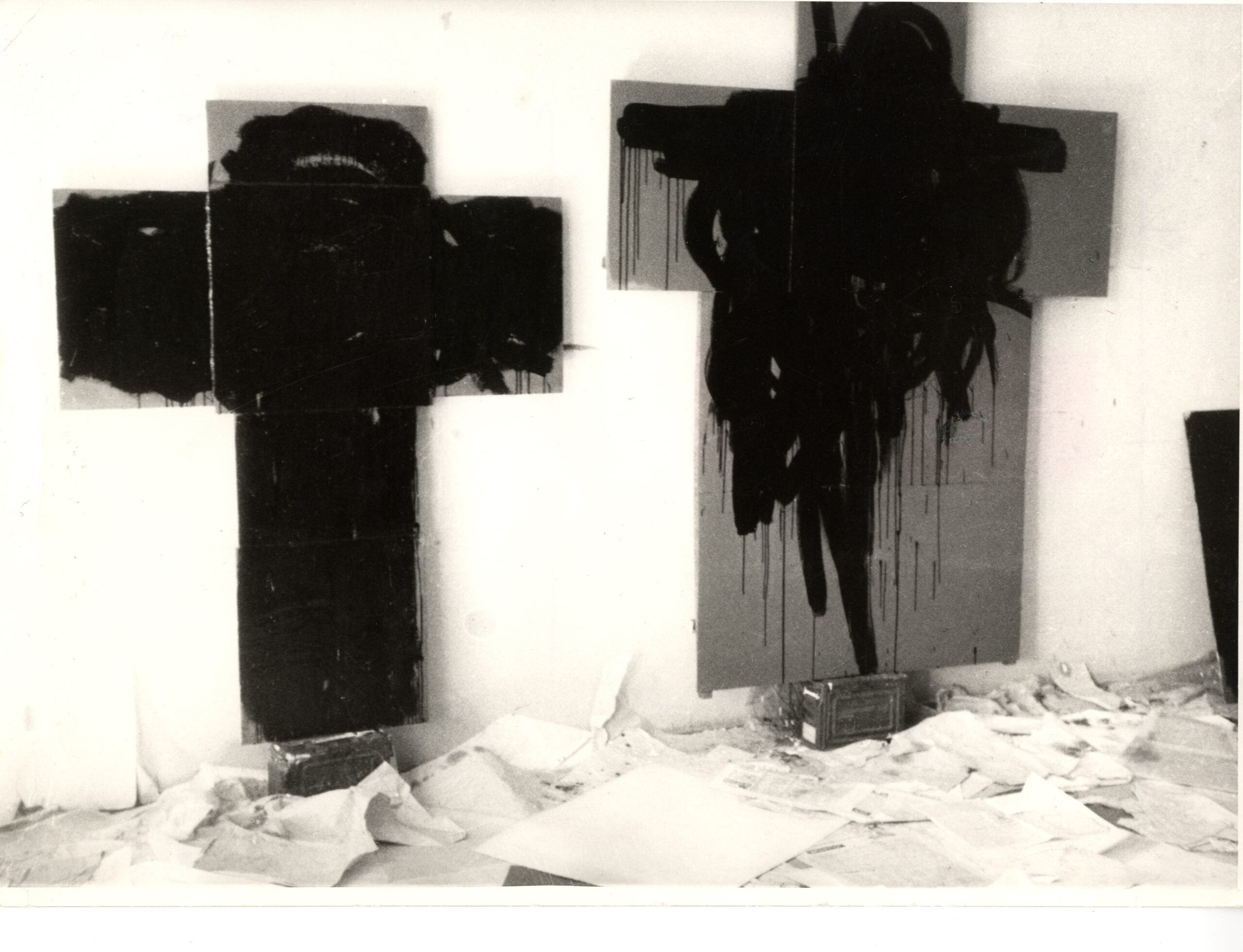
Paints a series of about 15 Kruzifikationen (Crucifixions) – overpainted, composite hard-fibre boards in various cross shapes – and does his first dry-point etchings.
Exhibition Comparaisons at the Musée d’Art Moderne in Paris.
1957
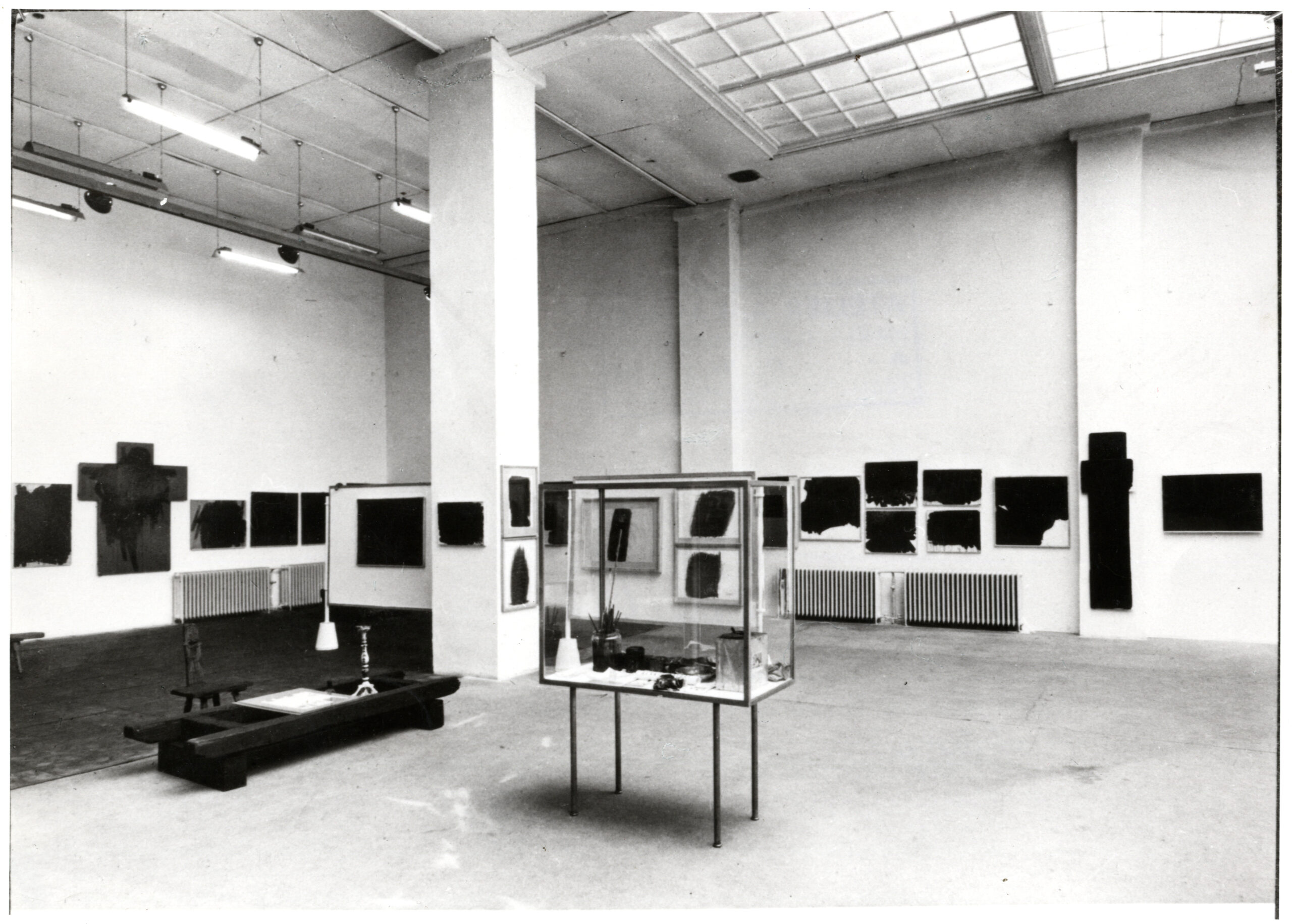
Exhibition Monochrome Komplexe 1955–1957 at the Wiener Secession in summer.
Gallery Arnaud in Paris exhibits Artistes autrichiens d’aujourd’hui and an exhibition of work by four Viennese painters – Hollegha, Mikl, Prachensky and Rainer – is held at the Museum für Völkerkunde in Hamburg.
1958
During a lecture in January at the Galerie St. Stephan in Vienne, Rainer poses 10 theses for progressive painting. In cooperation with Markus Prachensky he publishes the manifesto Architektur mit Händen (Architecture with Hands).
Galerie 33 in Bern exhibits NNNmalerei (by Rainer) and Peintures récentes de Markus Prachensky.
1959
Moves from Gainfarn to Vienna.
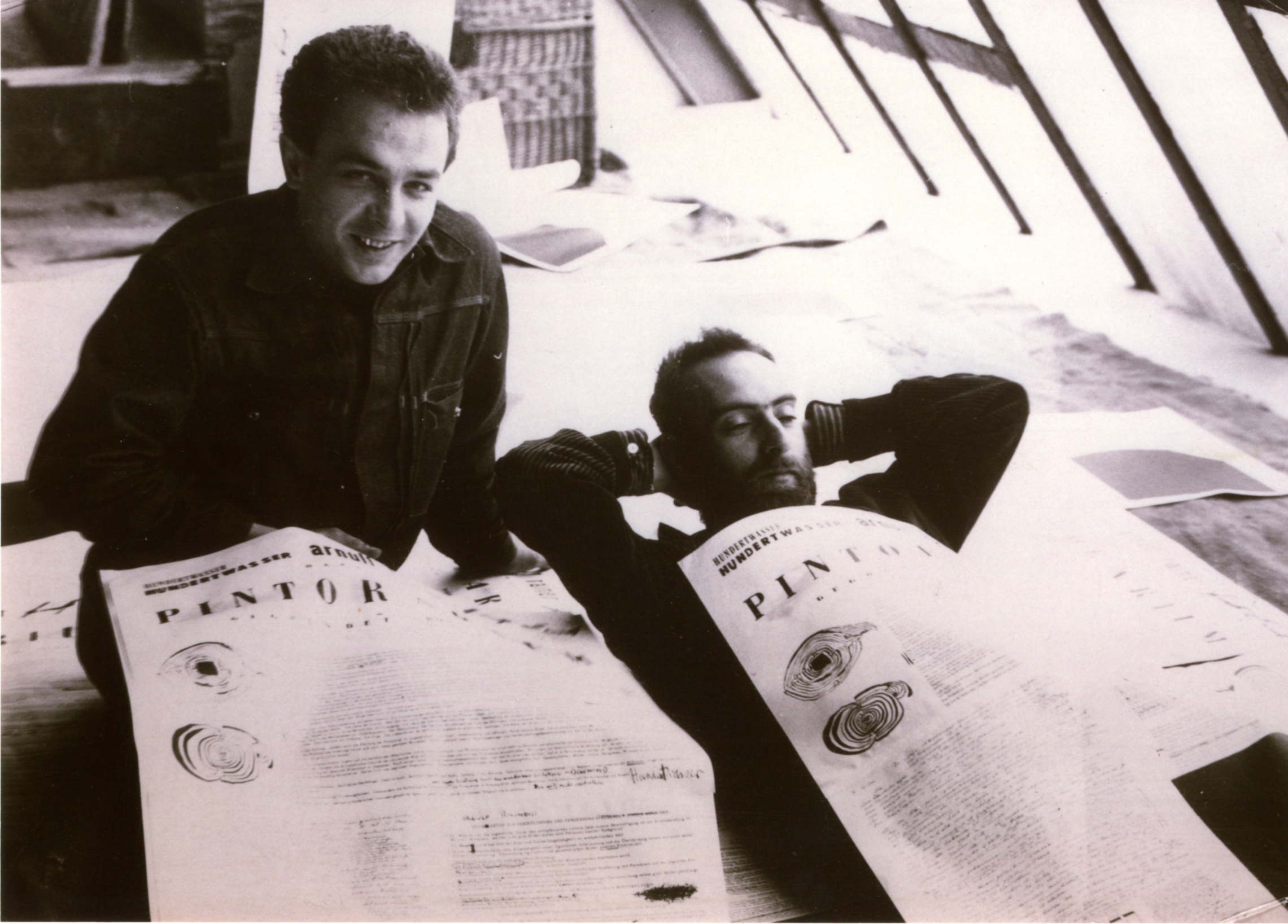
Together with Ernst Fuchs and Friedensreich Hundertwasser, Rainer founds the Pintorarium (as a ‘crematorium for cremating the academy’).
Peter Kubelka makes the film Arnulf Rainer, which consists of nothing but white spaces.
Victor Vasarely, Emilio Vedova, Georges Mathieu, Sam Francis and others offer work to be overpainted.
1960 – 1969
1960
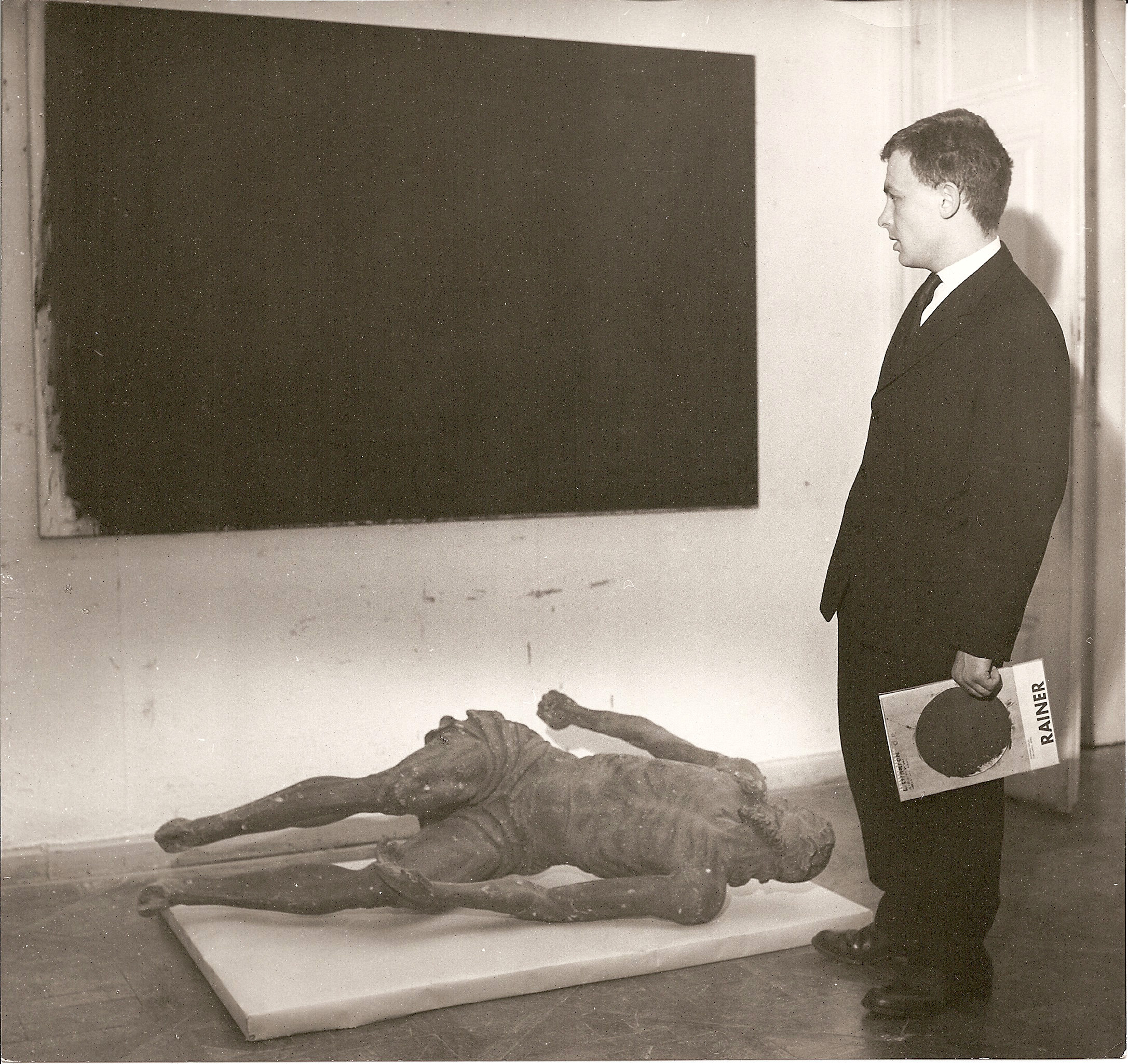
Galerie St. Stephan in Vienna exhibits Überzeichnungen und Übermalungen 1955–1960. Kreuz und Nacht (Cross and Night) is published by Panderma in Basel.
„Contrary to actional overpainting, monochrome overpainting is a slow process. It is a passive creative process: the painter must patiently wait for the next spot to be overpainted to present itself. (Though it is inherent in the structure of every imagination that all its spots will ultimately express this wish; it is the sequence that is crucial). The organic creative act is perhaps even more important than the completed picture, since the participation in the gradual darkening or drowning of the image, its gradual achievement of tranquillity and visibility (the big ocean) is similar to achieving a state of contemplation in religious life.“ (A.R. 1960)
Schloss Morsbroich, the municipal museum of Leverkusen, exhibits Monochrome Paintings (with Lucio Fontana, Yves Klein, Mark Rothko, Raimund Girke, Arnulf Rainer and others). The Arts Council Gallery in London shows Austrian Painting and Sculpture 1900–1960.
Studio in Frankfurt at Weserstraße 13.
1961
Takes part in the exhibition Young City Sees Young Art in Wolfsburg. Rainer overpaints the award-winning etching by a young female artist in black paint and is sued for this.
Solo exhibition at the Galleria del Cavallino in Venice. The Palais des Beaux-Arts in Brussels exhibits Art autrichien du vingtième siècle and Galerie St. Stephan in Vienna shows Überdeckungen und Radierungen (Coverings and Etchings)
Rainer begins to overdraw and overpaint his etchings.
1962
First use of ‘ultraphan’ (transparent plastic foil) and ‘pausleinen’ (paper with a thin layer of textile).
Receives an invitation to participate in the graphic art biennale in Milan and shows work at the exhibition Comparaisons at the Musée National d’Art Moderne in Paris. Galerie Schmela in Düsseldorf shows Überdeckungen, Galerie Rottloff in Karlsruhe shows Überdeckungen, Übermalungen, Überschreibungen (Coverings, Overpaintings, Overwritings) First exhibition in Japan, at the Minami Gallery in Taura.
1963
Moves to a studio at Wilmersdorfer Straße in West Berlin (until 1967). The portfolio Haute Coiffure with ten dry-point etchings is published.
Exhibition Writing and Image at the Stedelijk Museum in Amsterdam and at the Staatliche Kunsthalle in Baden-Baden. The National Museum of Modern Art in Kyoto exhibits Contemporary Trends of Painting and the Museum of the 20th Century in Vienna shows Idols and Daemons.
1964
Starts overpainting the book Gilgamesch. Eine Erzählung aus dem Orient.
Exhibition Figurative Übermalungen (Figurative Overpaintings) at Galerie Springer in Berlin.
1965
A series of figurative hallucinating drawings is created – mainly on ultraphan – with references to his early surrealist years. ‘After CAVE CANEM for ten years my goal was to achieve a dialectic negation of phantasy by covering up and overpainting. Dissatisfaction with everything, experiments with drugs, the encounter with art by the mentally ill brought me back to my early passions such as hyper-phantasy, neo-mythology and detail-overcrowding. The technical development of drawing materials in recent years (scratch-resistant foils, fibre pens, special fixatives, etc.) enabled the creation of super drawings.’ (A.R. 1968)
1966
Drawing experiments under the influence of hallucinogens filmed at the University Hospital in Lausanne. Film Künstler unter Psilocybin.
Exhibition Phantastica und Halluzinata 1946–1966 at Galerie Peithner-Lichtenfels in Vienna.
Arnulf Rainer receives the Austrian State Prize for Graphics.
1967
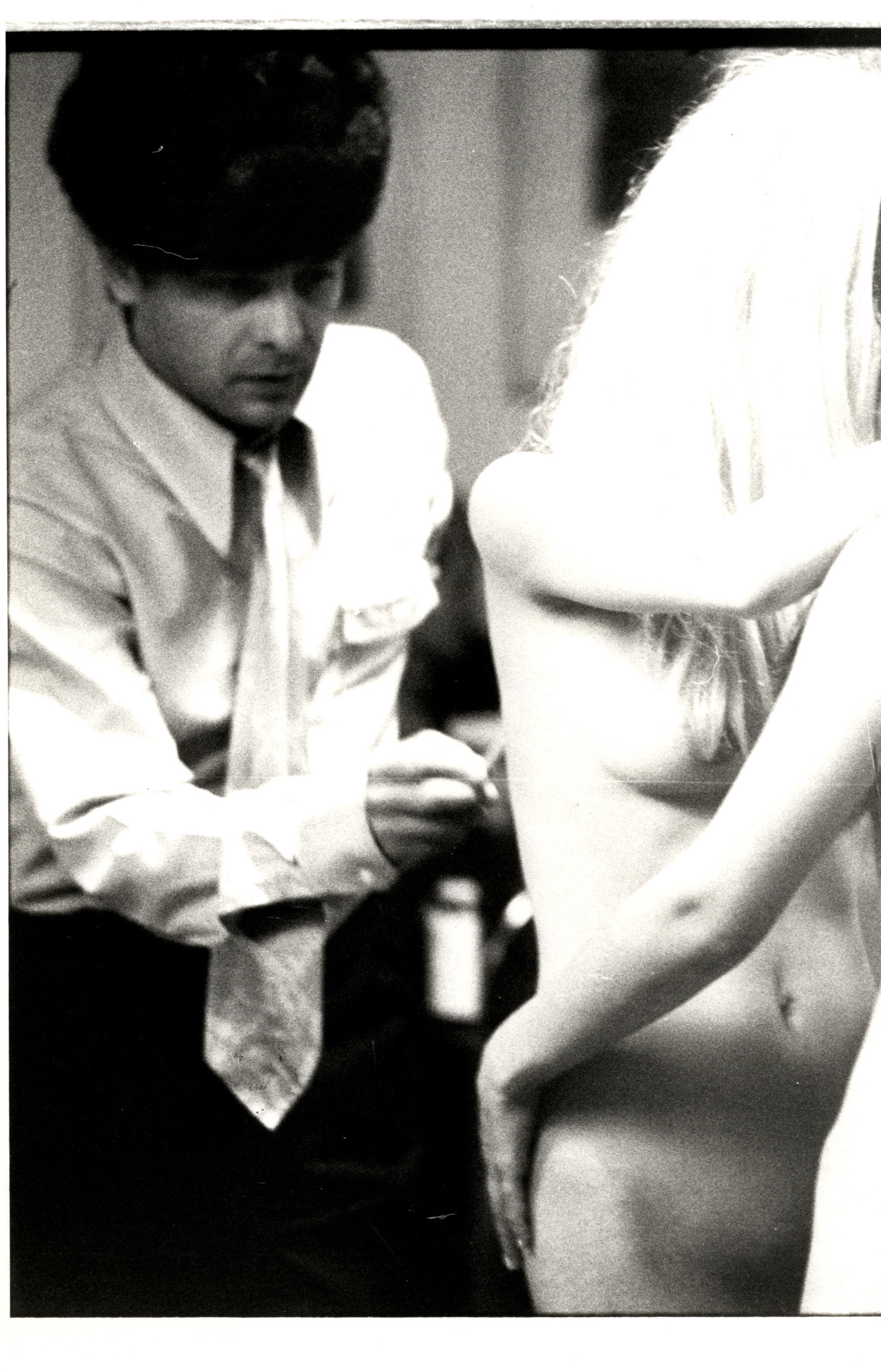
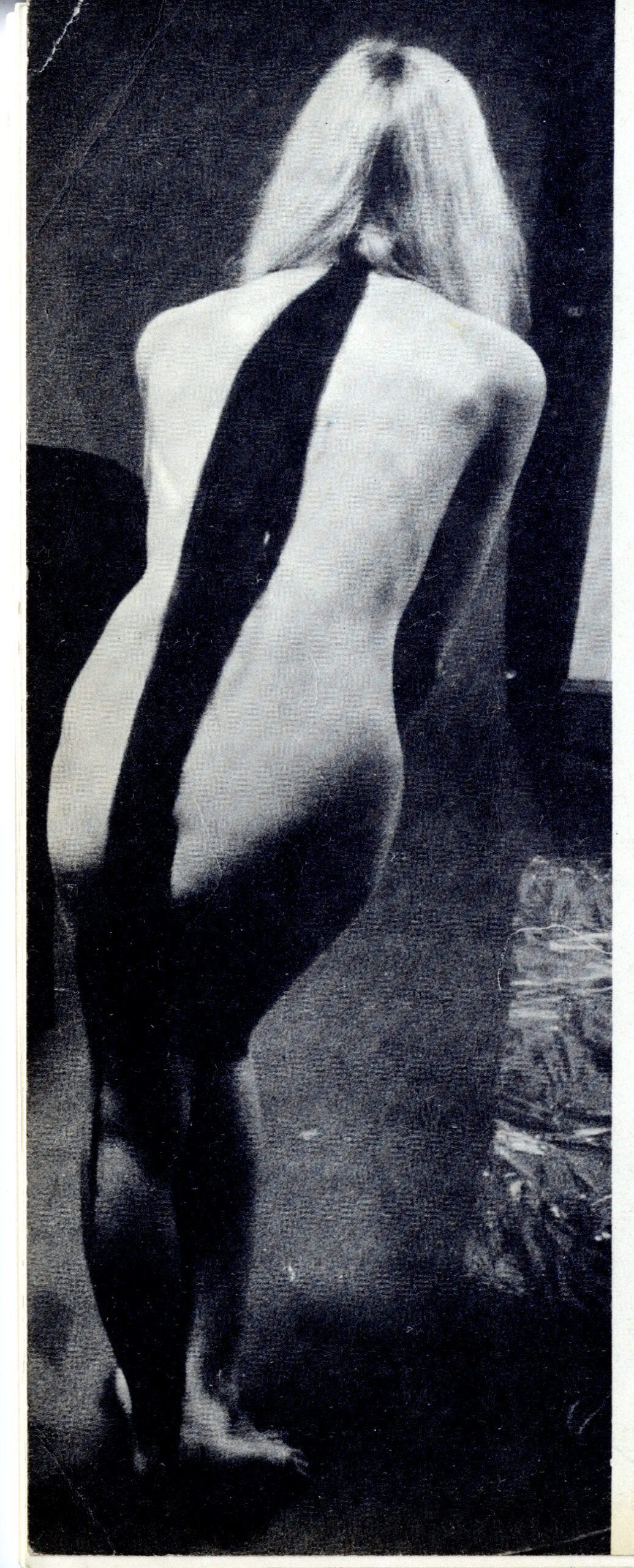
Exhibition TRRR. Psychopathologica, Manierismen, Drug-Sketches at the Galerie nächst St. Stephan in Vienna. Creation of Hyperzeichnungen (Hyperdrawings) such as Panorama berühmter Menschen (Panorama of Famous People). During the opening of the exhibition Pintorarium at Galerie Richard P. Hartmann in Munich, Rainer performs his first body painting (a black vertical line painted on the back of a nude model).
Continually increasing fascination with the art of the mentally ill. ‘People have ignored them, blind to the treasures they hold. Hitler – who was more sensitive to them – butchered them. It would be a mere symbolic amends to establish a museum showing the output and documentation of their art as a memorial to the hundreds of thousands of killings.’ (A.R. 1967)
1968
Studios in Munich (first at the Klenzestraße, later at the Schleißheimer Straße).
Experiments in drawing under the influence of LSD at the Max Planck Institute in Munich.
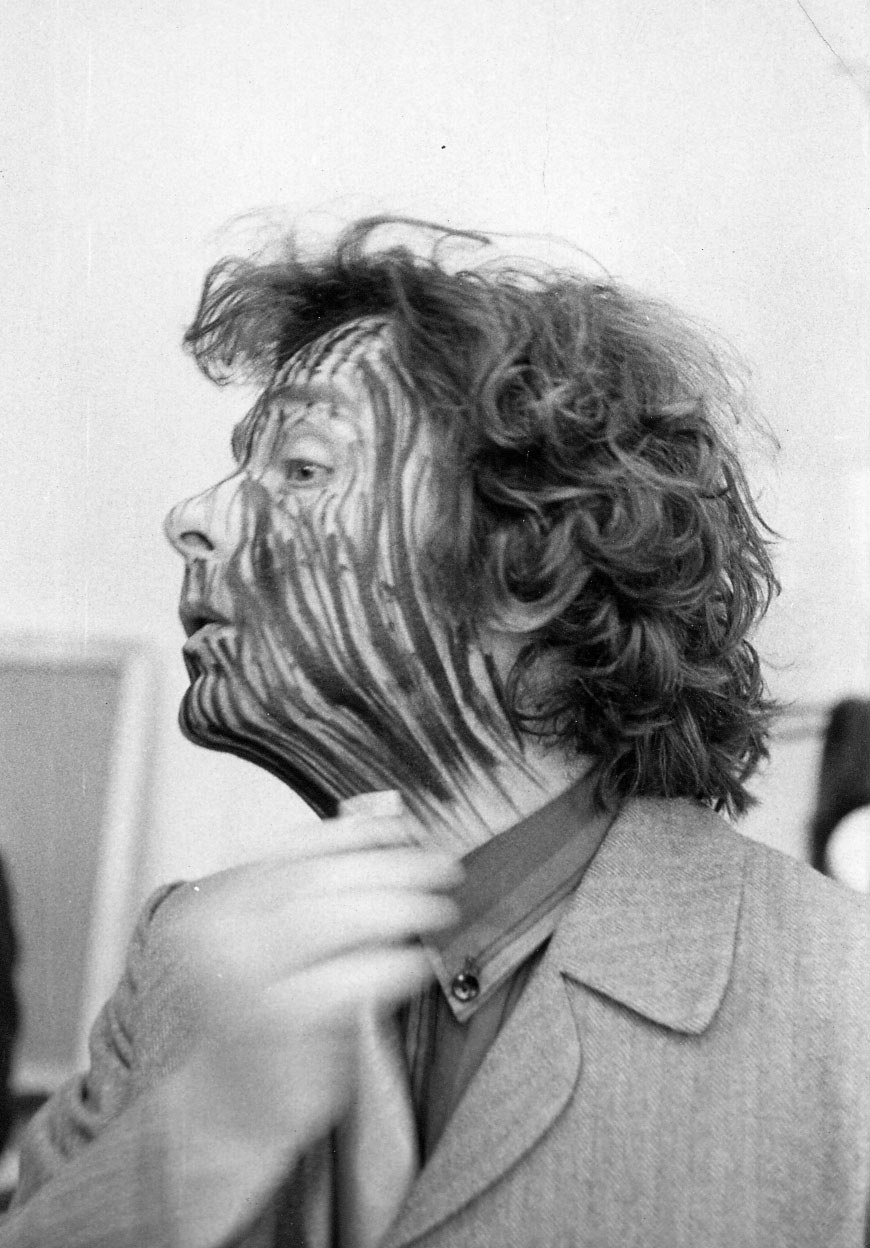
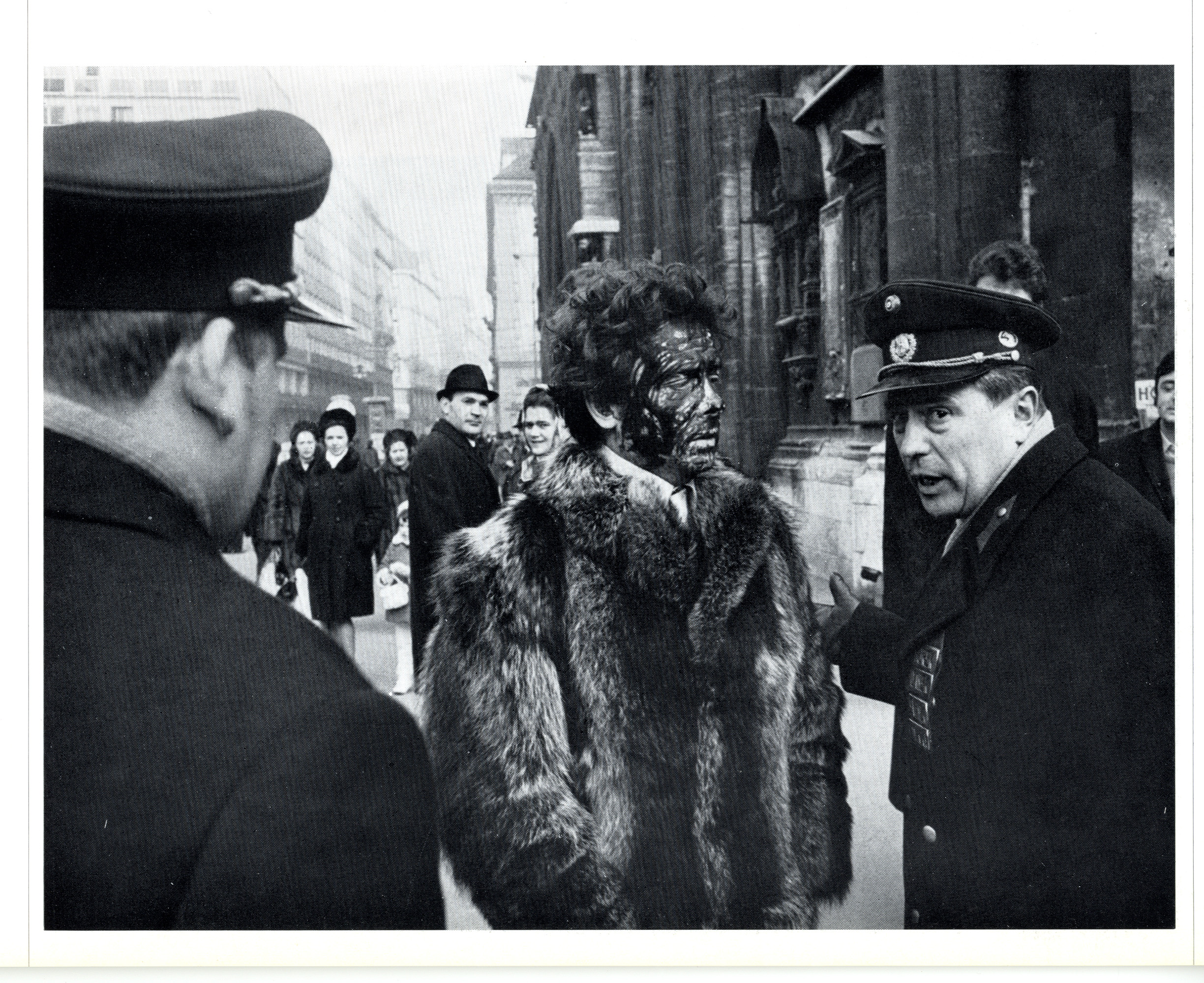
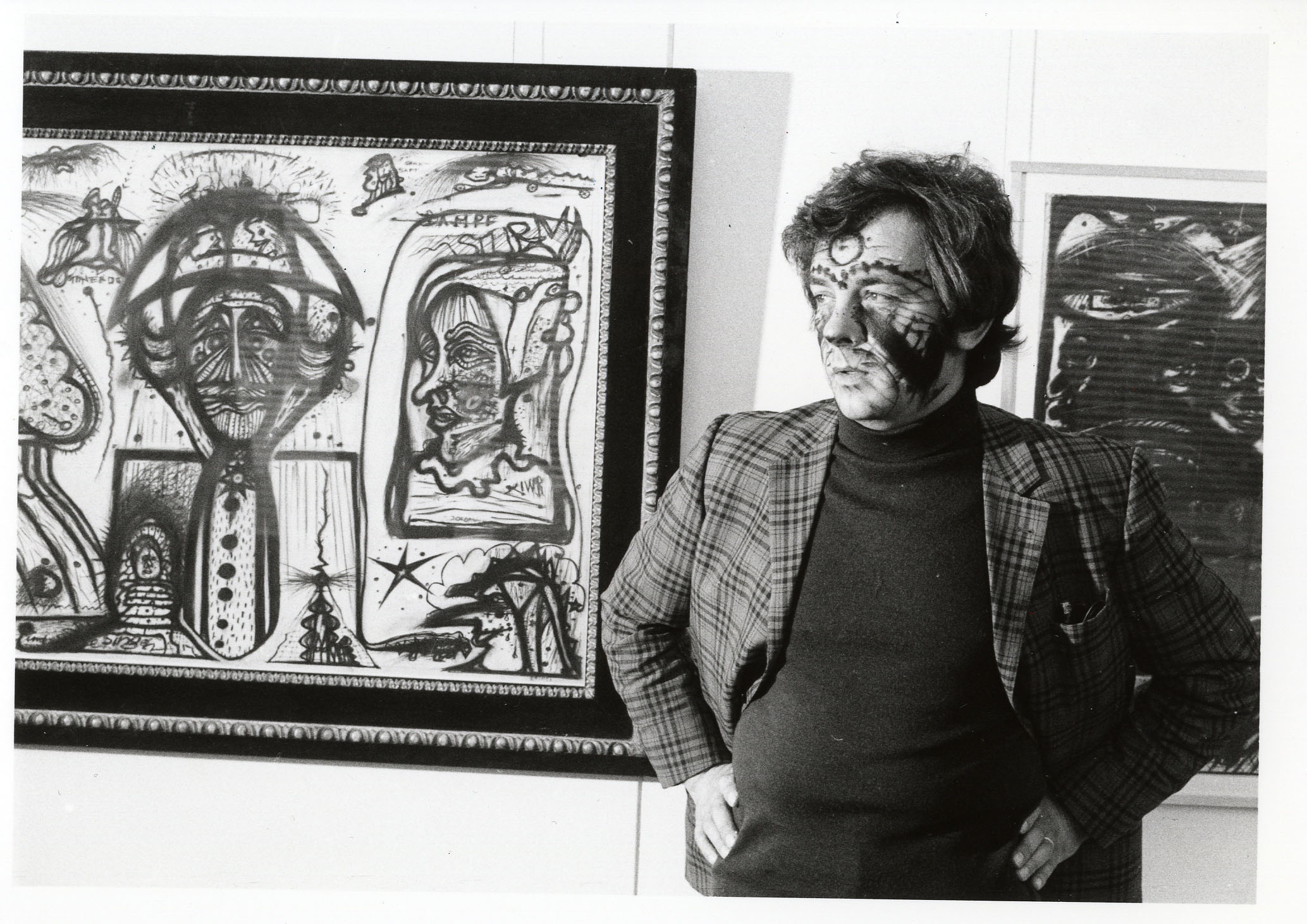
First self-paintings (face and hands) and appears in public in Vienna’s city centre painted in this way.
At the same time, numerous passport photos with the artist grimacing taken in photo booths are created, inspired by the facial distortions of the mentally ill.
First major retrospective exhibition at the Museum of the 20th Century in Vienna.
Galerie Richard P. Hartmann in Munich exhibits Die künstlichen Paradiese. Künstler arbeiten unter LSD (Artificial Paradises. Artists Working under the Influence of LSD).
1969
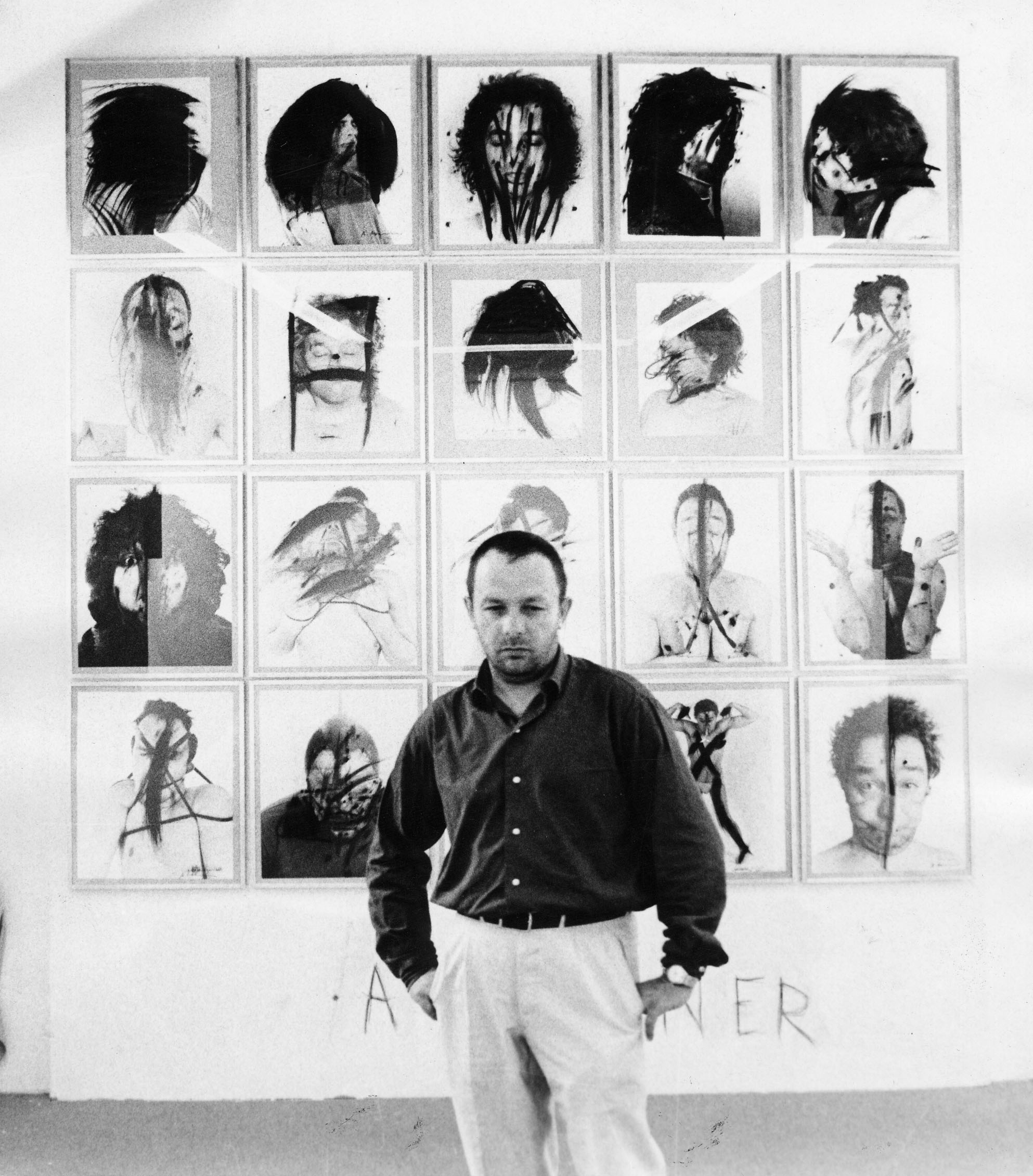
Enlarged photos from photo booths and photos made by photographers are over-drawn and overpainted. ‘Overdrawing the photographs of my mimical farces led to surprising discoveries. Many new and unfamiliar characters emerged who were hiding in me, that my muscles alone had been unable to express.’ (A.R. 1975)
1970 – 1979
1970
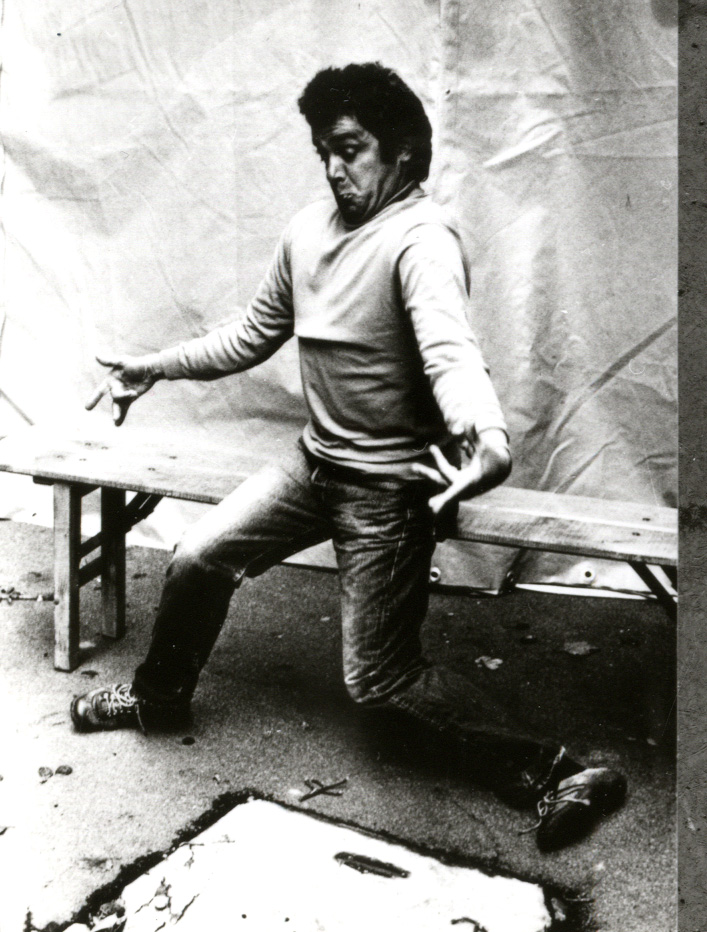
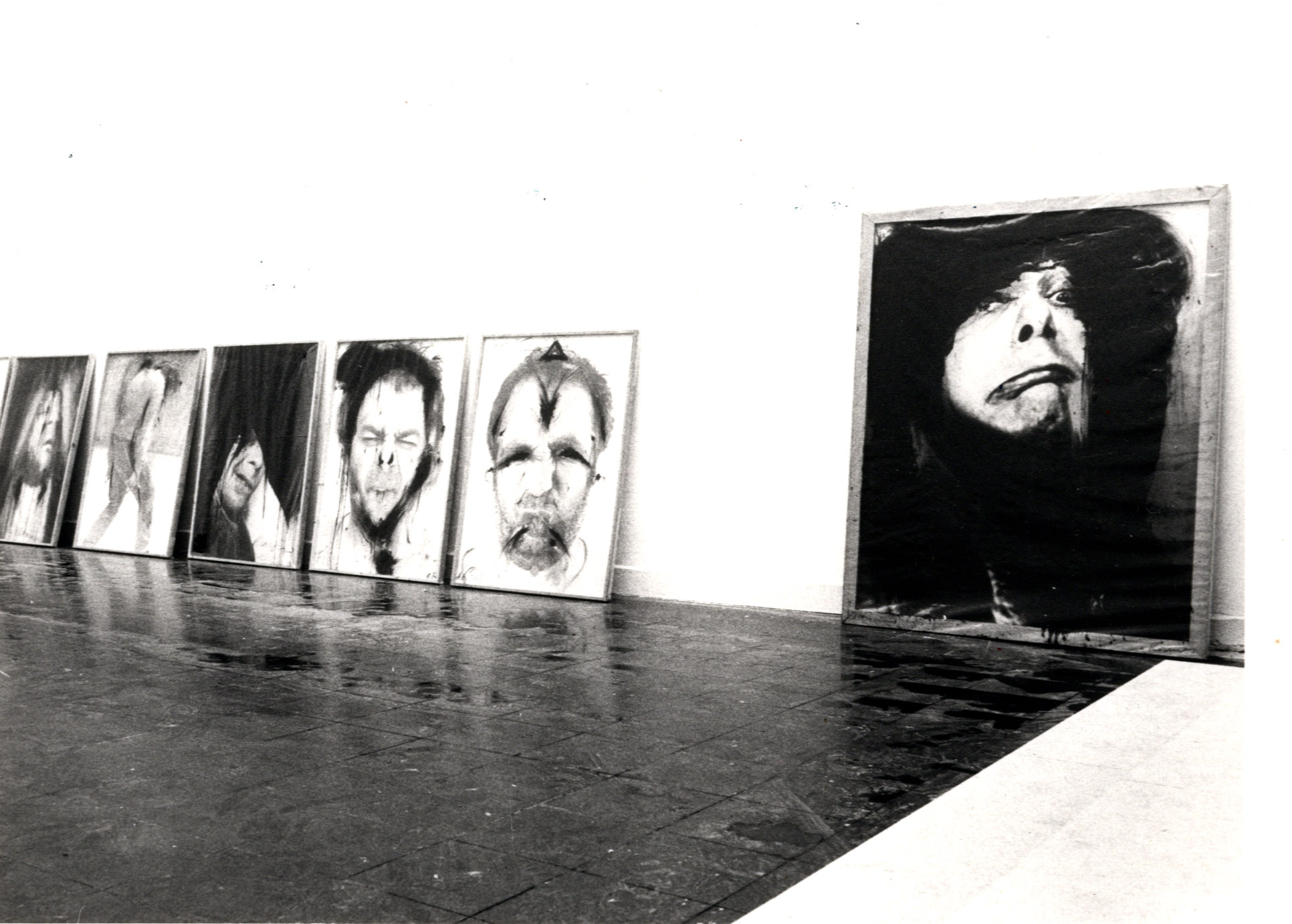
Photos are created of expressive postures such as hand and arm gestures, posing on one’s knees, lying down and sitting, Face Farces and Body Language series. He ties up his head and body with rubber bands (Gummibandserien) and wears stocking masks (Strumpfmaskenserie). Photos are reworked in black and colour.
Exhibition Face Farces 1965–1969 at Galerie van de Loo in Munich.
1971
First retrospective exhibition in Germany at the Kunstverein in Hamburg. Rainer represents Austria at the 11th Biennale of São Paolo with photo booth pictures and drawings on ultraphan, including Face Coloration, Face Correction, Face in Face and Doppelgesicht (Double Face).
1972
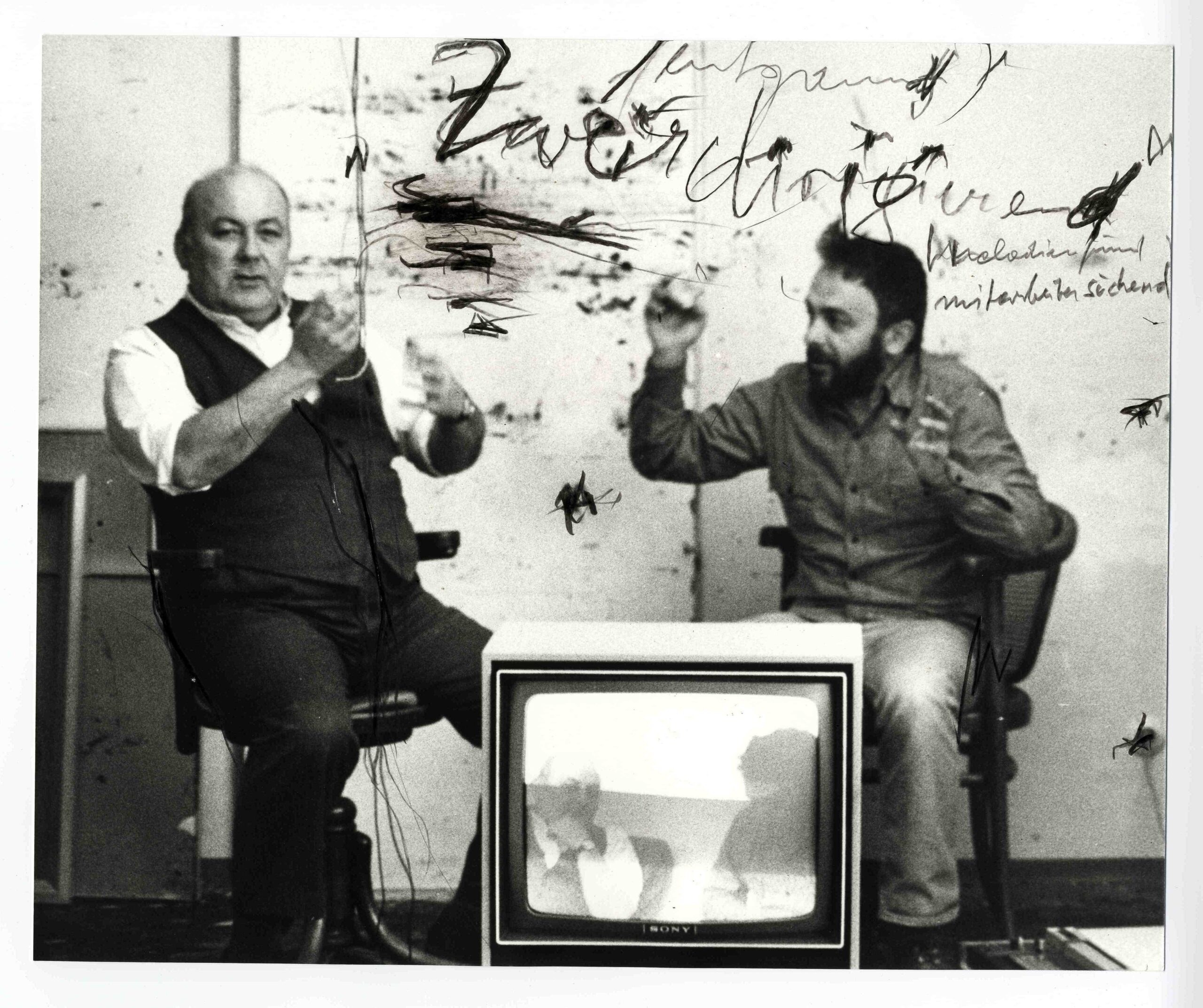
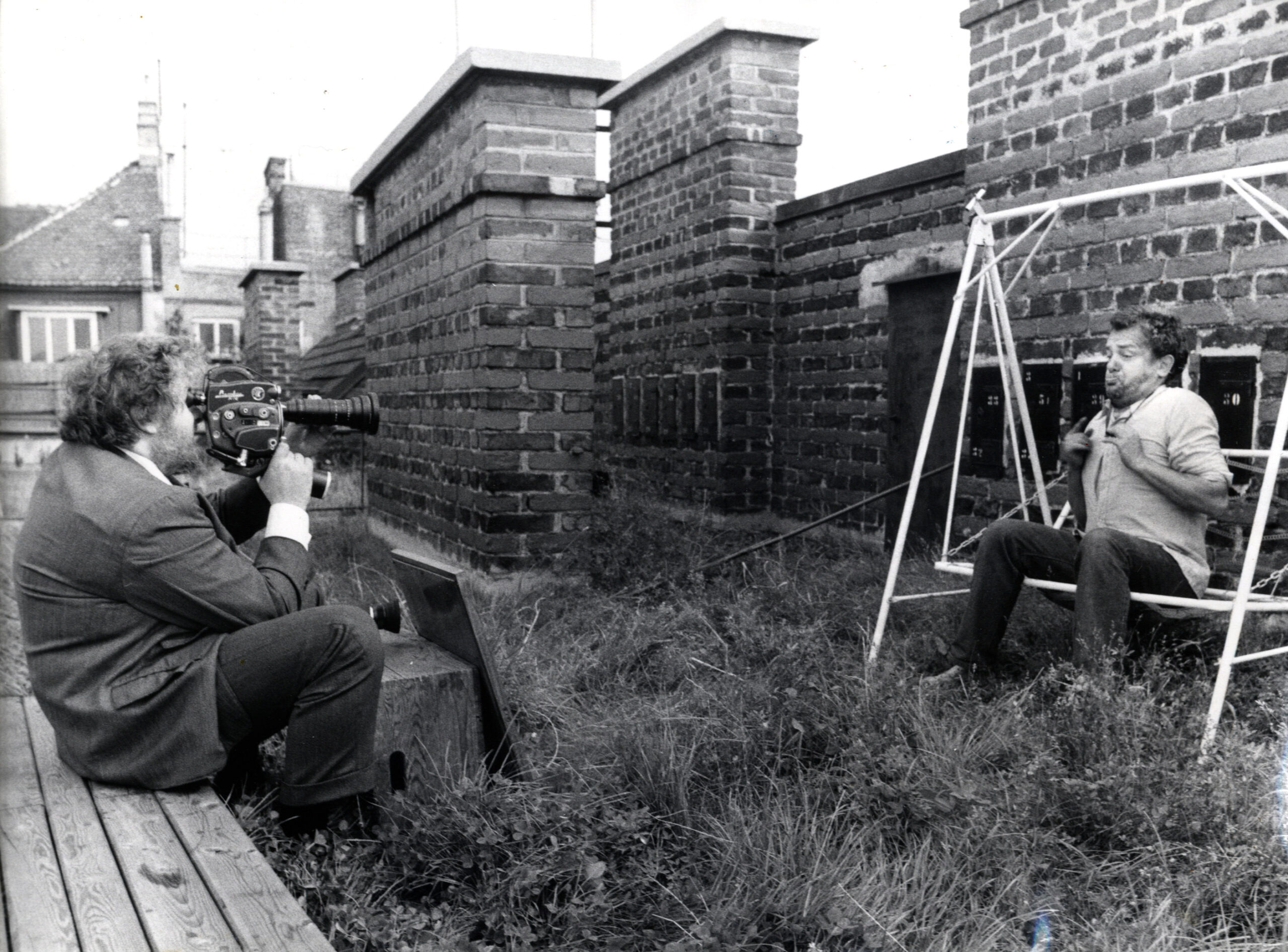
Rainer starts using new media. His self-presentations are recorded on video and film at the artist’s studio.
Exhibition at the Busch-Reisinger Museum of Harvard University in Cambridge, Massachusetts.
Kreuzübermalungen (Cross Overpaintings) and Face Farces are shown at documenta 5.
1973
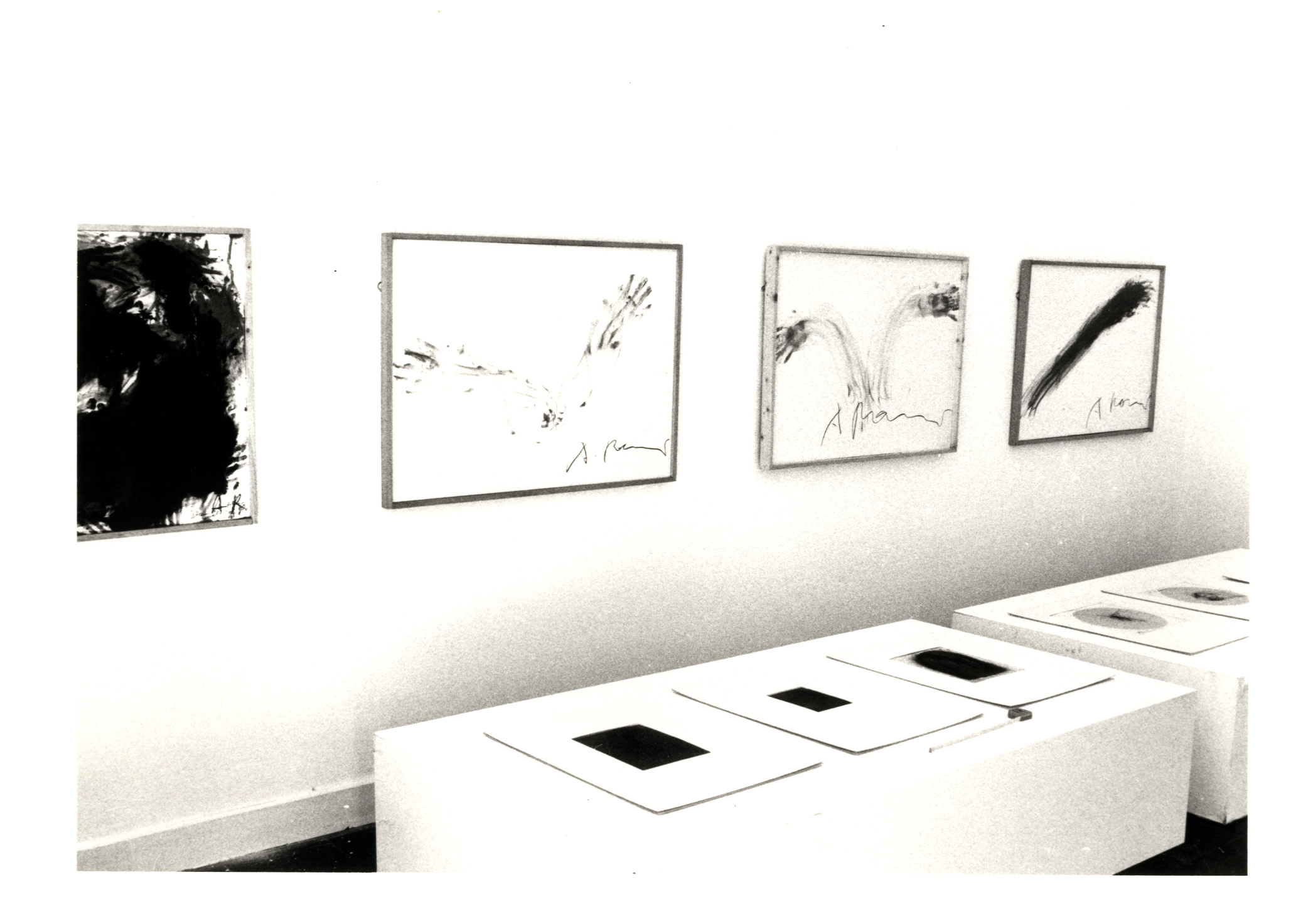
Beginnings of Gestische Handmalerei (Gestural Hand Painting): ‘Once, while overpainting cheeks in a blown-up photograph, in my enthusiasm I broke a brush. In haste, I used my hands instead, banging and thrashing on the cheeks, and was fascinated by the process, by the traces left by my hands. I decided to develop this independently.’ (A.R. 1974) Followed by experiments in painting with his feet.
Misch- und Trennkunst (Mixed and Separated Art) in collaboration with Dieter Roth.
Peter Kubelka starts work on the film Körpersprache – Arnulf Rainer (until 1975).
The Graphische Sammlung Albertina in Vienna shows etchings in a solo exhibition. Galleria LP220 in Turin exhibits Poses.
1974
Rainer receives the Art Prize of the City of Vienna, which was then revoked on account of his refusal to take part in the award ceremony.
Creation of the films Mouthpiece, Verlegenes und Vergebliches, Confrontation with my Videoimage; collaborates with Dieter Roth and others in Verlegenes und Vergebliches.
First exhibition of Gestische Handmalerei (Gestural Hand Painting) at the Kunstraum in Munich.
1975
The Ariadne Gallery in New York shows Superpaintings (Übermalungen) 1954–1964; Galerie Grünangergasse in Vienna shows Very Large Pictures; the Museum of Contemporary Art in Chicago shows Bodywork; Galerie Stadler in Paris exhibits Body Poses & Face Farces; the Ruth S. Schaffner Gallery in Los Angeles shows Face Farces and Studio Santandrea in Milan holds an exhibition of Autorappresentazioni.
Misch- und Trennkunst (Mixed and Separated Art) with Dieter Roth is first shown at Galerie Grünangergasse and afterwards at the Kulturhaus in Graz.
1976
Rainer rents a studio in an old monastery near Passau in Bavaria.
Rainer writes the essay Kleinzeug for the publication Tägliches Kleinzeug: ‘Daily and nightly small stuff created for myself and for others who are fed up with big things. I create my large work as a means to get to the small, because I feel an increasing fear and therefore avoid what one would call gallery showpieces, striking paintings and grand square sculptures.’
Solo exhibitions in Cologne, Mannheim, Linz, Munich, Frankfurt, Paris, Vienna, Innsbruck, Düsseldorf and other cities.
1977
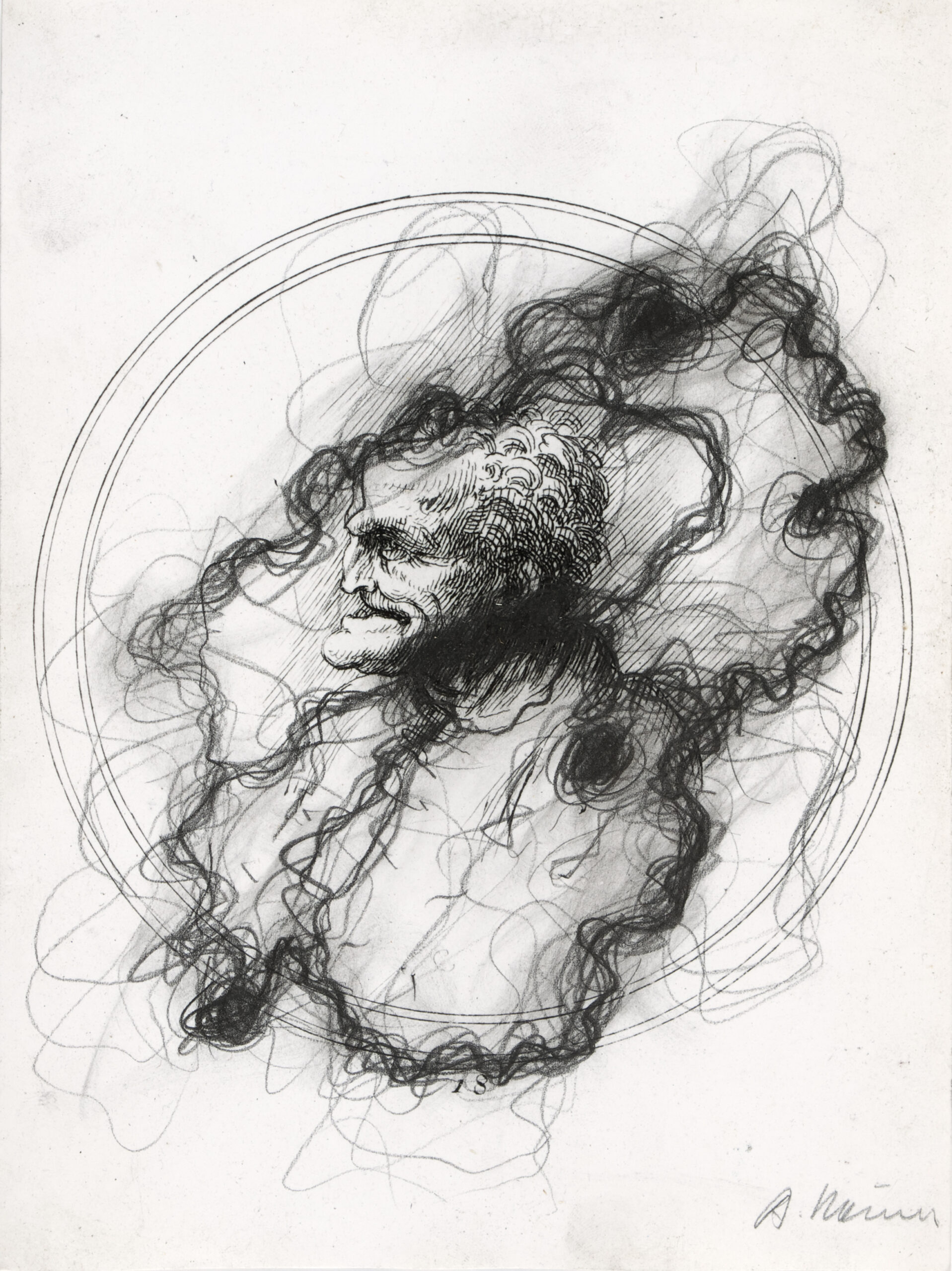
Rainer ‘is fed up with drawing on himself only.’ He starts looking for great mimes and meets Franz Xaver Messerschmidt and ‘the comic faces of this baroque Austrian’ and reworks the photographs he makes. Exhibition at the Kunstraum in Munich. He overdraws a book with etchings after drawings of characterful heads by Leonardo da Vinci. A facsimile edition is published by Löcker & Wögenstein in Vienna.
Start of work on Totenmasken (Death Masks). ‘A death mask is a cast of a self-presentation at the moment of entry into immediate facelessness.’ (A.R. 1978) Starts work on the major cycles Schlangenfrauen, Frauensprache and Frauenrausch (Snake Women, Women’s Language and Women’s Rapture).
Retrospective exhibition 1950-1976 Der große Bogen, first at the Kunsthalle in Bern and subsequently at the Lenbachhaus, the municipal gallery in Munich. Stichting de Appel in Amsterdam shows videotapes and photographs. Takes part in documenta 6 in Kassel.
1978
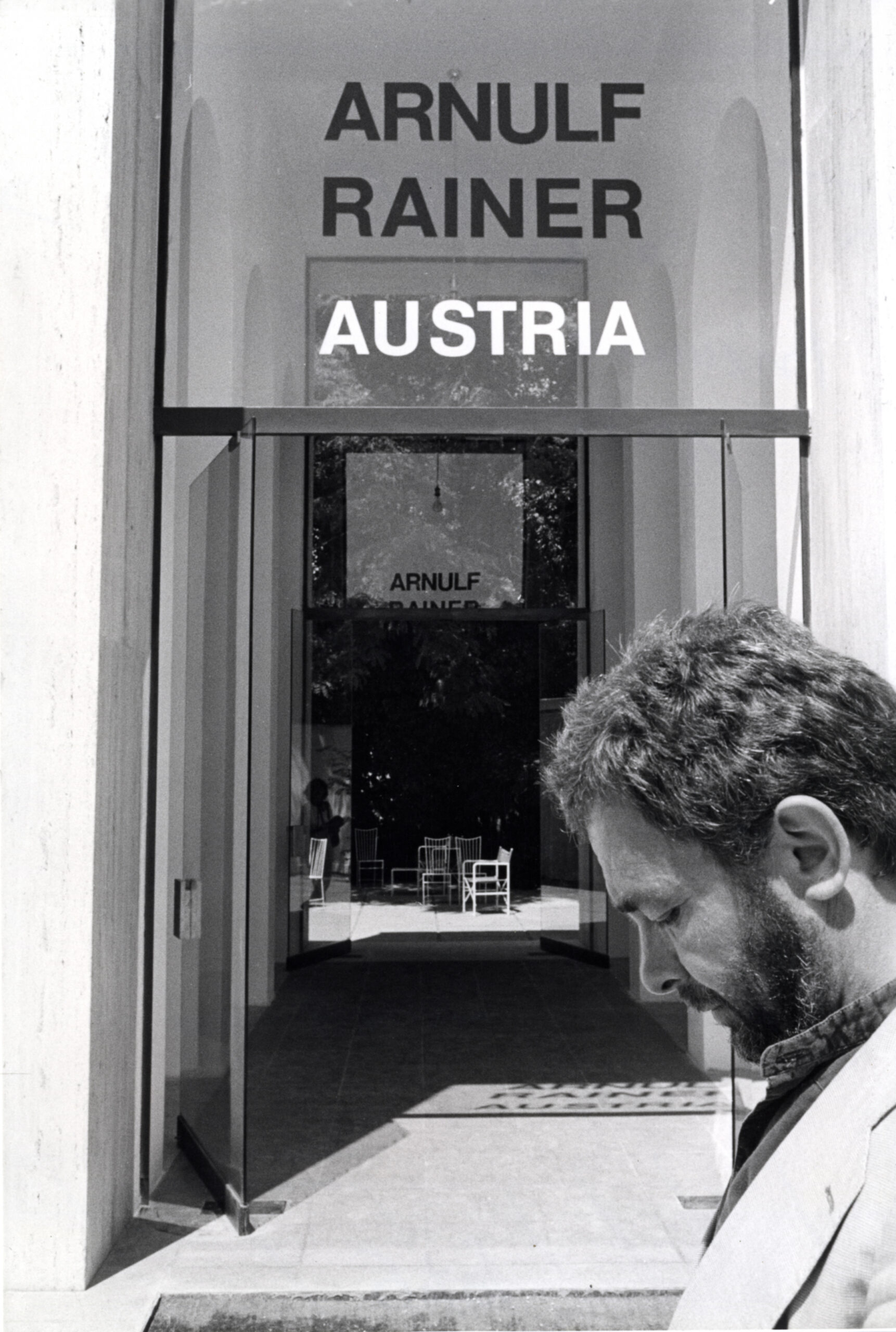
Rainer represents Austria at the Biennale in Venice. The exhibition Linguaggio del corpo includes Selbstdarstellungen, Gestische Hand- und Fußmalerei, Selbstverwandlungen, Ekstasen (Frauensprache), Yogahaltungen, Verschlingungen, Sterbegesichter and Totenmasken.
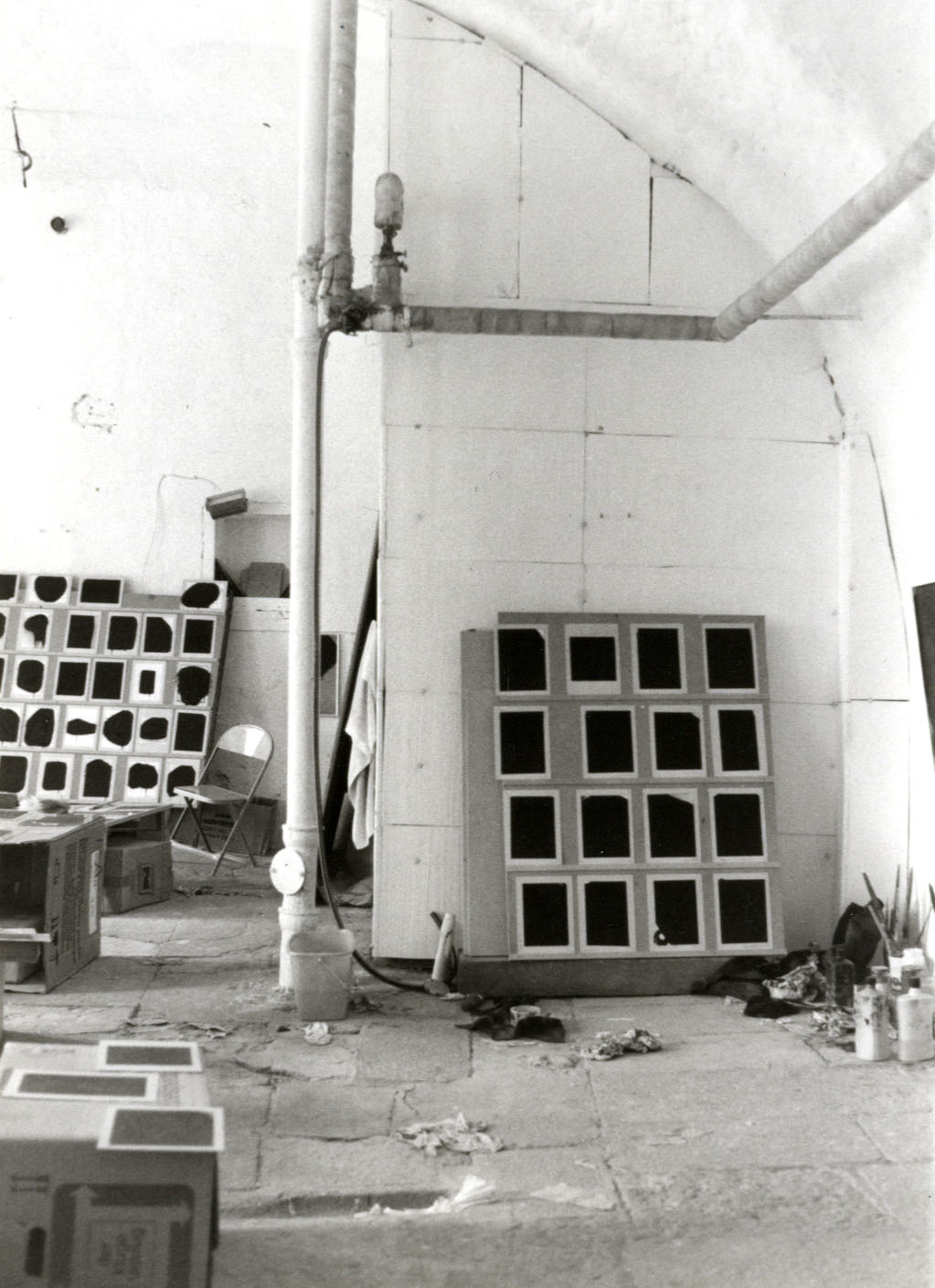
He receives the Great Austrian State Prize. With the prize money, Rainer acquires a collection of original death masks, which he overpaints repeatedly over a period of years. Over the years many photographs of his work were taken for the Rainer archive. These are in black and white and therefore no longer up-to-date for use in publications. Rainer first glues these pictures onto pieces of cardboard and wood and subsequently on aluminium plates and reworks them with black ink and oil paint. He calls the resulting series Reste (Remains).
1979
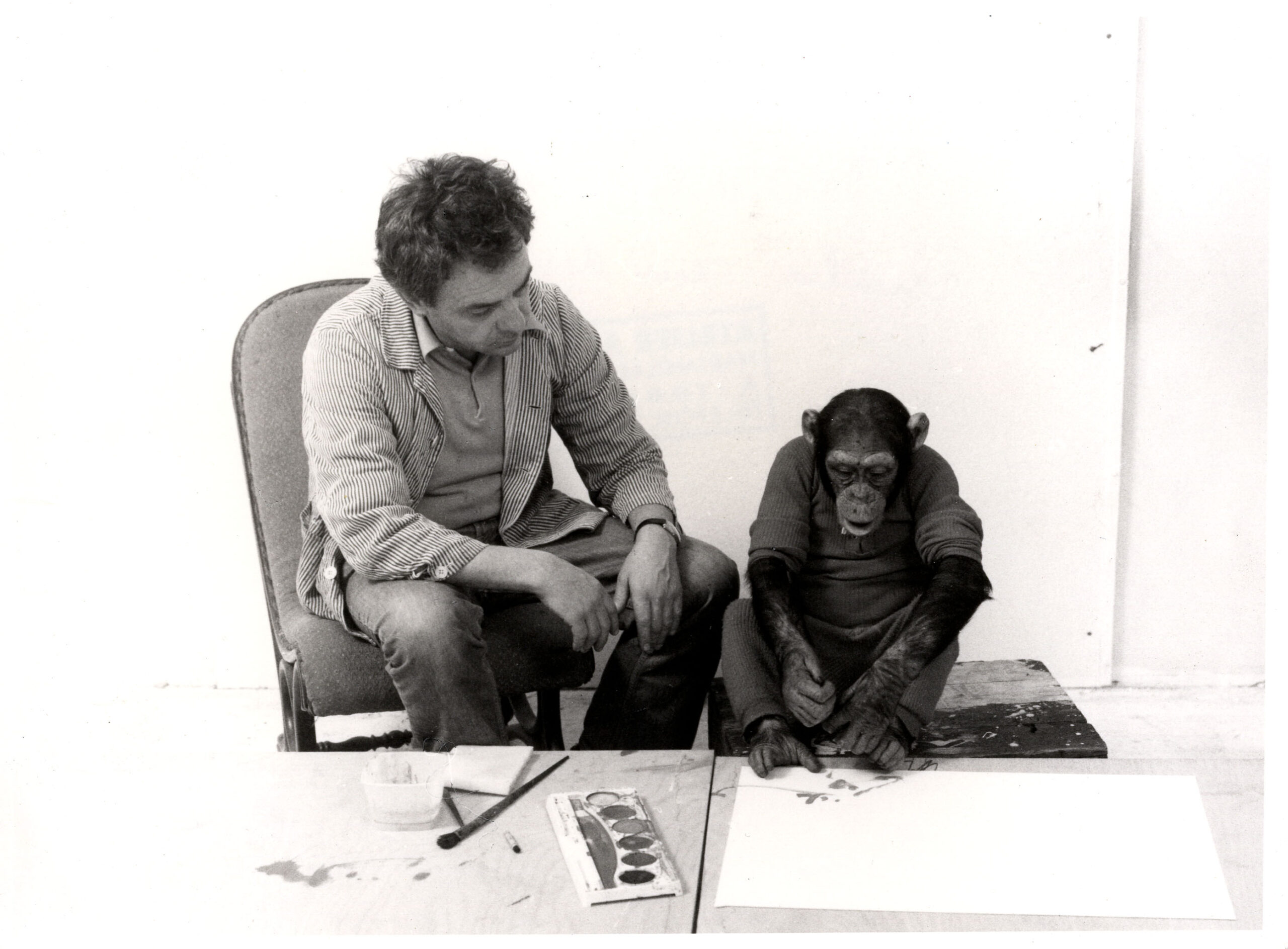
ORF arranges two chimpanzees that will paint together with Rainer for the film Körpersprache – Körperkunst (Body Language – Body Art). This results in the series Nachmalungen in which Rainer attempts to copy and ‘outdo’ the drawings and paintings made by the chimpanzees.
At the Expansion: Internationale Biennale für Graphik und visuelle Kunst in der Wiener Secession Rainer repeats this experiment with Dieter Roth. A film is made on the subject. Rents another studio in an old granary near Passau in Bavaria.
The Frankfurter Kunstverein takes over the exhibition Totenmasken from the Österreichische Galerie im Belvedere in Vienna. The municipal gallery Lenbachhaus in Munich shows Performances 79. Körpersprache. Tanz-Musik. Video-Film. Theater.
Exhibition Körpersprache held at the Galerie van de Loo in Munich and Galerie ak in Frankfurt. Rote Übermalungen 1956–1979 and the cycle Reste at Galerie m in Bochum.
Exhibition Photographie als Kunst 1879–1979. Kunst als Photographie 1949–1979 at the Tiroler Landesmuseum Ferdinandeum in Innsbruck.
1980 – 1989
1980
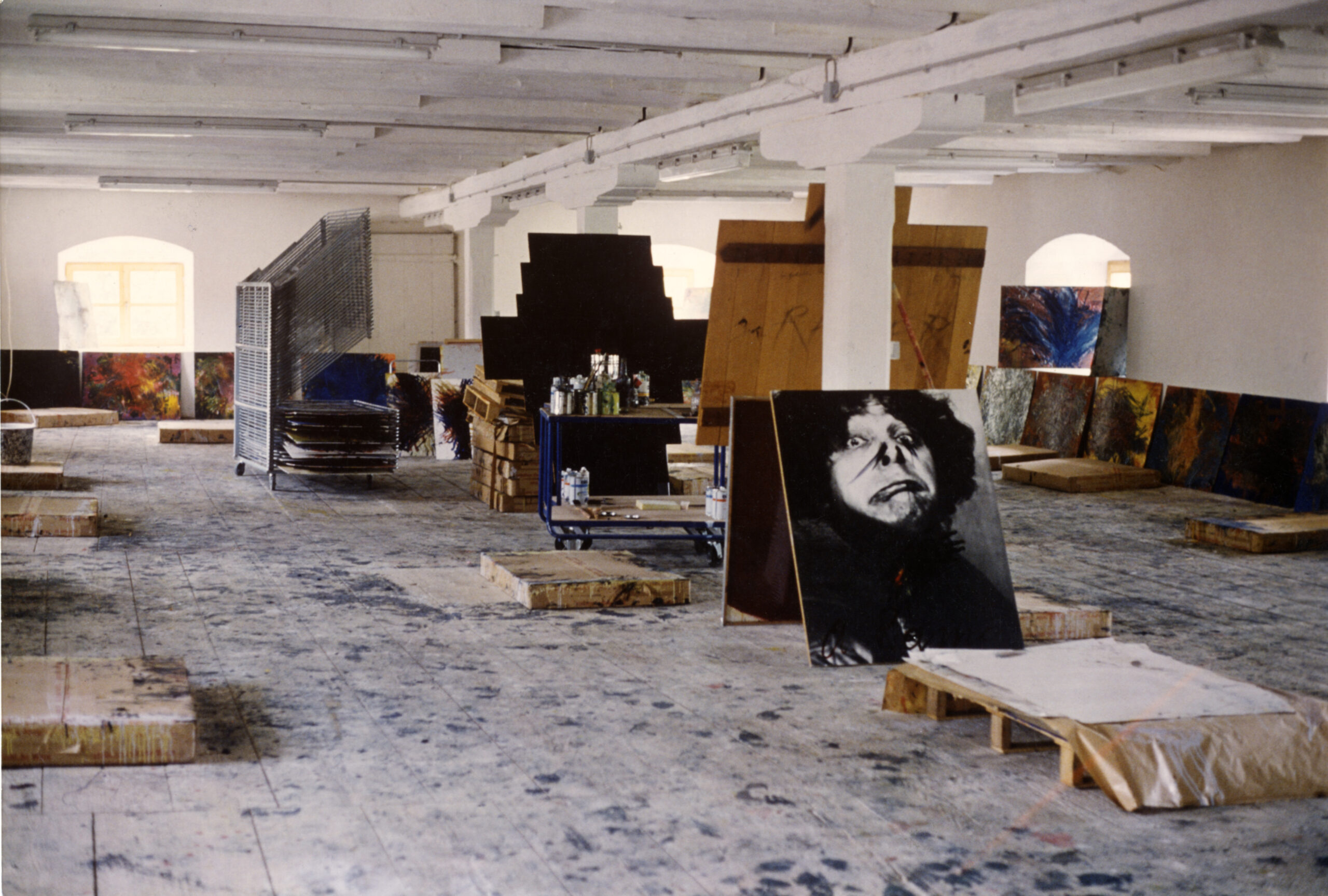
Rainer acquires a farm in Upper Austria which will be converted into a studio a few years later.
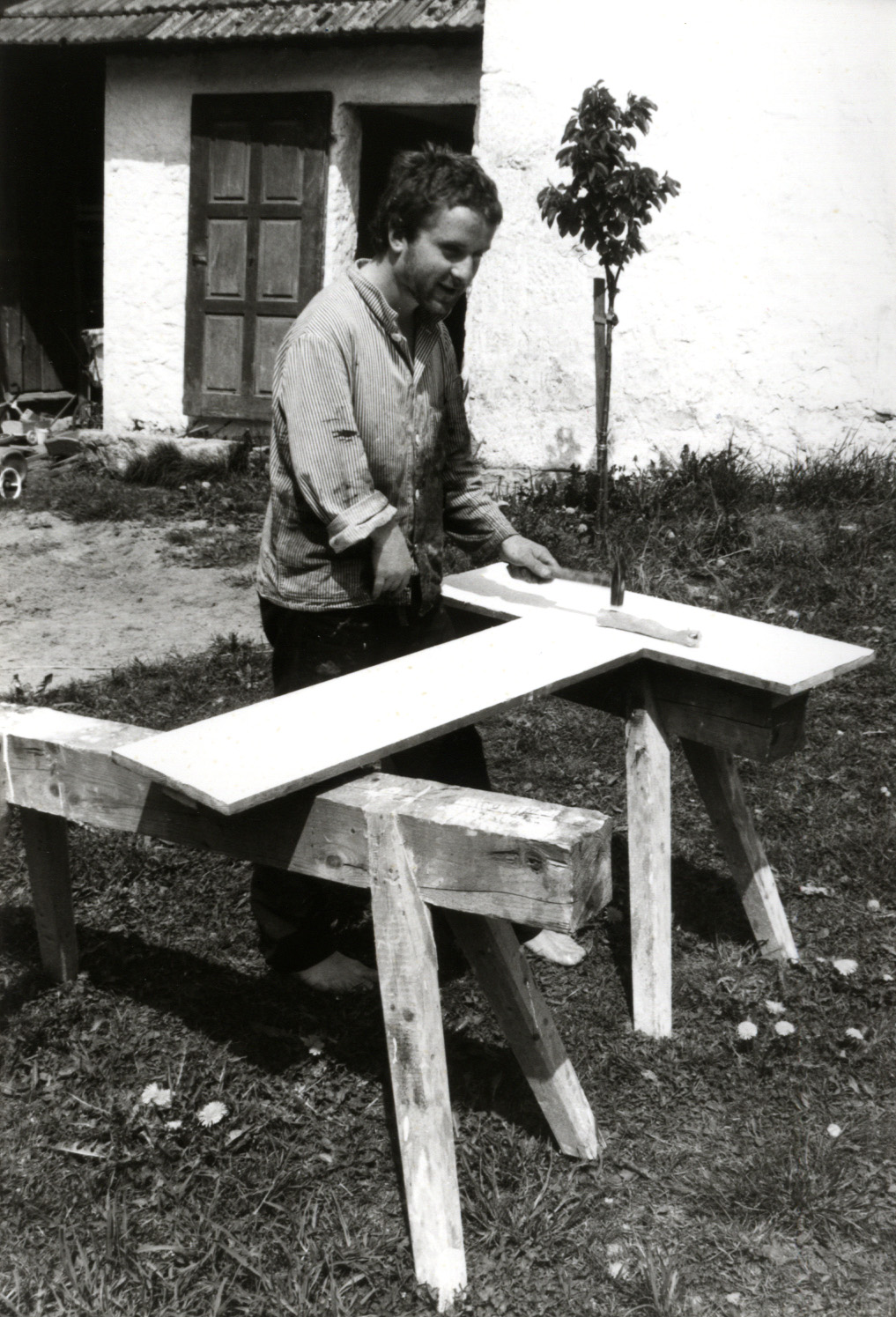
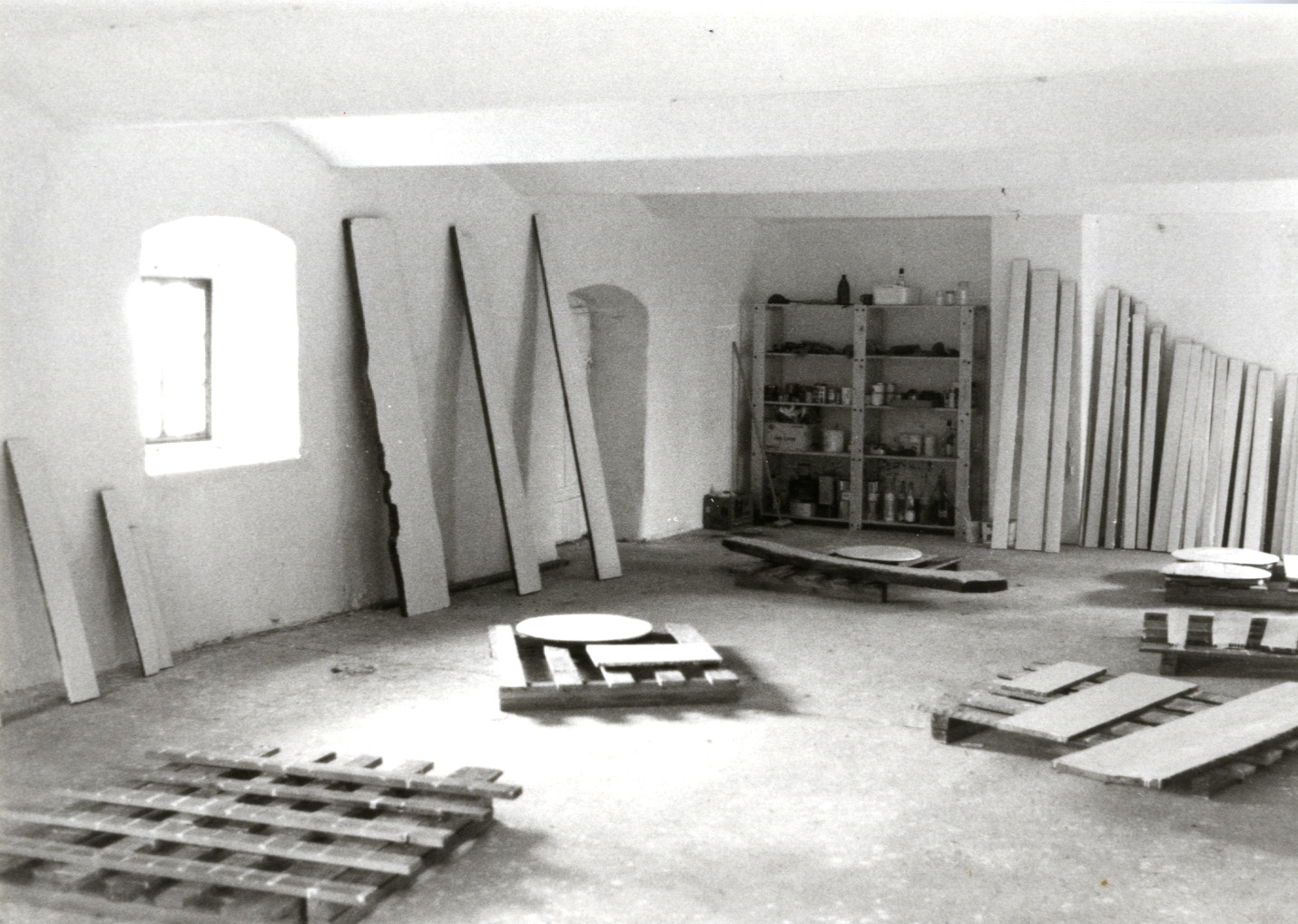
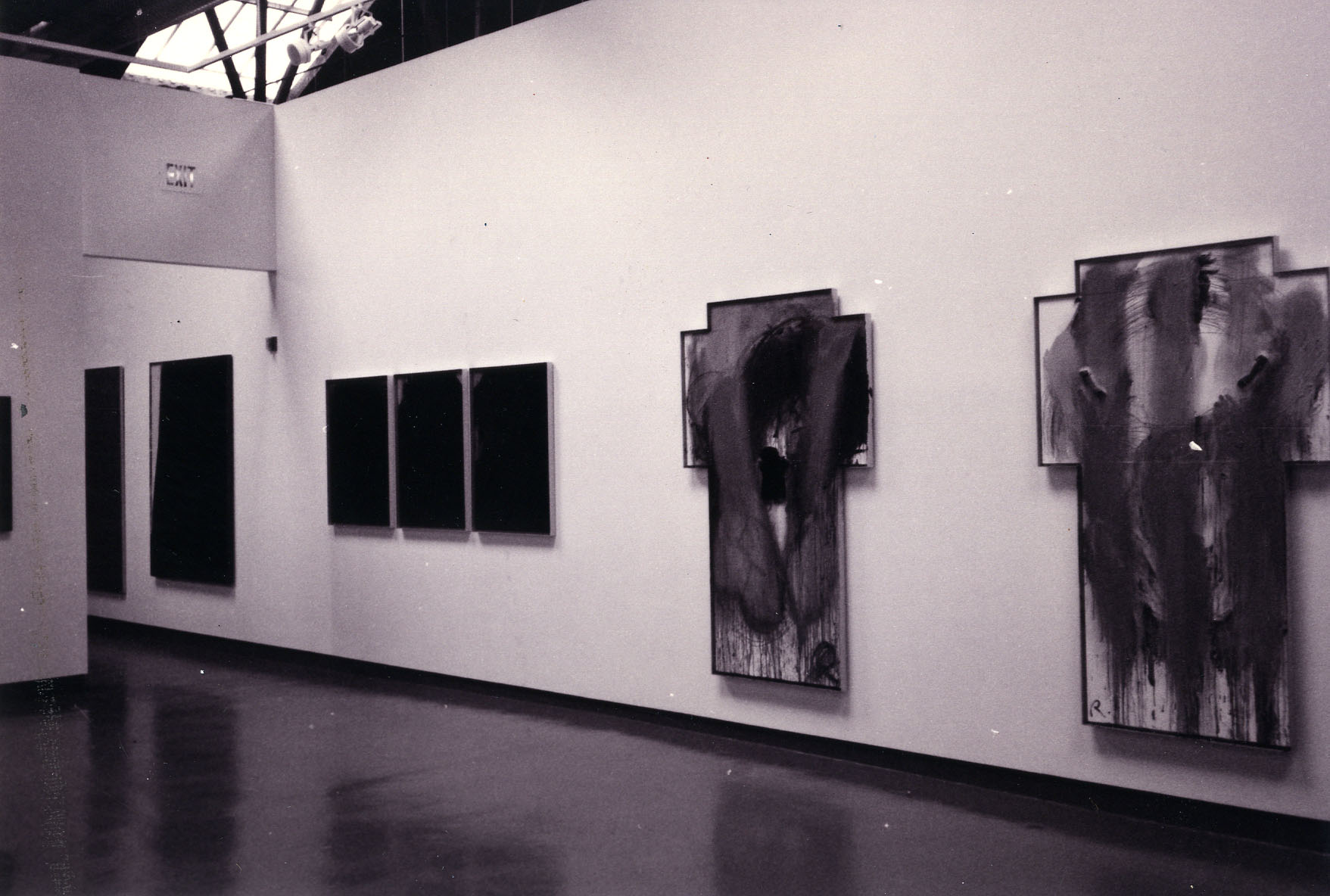
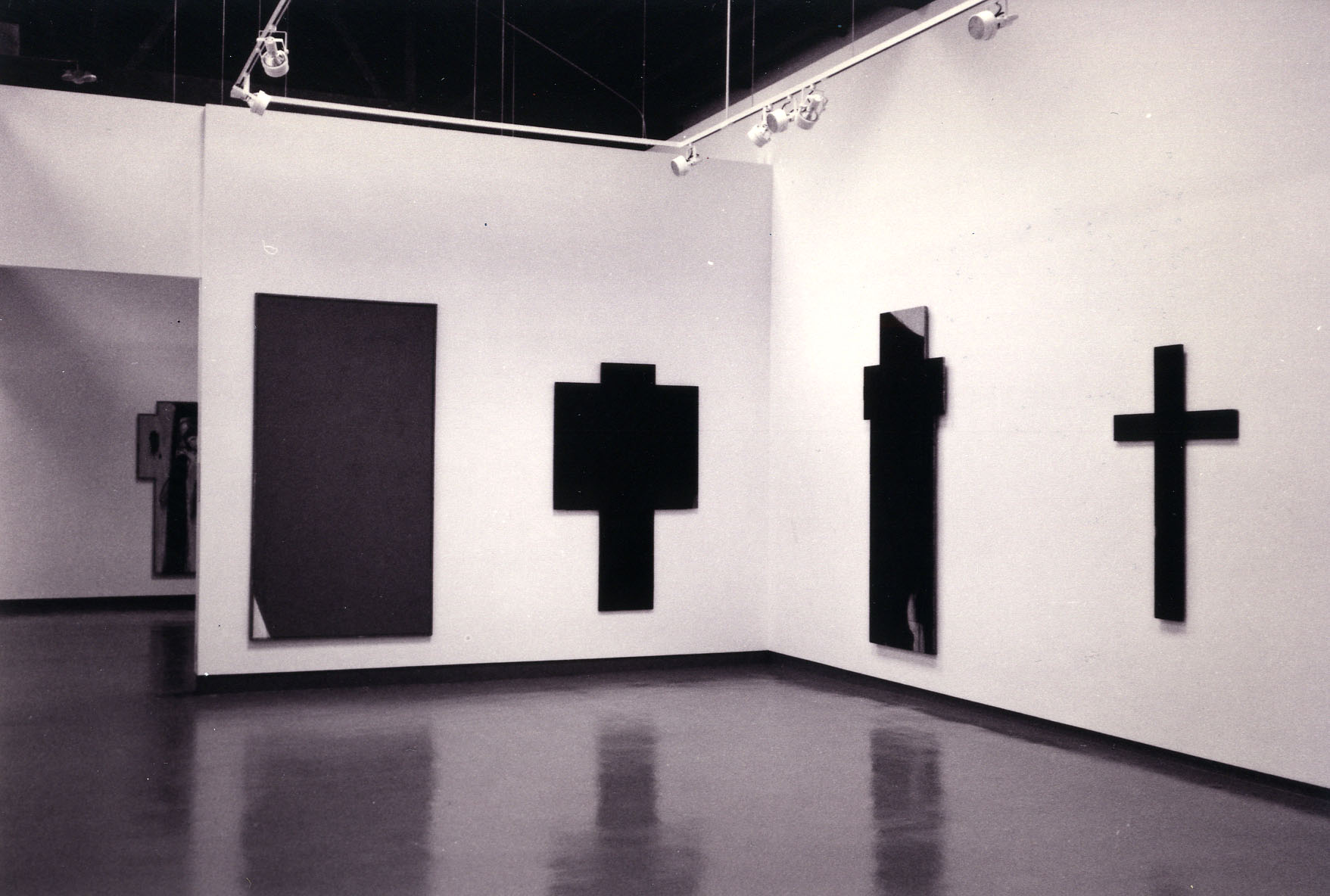
He resumes working with cross shapes. Several large crosses made of wooden planks are created, some with applications of small, often damaged figures of Christ.
Other wooden planks are used for the series Schwarzen Mumien (Black Mummies).
Some of the overpainted death masks are individually stuck in wooden boxes and overpainted. Kistenwalhalla series. Rainer overdraws photos and reproductions of self-portraits by Van Gogh; exhibition …Als van Gogh als… at Galerie Heike Curtze in Düsseldorf.
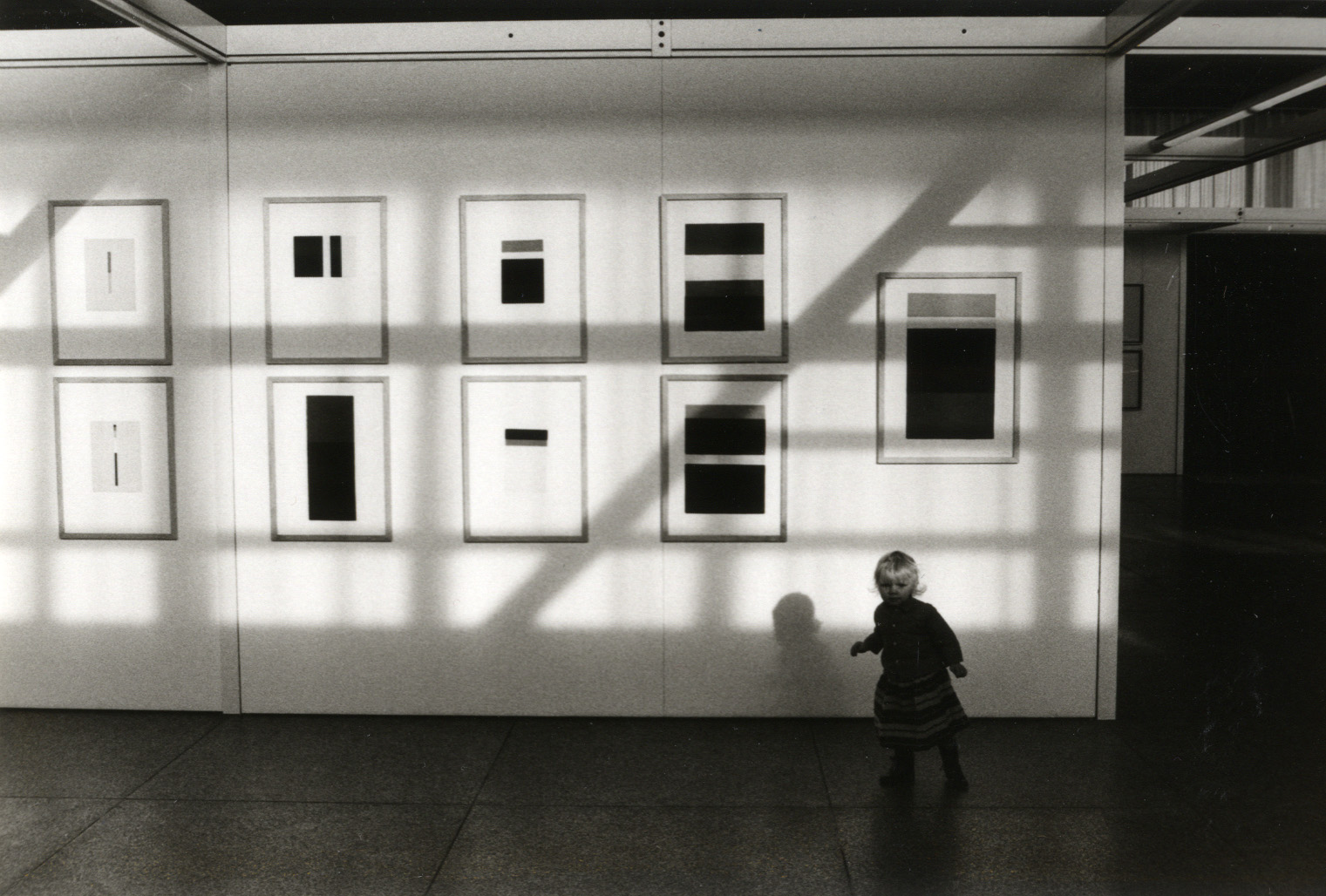
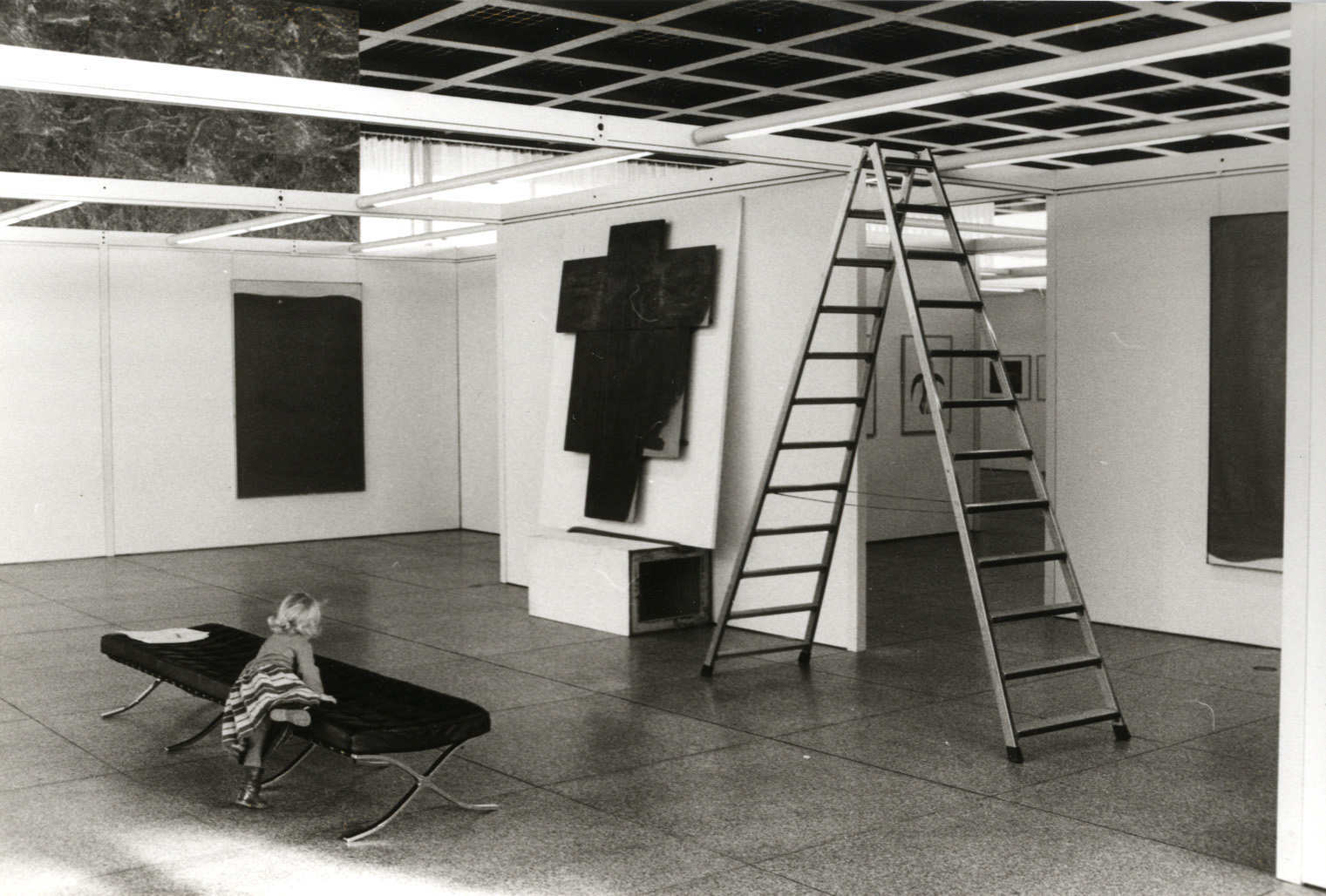
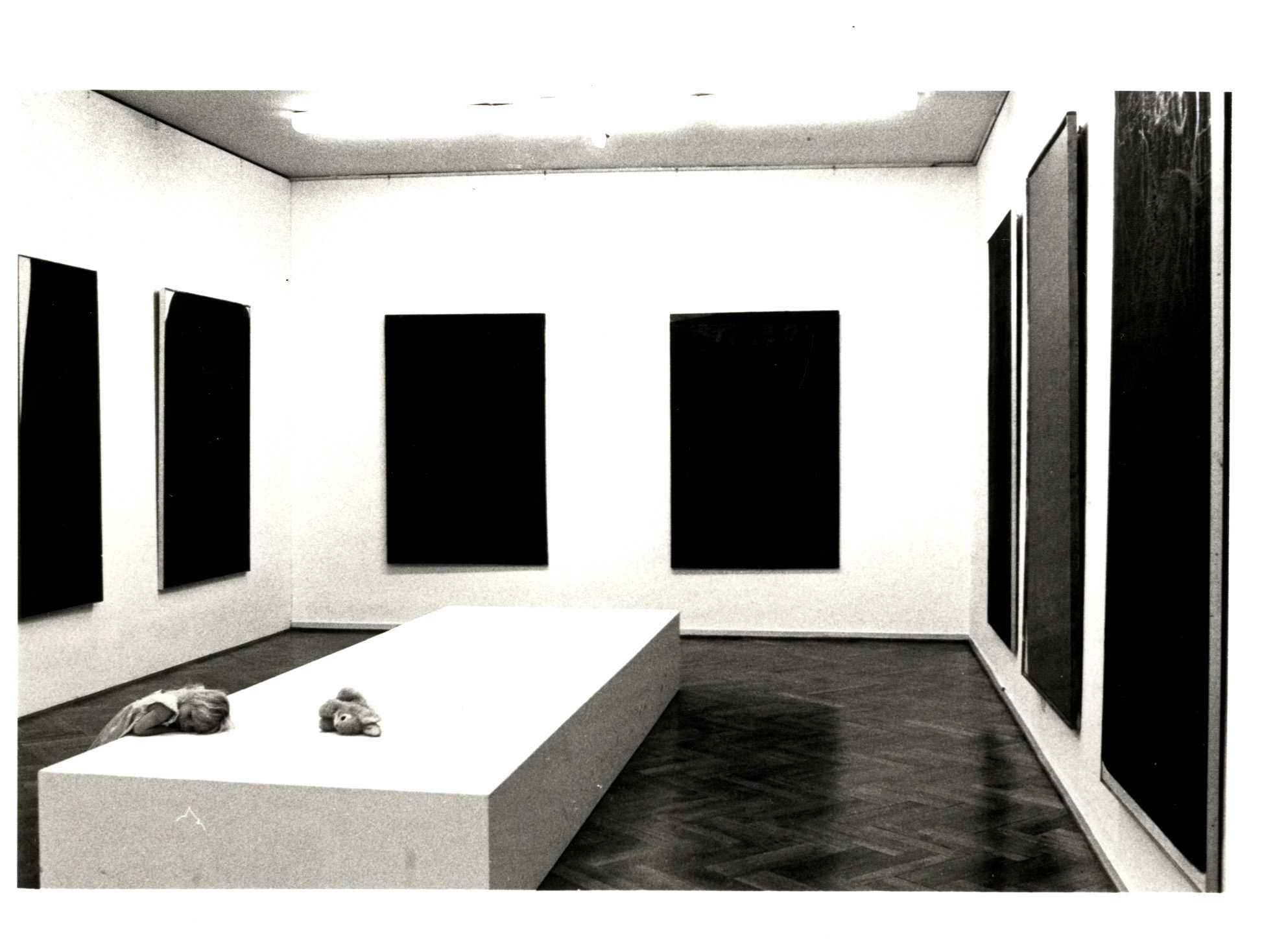
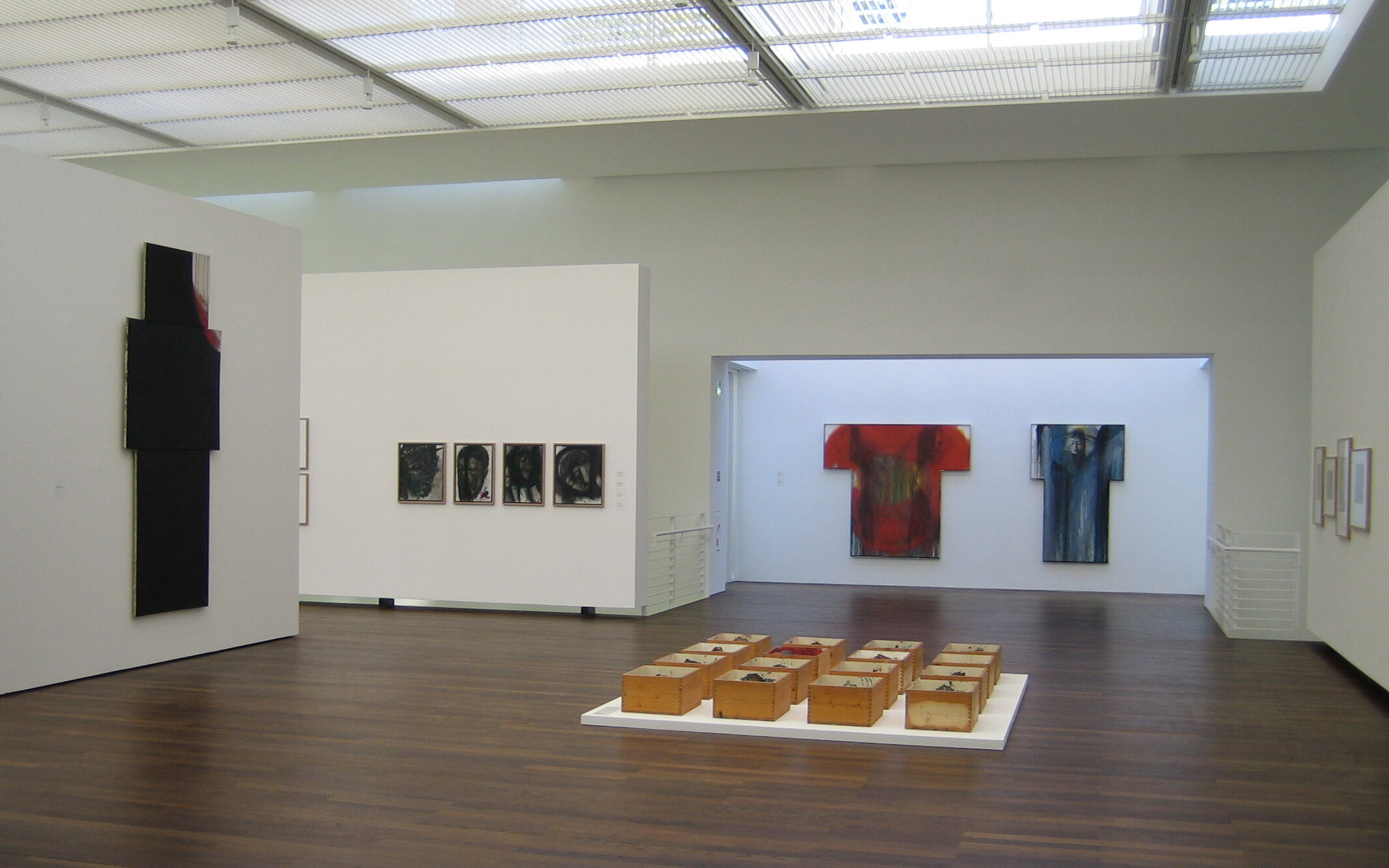
Comprehensive retrospective exhibition at the Nationalgalerie in Berlin and subsequently at the Staatliche Kunsthalle in Baden-Baden, at the Städtische Kunstmuseum in Bonn and at the Museum of the 20th Century in Vienna.
Takes part in the 39th biennale in Venice, showing in the centre pavilion with reworked Totengesichtern (Cadaveri series).
Solo exhibitions at the Van Abbe museum in Eindhoven, the Whitechapel Art Gallery in London and the Walker Art Center in Minneapolis.
1981
Professorship at the Academy of Fine Arts in Vienna; Rainer becomes a member of the Academy of Arts in Berlin. First artist to receive the Max-Beckmann Prize of the City of Frankfurt.
Ends the series Straßenräuber (reworked caricatures of 19th century poets and writers mounted by Rainer on aluminium and wooden boards). These are exhibited at the Hessische Landesmuseum in Darmstadt and at the Museum of Modern Art in Vienna.
Resumes work on hand and finger paintings.
Übermalungen exhibited at the Städtische Galerie im Städelschen Kunstinstitut in Frankfurt.
1982
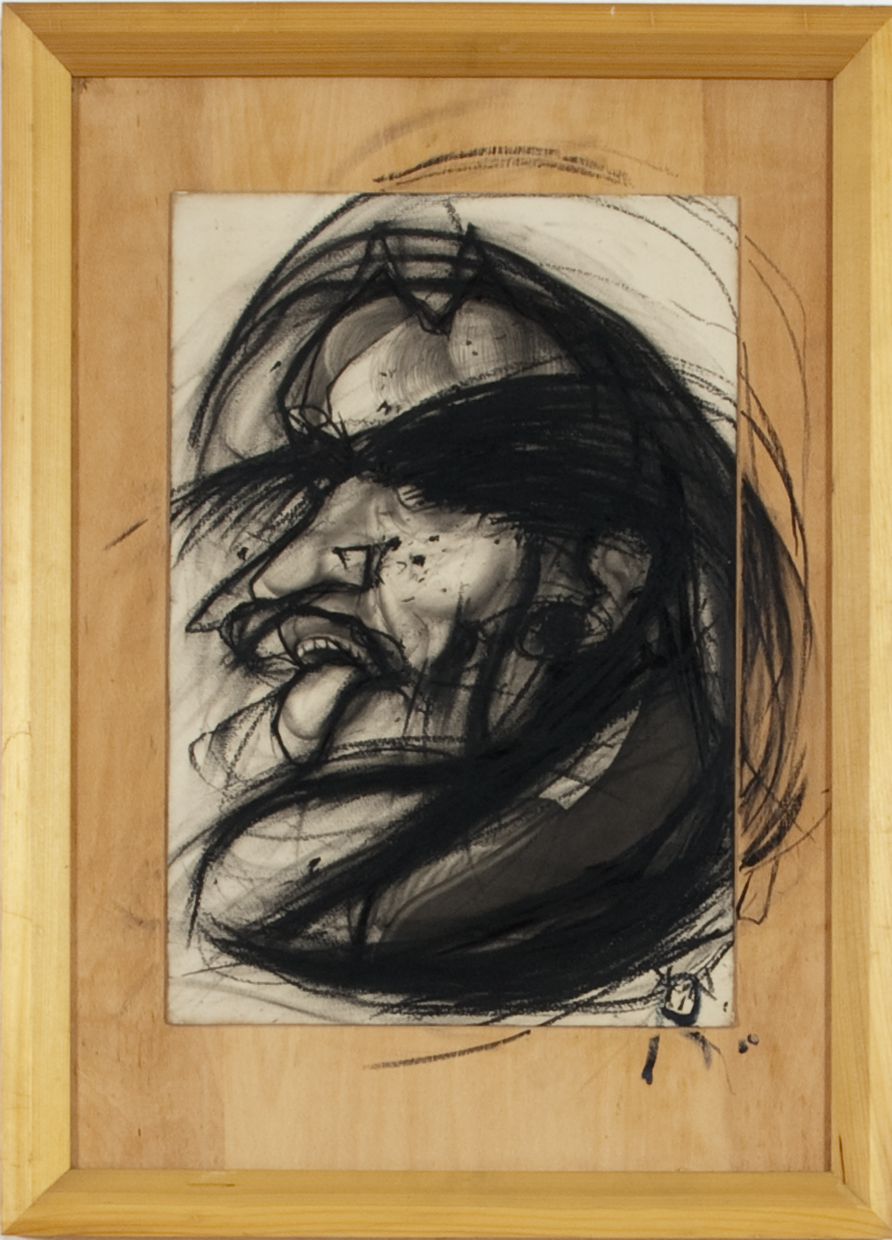
Rainer receives a pile of photos from a gallery owner, which were made in Hiroshima and Nagasaki after the bombs were dropped. The series Hiroshima is created. This cycle is exhibited in more than 17 European locations.
Takes part in documenta 7 with a selection of newly created hand and finger paintings.
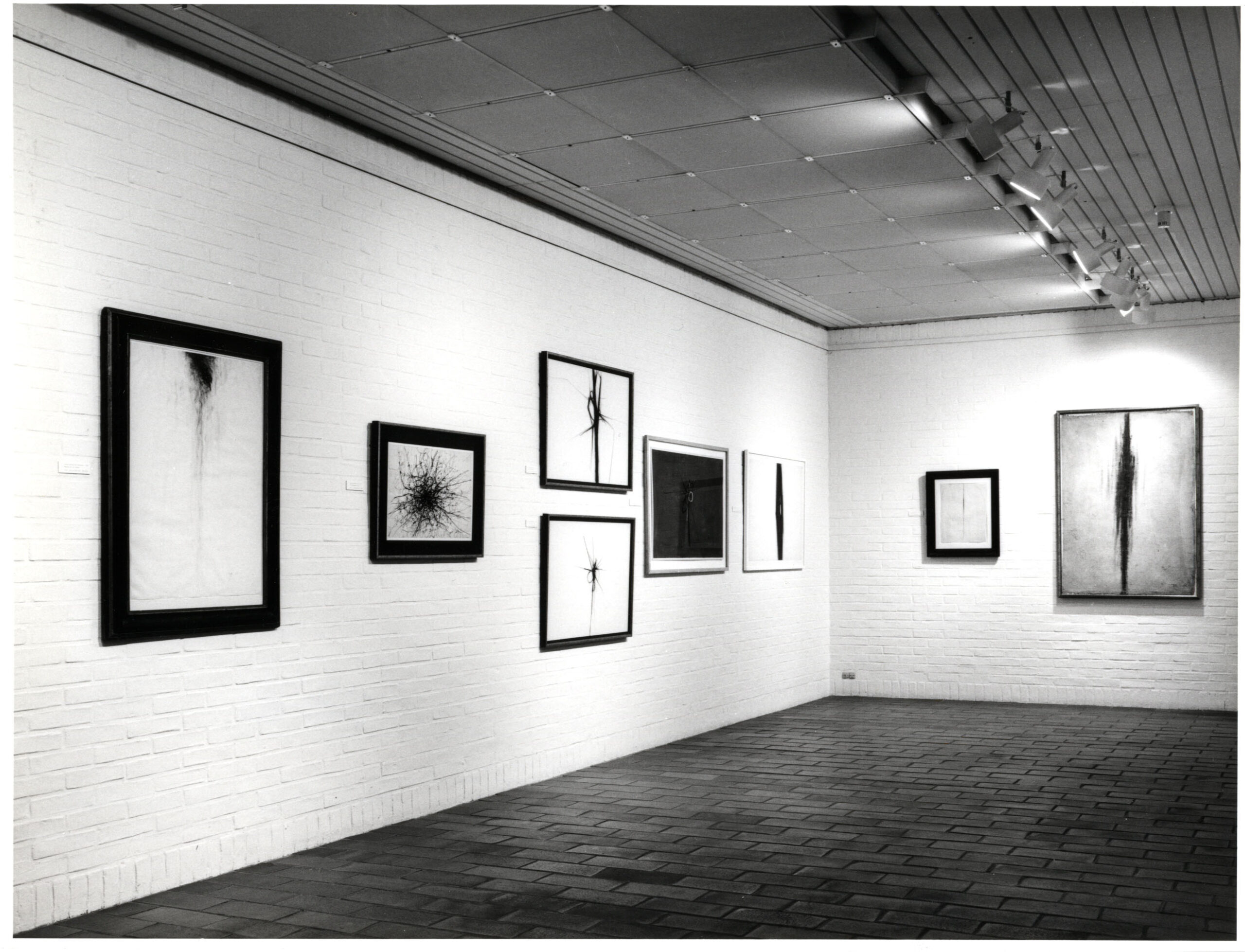
Solo exhibition at the Louisiana Museum of Modern Art in Humlebæk.
1983
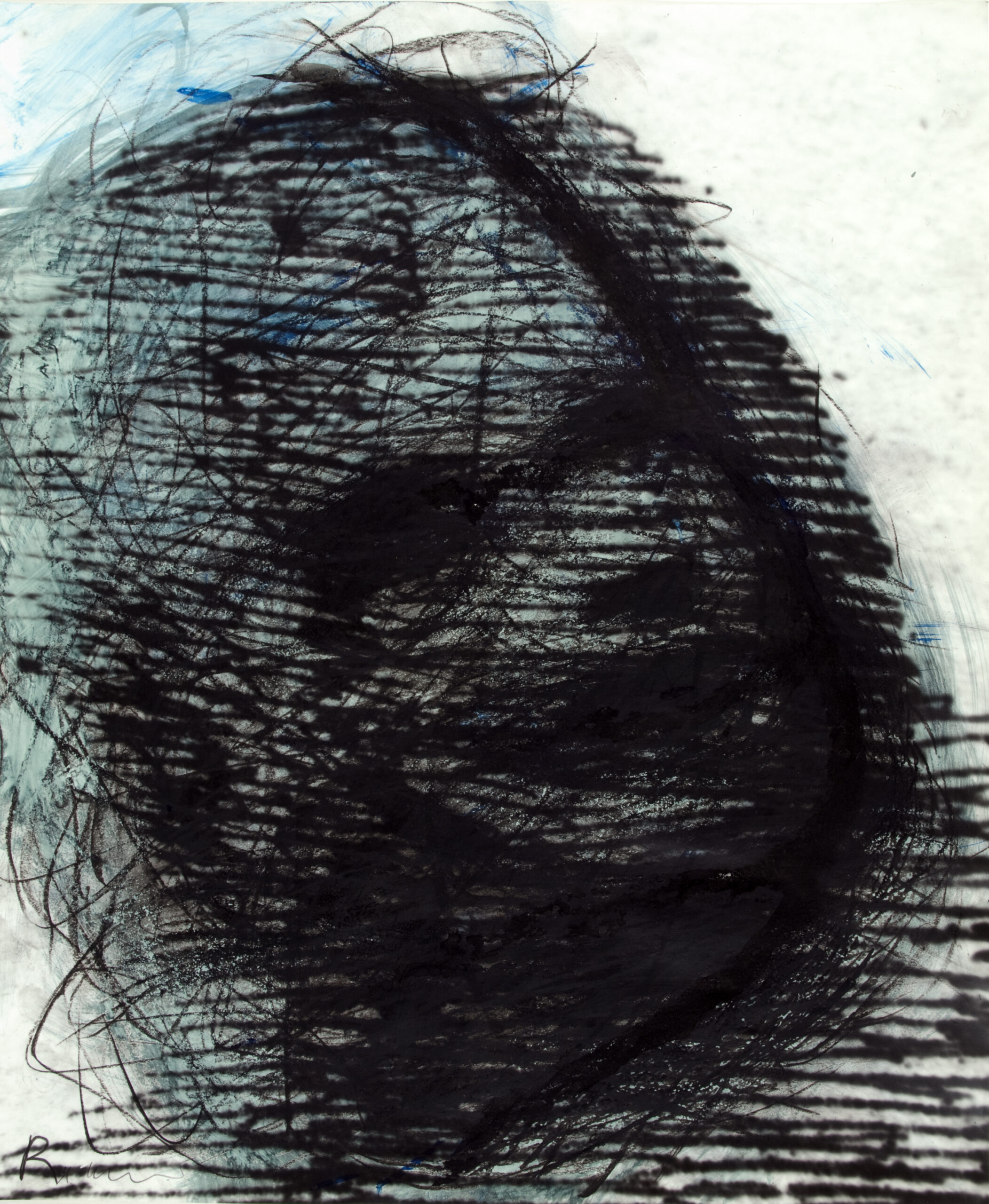
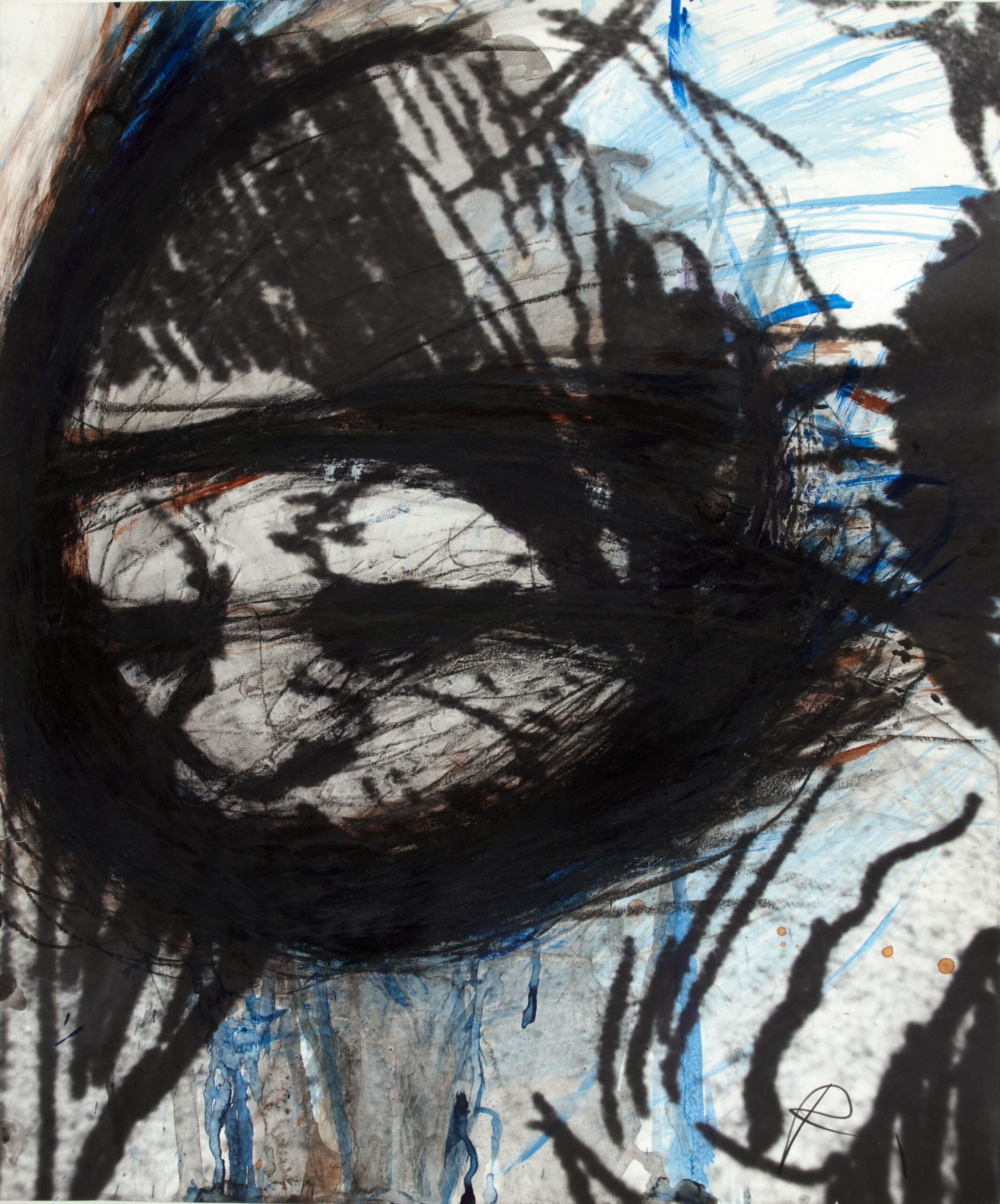
Continues to work on large wooden crosses and death mask pictures. Rainer intensifies work on heads of Christ which he commenced in 1980 (reworked photos of the stages of the cross). At the same time he creates the series of Goya overpaintings.
1984
The municipal museum Abteiberg in Mönchengladbach presents Gesichter mit Goya (Faces with Goya).
Exhibition Mort et sacrifice of the Musée National d’Art Moderne at the Centre Georges Pompidou in Paris.
Takes part in the exhibition Portraits of Artists at the San Francisco Museum of Modern Art and in the opening exhibition of the Castello di Rivoli in Turin.
Exhibition Finger and Hand Painting 1981–1983 is held at the Van Abbe museum in Eindhoven.
1985
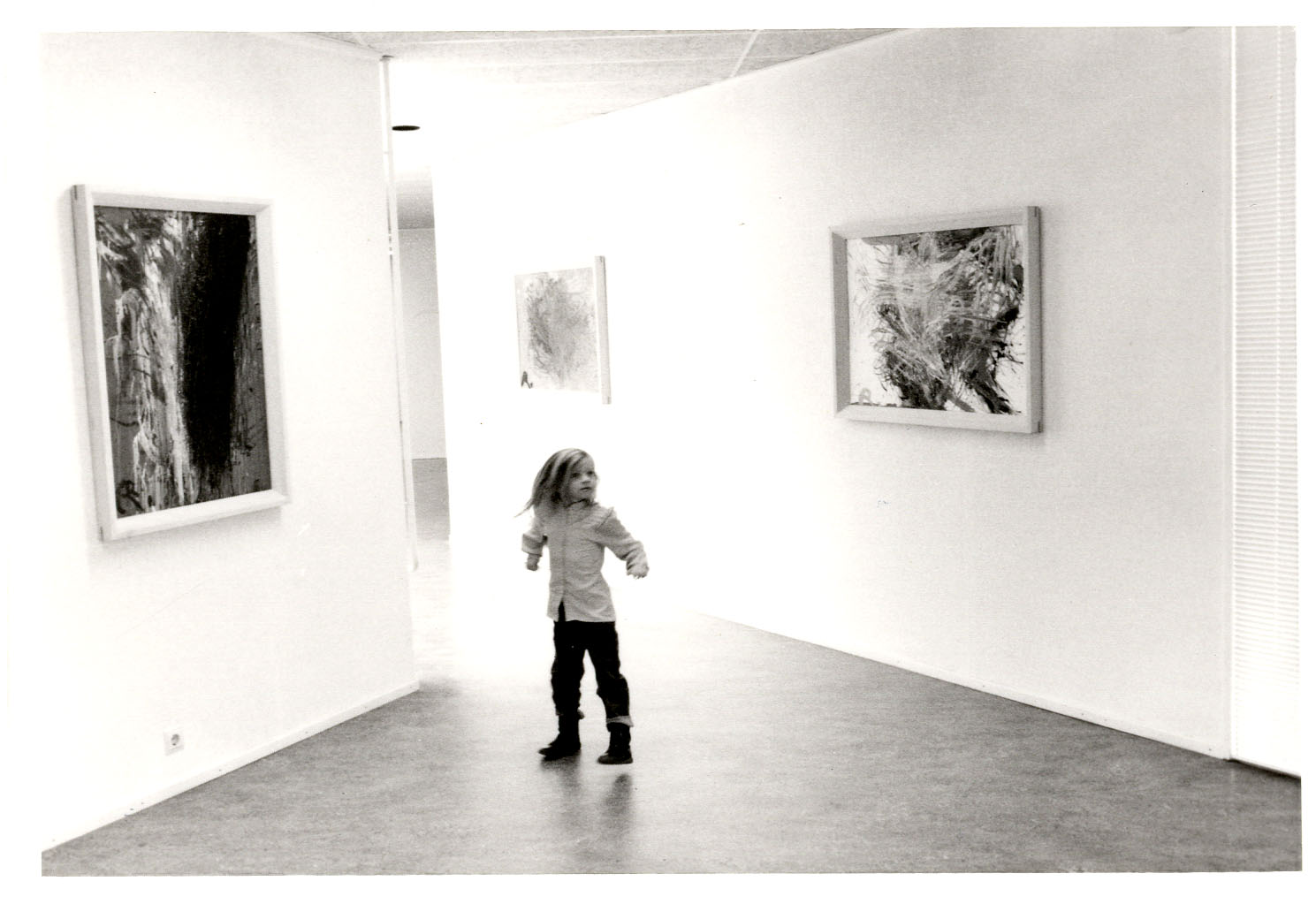
Rainer uses the illustrations in books from the 18th and 19th century that he has been collecting for many years for the series Animalia and Botanika. The scientific illustrations are reproduced on photo linen and are mounted on wooden boards before being reworked. Thus, the series like Aus der Schlangengrube (From the Pit of Snakes) and Orchideen (Orchid Ideas) are created.
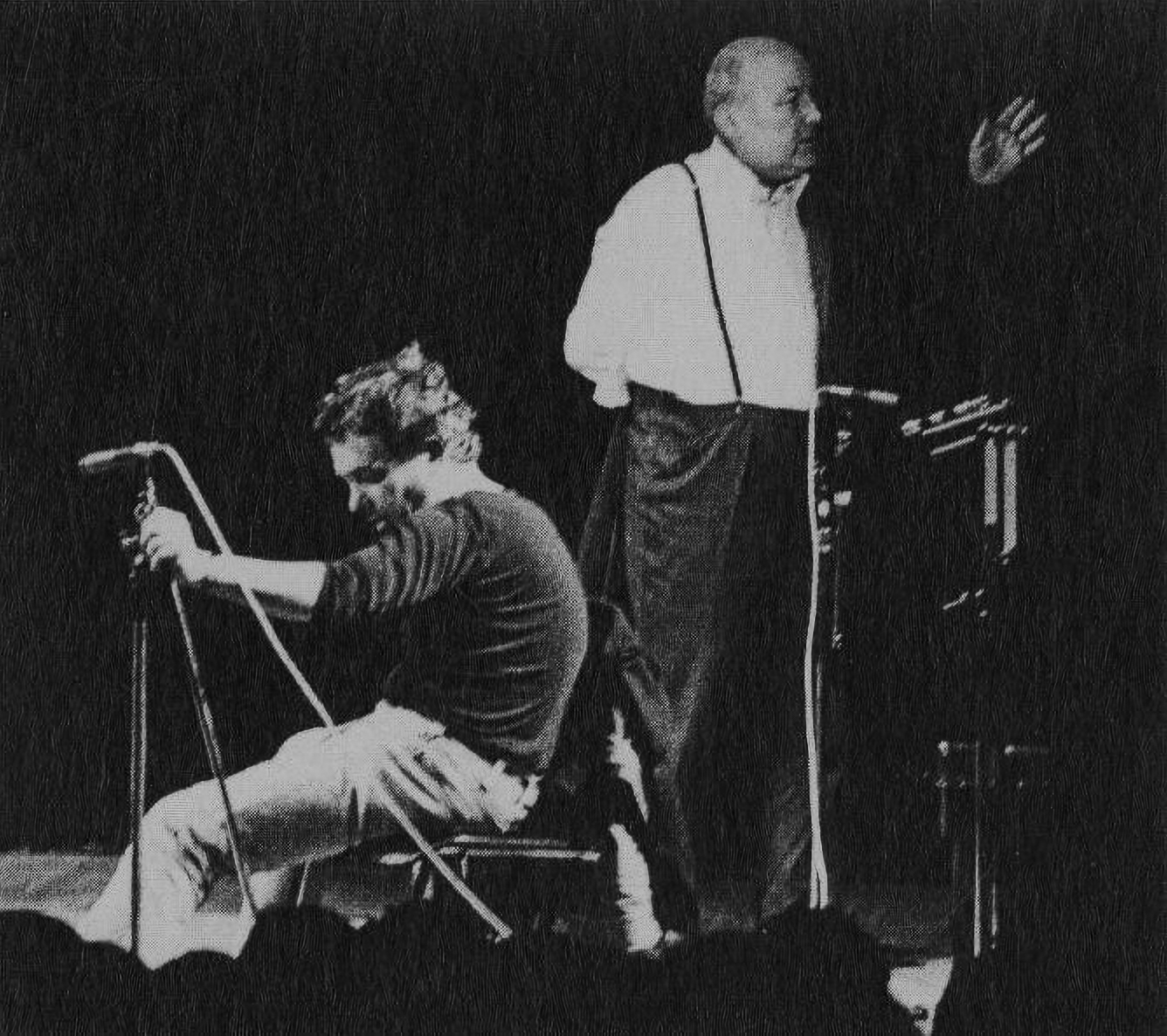
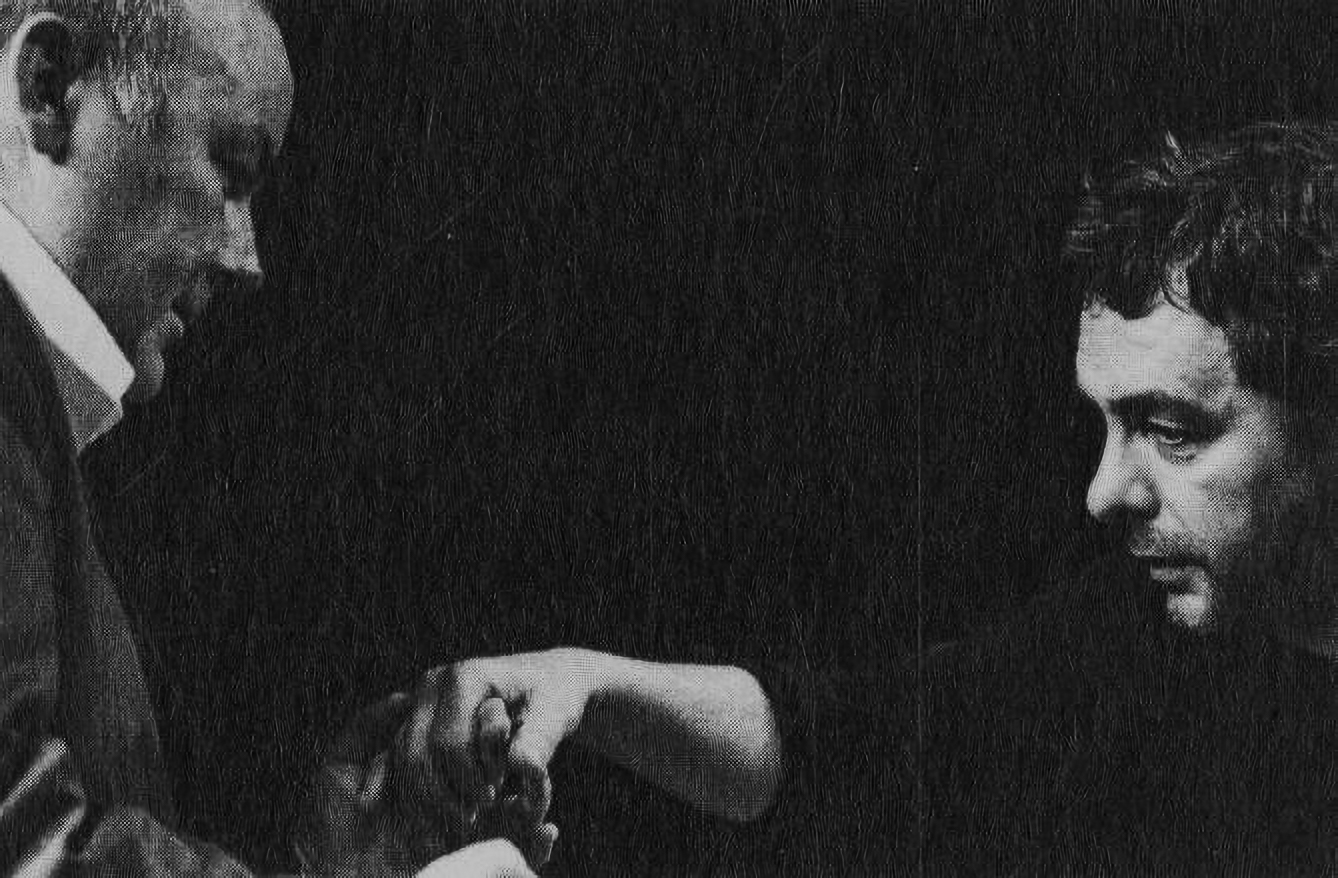
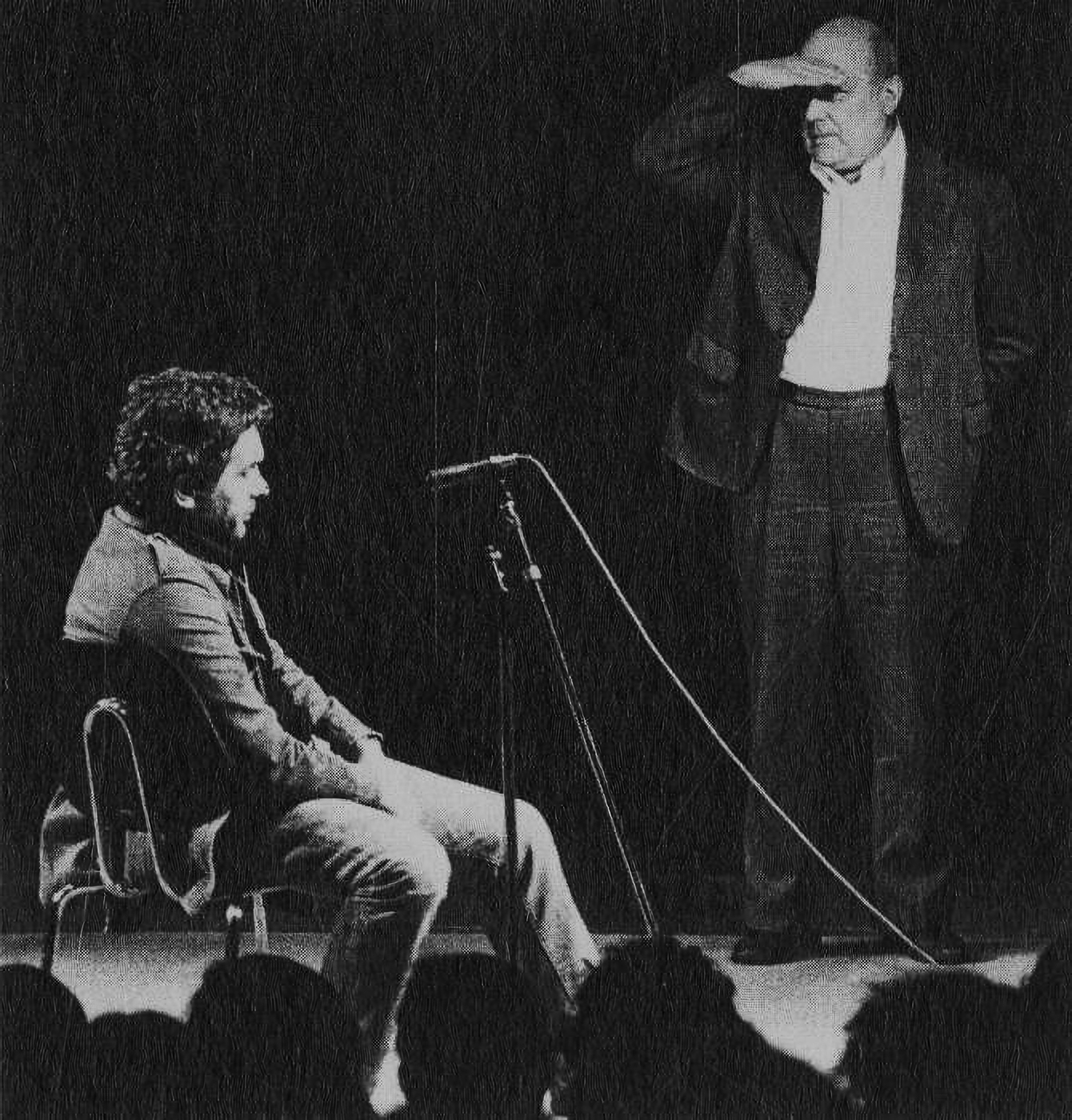
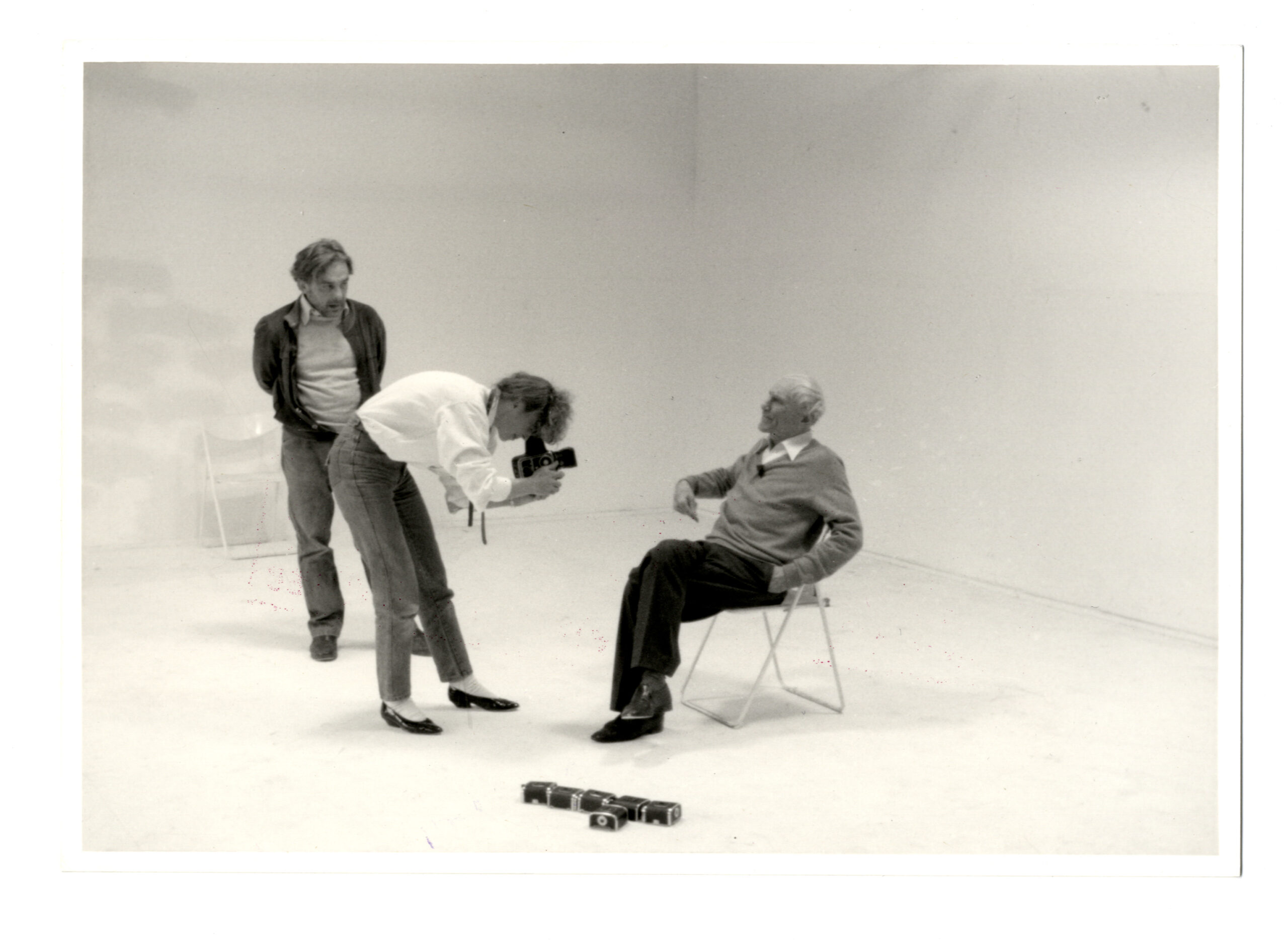
Meets the actor Bernhard Minetti in Munich for a photo session commissioned by the Bayerische Rundfunk. The resulting overdrawings Theater/Minetti are exhibited at the Schauspielhaus in Bochum and at the Neue Nationalgalerie in Berlin.
When he runs out of ideas while working on some drawings on ‘nature auto prints’ he asks Günter Brus to continue the work. This is the first cooperation with another artist besides Dieter Roth. One year later, the works are exhibited at the Kunsthalle in Hamburg with the title Vertiefung mit Bewölkung.
1986
The exhibition Arnulf Rainer. Self-Portraits travels in the US from the Ritter Art Gallery of the Florida Atlantic University in Boca Raton to the Grey Art Gallery of the New York University and to the North Carolina Museum of Art in Raleigh. The Musée Cantonal des Beaux-Arts in Lausanne exhibits hand and finger paintings together with work by Louis Soutter under the title Les doigts peignent – Die Finger malen aus.
1987
Crosses made of specially produced honeycomb plates with pictures of Christ stuck on (exhibition Malerei auf Kreuzen at Galerie m in Bochum) and larger sizes with various applications. Rainer also overpaints a series of school panels (chrome lithographs of animals, anatomy, landscapes, cities) he found in junk shops.
Exhibition Masqué – Démasqué at the Musées Royaux des Beaux-Arts in Brussels on the occasion of the Europalia 87; Works on Paper 1949–1987 at Museum Overholland in Amsterdam, and Métaphores de la mort at the Centre National d’Art Contemporain in Grenoble. Modern drawings from the collection of Franz von Bayern are exhibited at the Neue Pinakothek in Munich.
1988
First works in the Shakespeare cycles. The most important works from collections in Nordrhein-Westfalen are shown in the exhibition Arnulf Rainer. Werke der fünfziger bis achtziger Jahre at the museums Haus Lange and Haus Esters in Krefeld and at the Neue Galerie in Kassel.
1989
Rainer acquires a part of the former monastery near Passau.
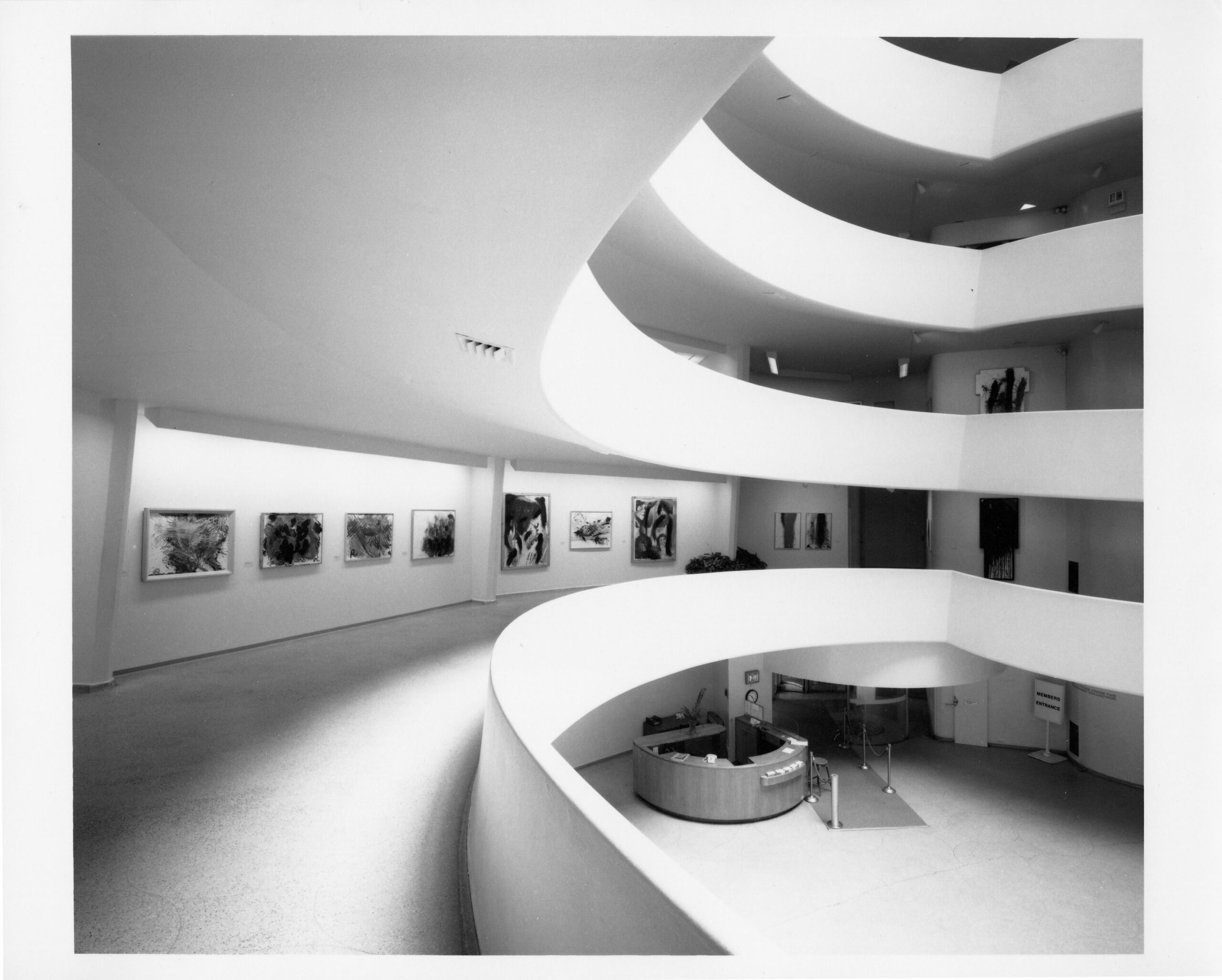
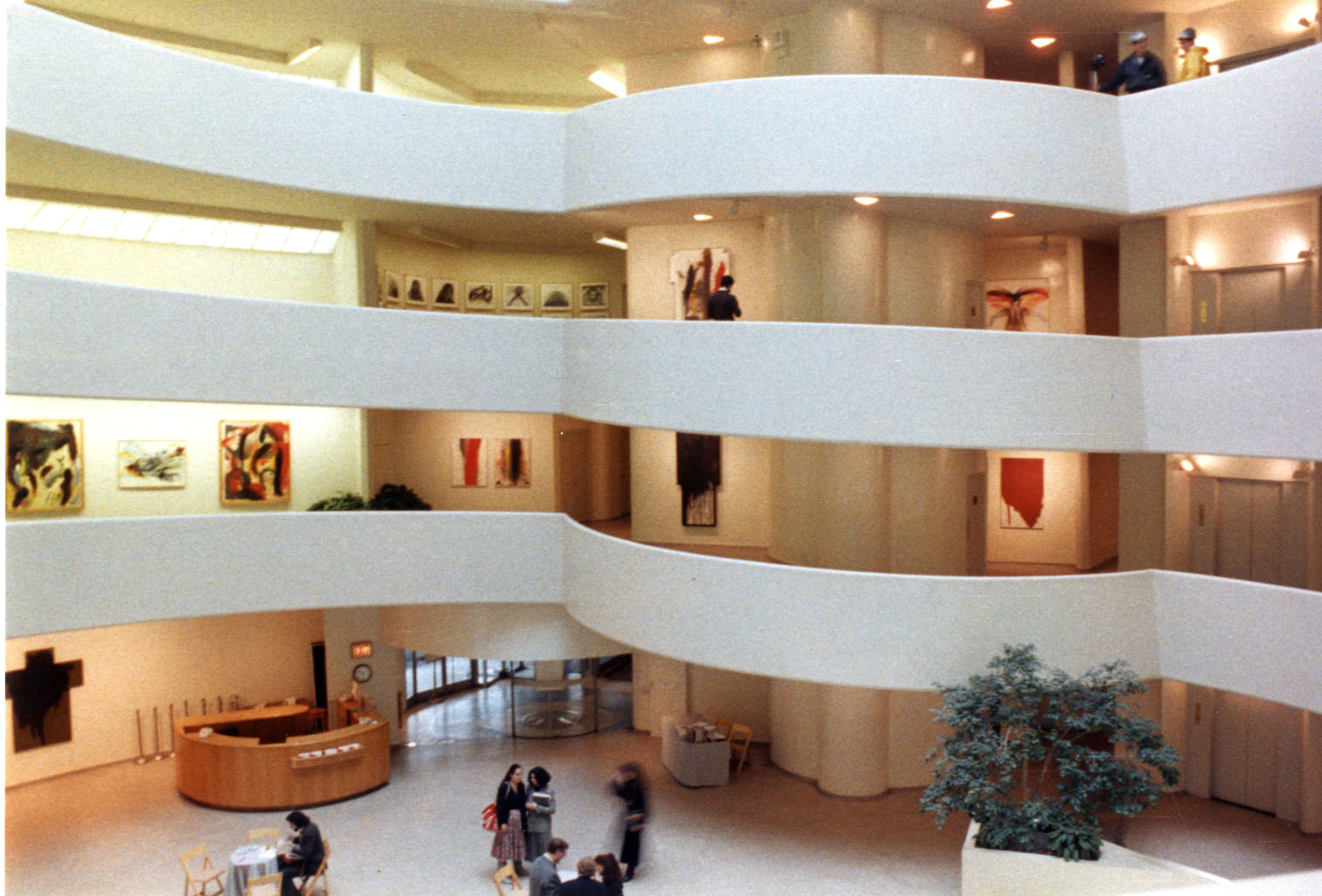
Prize of International Center of Photography in New York. Comprehensive retrospective at the Solomon R. Guggenheim Museum in New York and afterwards at the Museum of Contemporary Art in Chicago and at the Historische Museum der Stadt Wien in Vienna.
Takes part in the exhibition Sechzig – Zeichnungen einer Generation at the Graphische Sammlung Albertina in Vienna.
1990 – 1999
1990
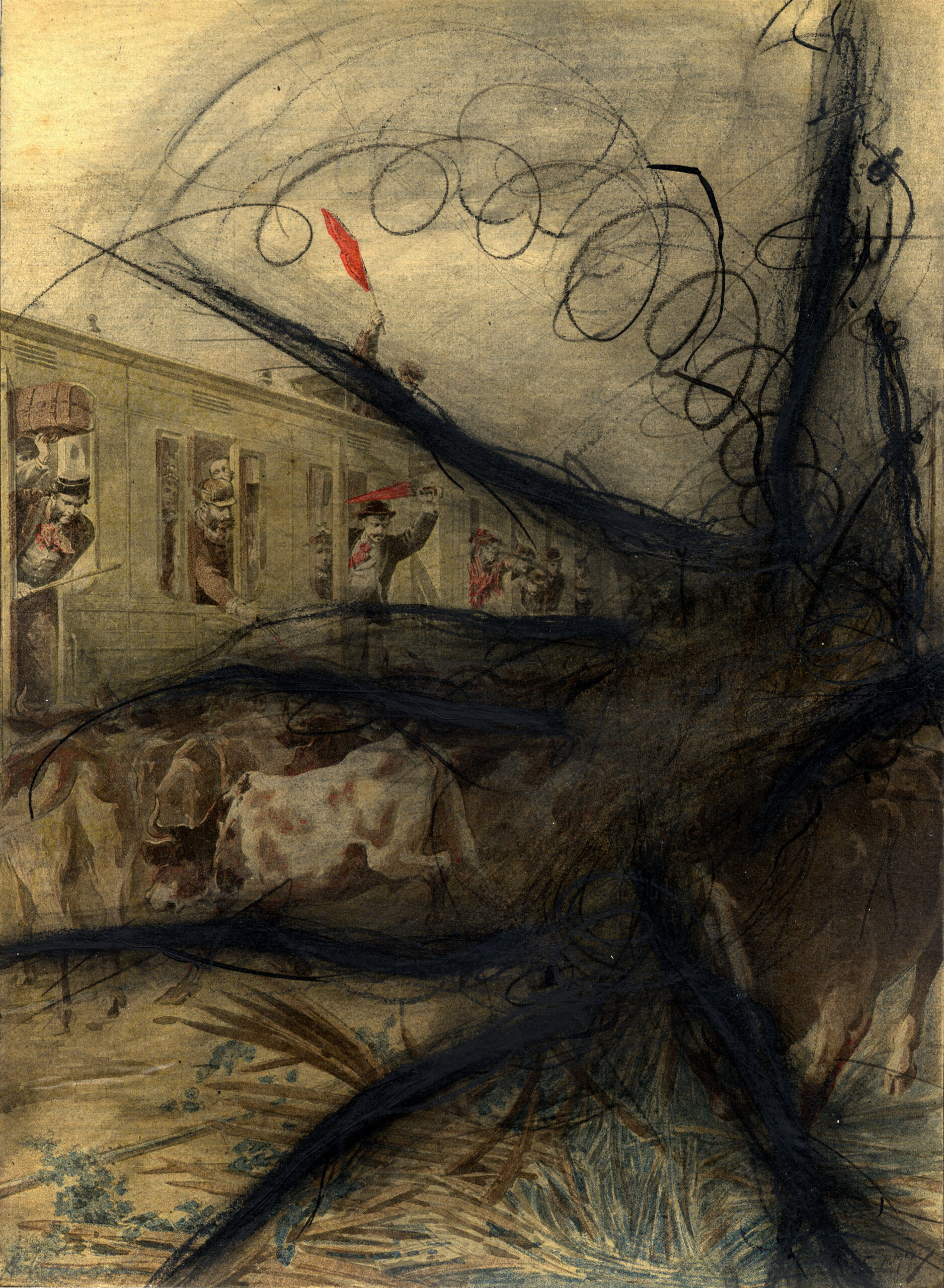
At a flea market in Paris, Rainer acquires a pile of old newspapers (Le Petit Parisien and Le Petit Journal). The series Katastrophen (Catastrophes) is created from the re-workings of the partially coloured covers.
Retrospective exhibitions at the Castello di Rivoli in Turin and at the Gemeentemuseum in The Hague.
Exhibition Hommage to Vincent van Gogh at the Van Gogh Centrum in Zundert and at the Bonnefanten museum in Maastricht. The Saarland Museum in Saarbrücken shows Paintings 1980–1990 and the Städtische Kunstmuseum in Bonn for the first time shows Übermalte Bücher (Overpainted Books).
1991
Some works from the Katastrophen series are enlarged and mounted on wood, creating large pictures with this theme. Series Märtyrerbilder (Martyrs Pictures).
Exhibitions at the Konsthall in Malmö and at the Brandenburgische Kunstsammlungen in Cottbus. Further solo exhibitions in Cologne, Salzburg, Munich, Vienna, Düsseldorf, Omaha, Nebraska and other cities.
1992
Rainer starts to work on the Engelsbildern (Angel Pictures) and Geologica.
The Menil Collection in Houston exhibits about 40 cross pictures dating from 1969 – 1991 under the title Young Cross.
Kreuz-Weisen at the Kunst-Station St. Peter in Cologne; Funeralia Salisburgensia at the Galerie Thaddaeus Ropac in Salzburg and Schenkung Otto van de Loo in the Neue Nationalgalerie in Berlin.
1993
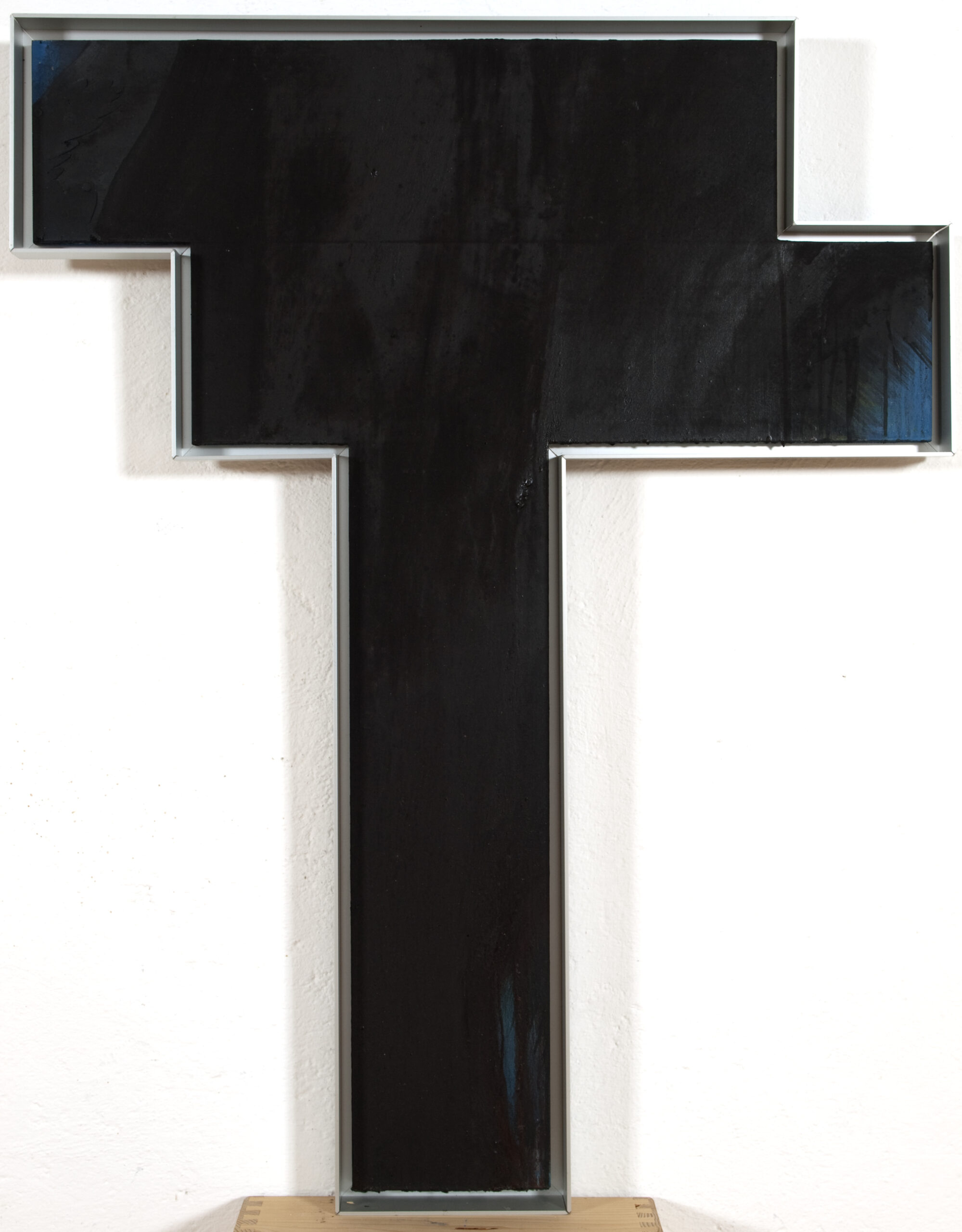
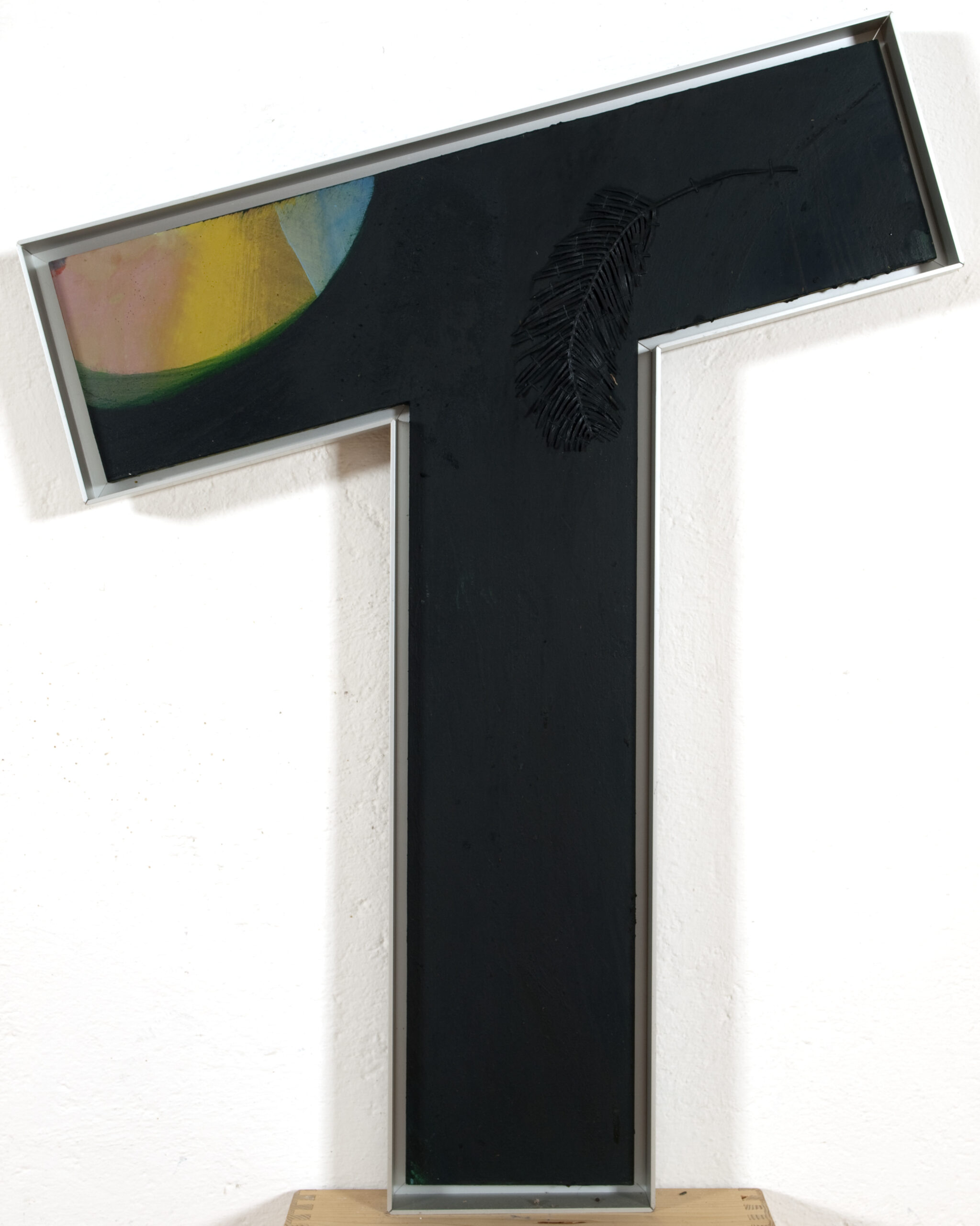
The remaining plates after completing the crosses, are used to create smaller T-shaped crosses, which are then overpainted. Continues to work on the Engelsbildern, large crosses and Geologica.
Opening of the Arnulf Rainer Museum in New York (until 1996).
Exhibitions at the Fundação de Serralves in Porto with Obras recentes; at the Kunsthalle Dominikanerkirche in Osnabrück and at the Hessische Landesmuseum in Darmstadt.
1994
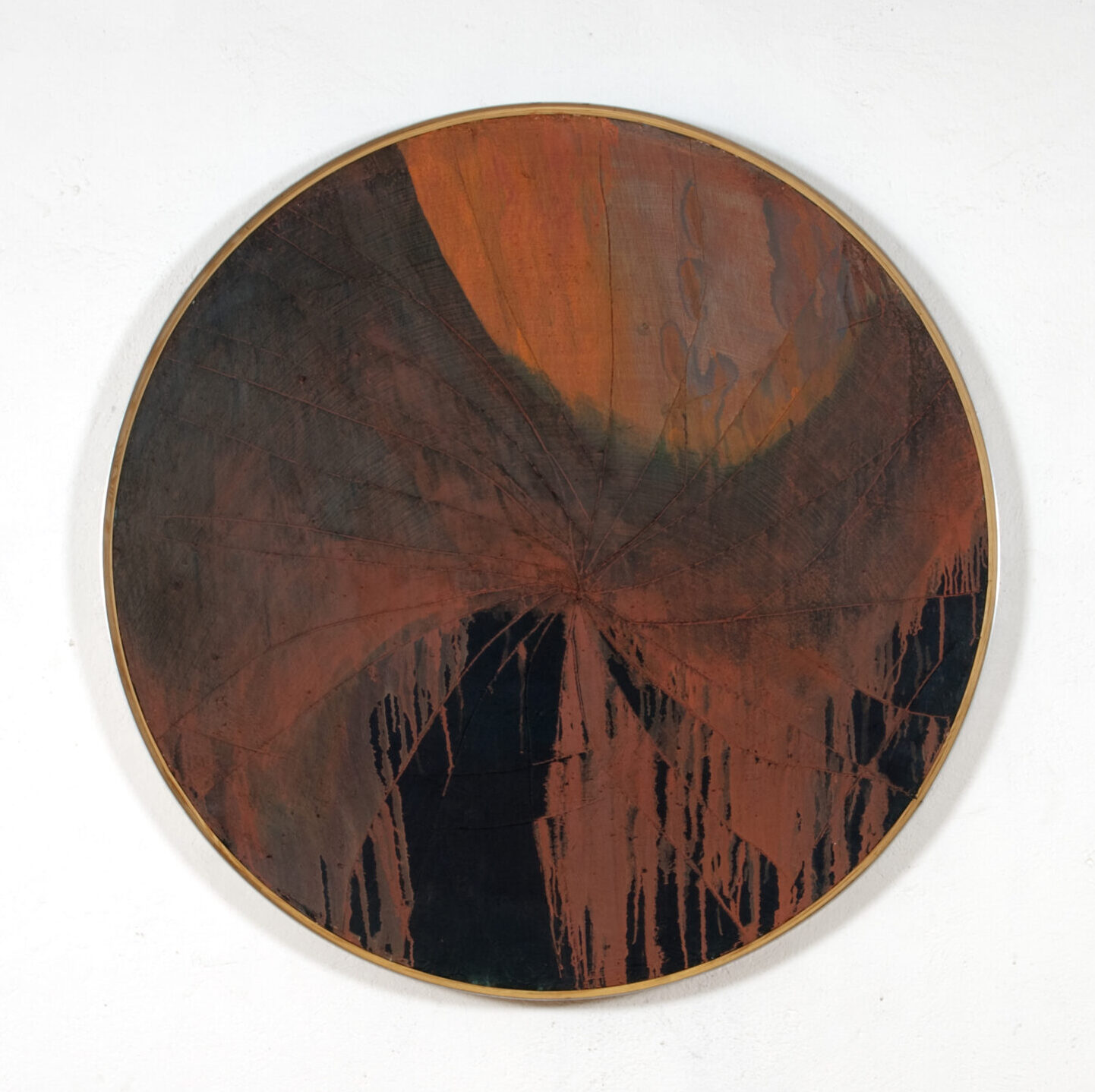
Rainer has rounds cut out of panels. Before overpainting, some of these are covered in plaster in which Rainer scratches patterns. Creation of the series Kosmosbilder.
Retrospective exhibition at the Schömer-Haus in Klosterneuburg. Solo exhibitions at the Museum of Modern Art in Passau and at the Kunsthalle in Recklinghausen.
1995
Arnulf Rainer is given emeritus status at his own request.
Inspired by illustrations of microscopic structures in old books, Rainer develops the series Mikrokosmosbilder (Microcosmos Pictures), in which new techniques and materials are used, such as grooved sheets of aluminium, cardboard built up with pellet-gun shells and rootlike structures made of cardboard. The involvement with pictures of angels leads him to the Makrokosmosbilder (Star and Sky Structures).
Exhibition Lucio Fontana – Arnulf Rainer. Über das Bild hinaus at the Museum for Modern Art in Bozen. Katastrophen und Desaster exhibited at the Nationalmuseum Cotroceni in Bukarest and at the Brukenthal-Museum in Hermannstadt/Sibiu. The International Culture Centre Egon Schiele in Krumau/Český Krumlov shows Überzeichnungen, Übermalungen and the Graphische Sammlung Albertina in Vienna presents the show Glaube – Hoffnung – Liebe -Tod. Von der Entwicklung religiöser Bildkonzepte (Faith – Hope – Love – Death. The Development of Religious Pictorial Concepts).
1996
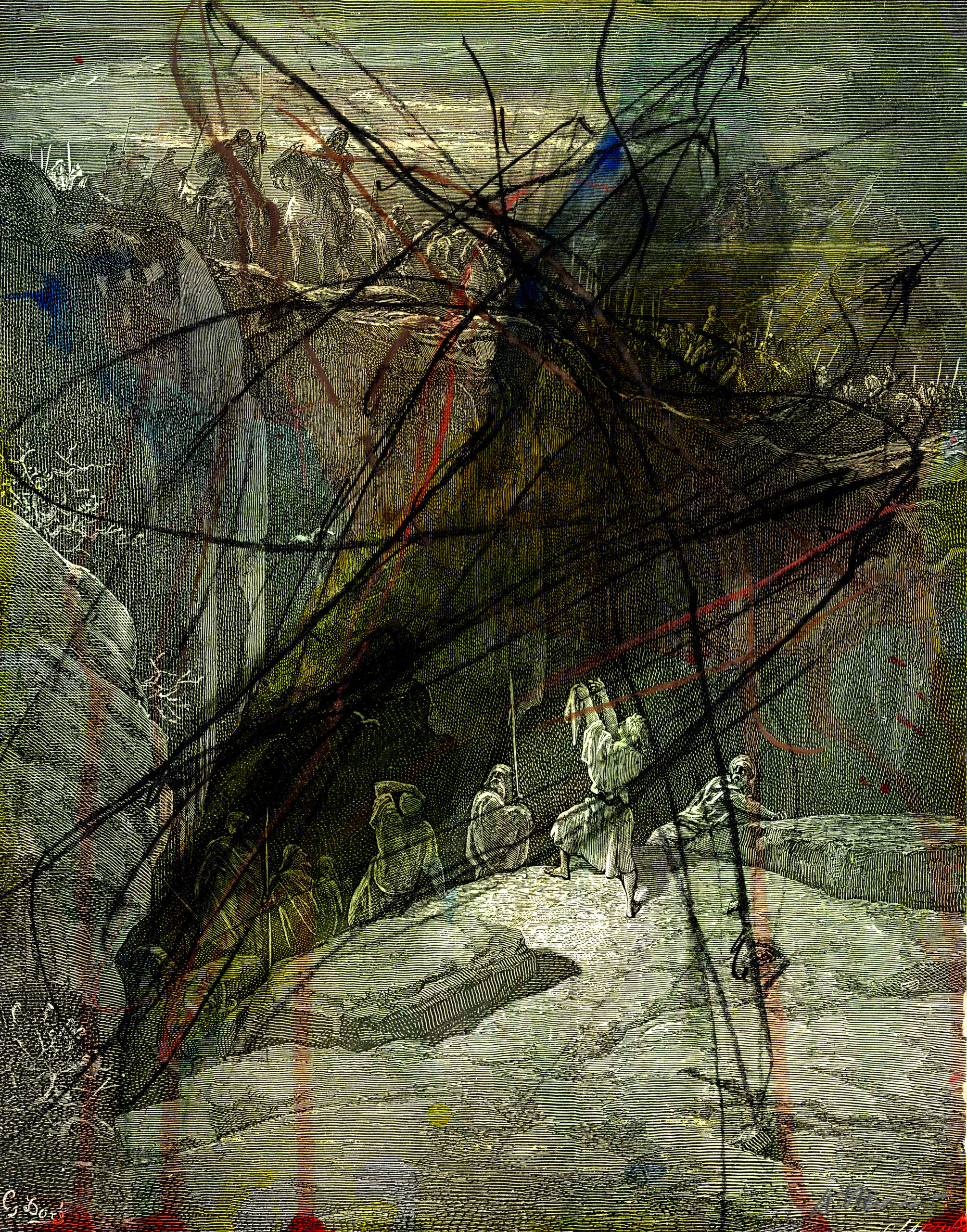
Rainer is commissioned to illustrate a bible edition and starts overdrawing illustrations on this subject by Doré and other artists and from old bibles.
Exhibitions at the Oldenburger Kunstverein, at the National Gallery of Iceland in Reykjavík and on the occasion of the 23rd Bienal Internacional de São Paulo. The CGAC Centro Galego de Arte Contemporánea in Santiago de Compostela presents Campus Stellae.
Collector Frieder Burda shows work from his collection under the title of Richter, Polke, Rainer at the Staatliche Kunsthalle in Baden-Baden.
1997
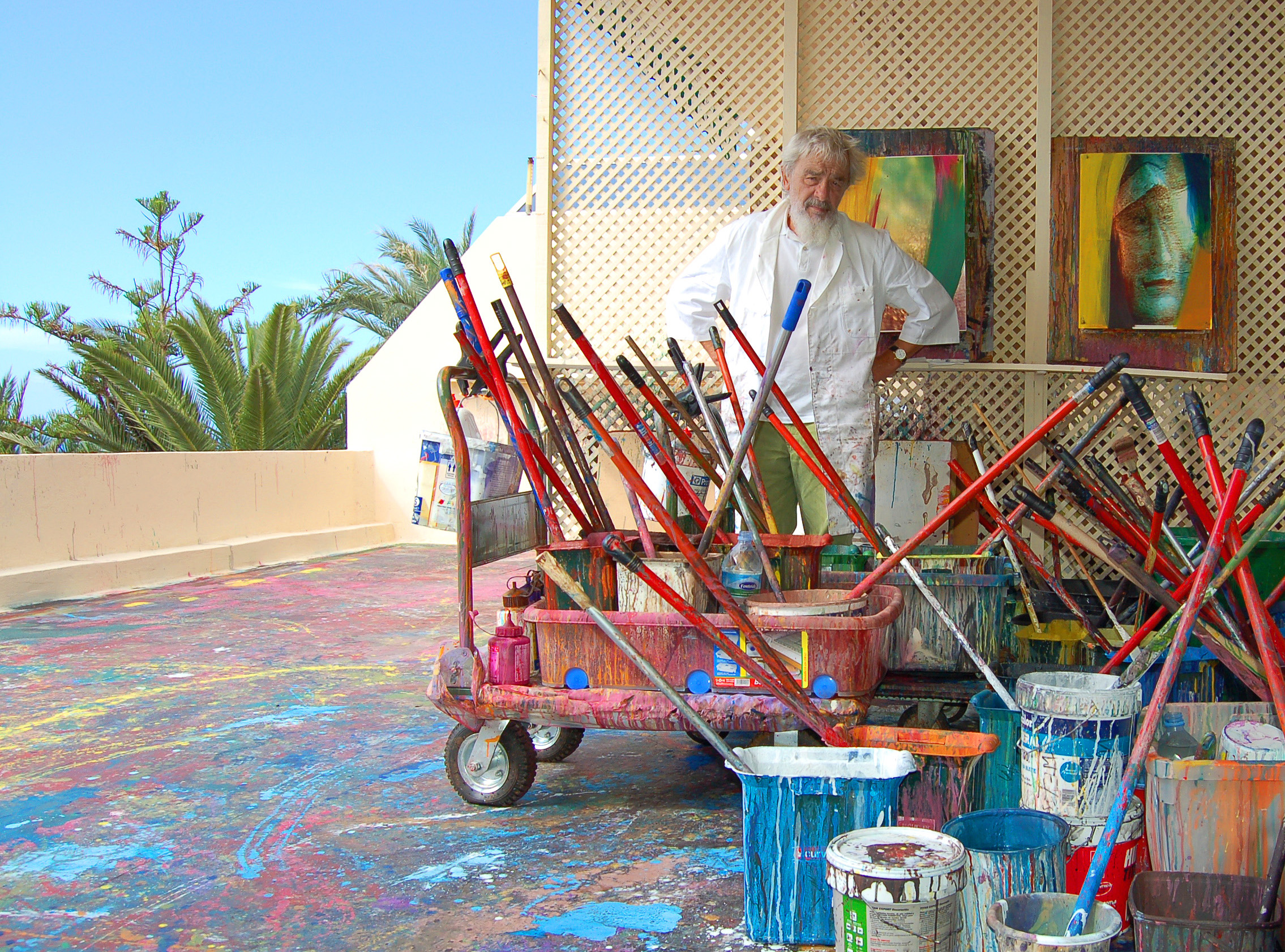
First winter in Tenerife. A terrace with sea view is used as studio. On some of the Mikrokosmos pictures Rainer mounts silk leaves and fabric flowers (Blattmalerei). He creates Schwarze Stämme, Kurven, as well as Schleierbilder and Diagonalmalerei. Resumes hand painting in red, magenta, brown and dark green on partly foam-padded drawing boards (New Hand Painting).
Further development of actor portraits started in the eighties with the Minetti cycle, the Mimenporträts.
Exhibition Arnulf Rainer at the Museo Nacional de Bellas Artes in Buenos Aires and at the Museo Nacional de Bellas Artes in Santiago de Chile. At the Kunsthalle Krems abgrundtiefe – perspektiefe. Retrospektive 1947–1997 and the Kunstmuseum in Bonn shows Die Radierungen (The Etchings).
1998
A bible illustrated by Rainer is published in a limited edition by Pattloch Verlag. He reworks much enlarged faces of Giotto, Botticelli, Fra Angelico (Series Giotto and Others) as well as etchings by Corot, and continues work on the Schleierbildern (Veil Paintings).
The Carolino Augusteum in Salzburg shows Festspieler. Solo exhibition at the National Gallery in Prague.
1999
Always having admired the drawings of Victor Hugo, Rainer starts to overdraw a series of facsimiles, resulting in the cycles Traumland (Dream Land) and Victor Hugo.
Fingermalereien – Schleierbilder 1998 exhibited at the Städtische Kunstsammlungen in Augsburg. Galerie Ropac in Paris presents Visages d’acteurs français.
2000 – 2009
2000
After series on paper on the subjects Mikro-Mikro, Himmel, Ozean, Höhlengeologie, Salzkammergut, he reworks work by Canova and Caspar David Friedrich.
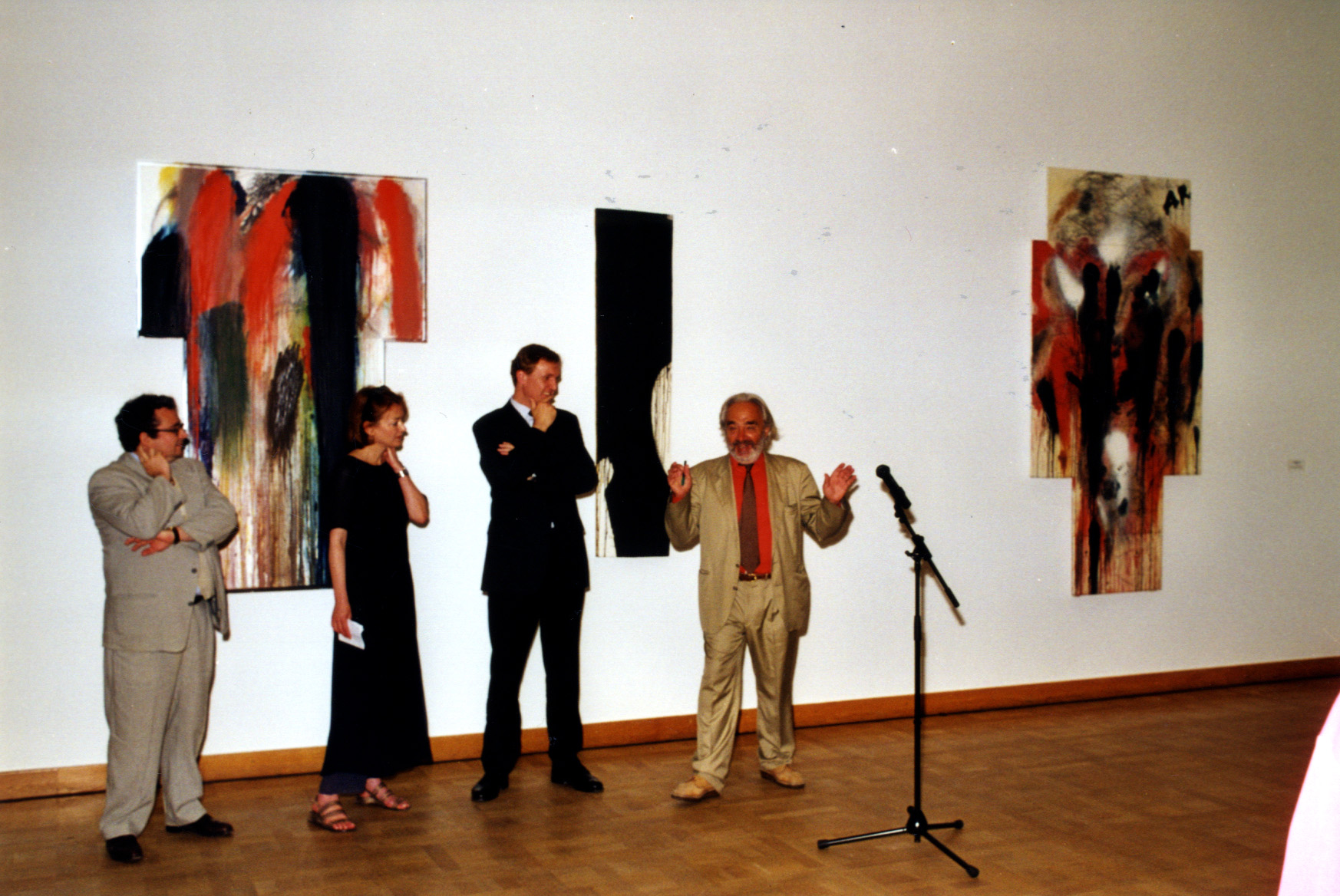
Major retrospective exhibitions Even Before Language at the Stedelijk Museum in Amsterdam and Gegen.Bilder at the Kunstforum der Bank Austria in Vienna on the occasion of the artist’s 70th birthday. Exhibition at the Neue Galerie der Stadt Linz.
2001
Inspired by the confrontation with Canova, Rainer creates the series Klassizismus. Focuses on the subject of landscapes and additional reworking of reproductions of his own works, the Selbstübermalungen (Self Overpaintings).
Solo exhibitions at the Galleria d’Arte Moderna in Bologna and at Museum Würth in Künzelsau. Sinclair-Haus in Bad Homburg shows Arnulf Rainer and Victor Hugo; the municipal gallery Lenbachhaus in München shows overpaintings from the collection of Frieder Burda.
2002
Reworking of reproductions of outsider art as well as nudes from art history, antiquity, architecture, sea, underwater, mummies, Buddhas. ‘Drawing gives my work an imaginative flexibility and versatility. The many series emerge completely independently of painting, but do have an impact on it.’ (A.R. 1998)
The Jablonka Galerie in Cologne and the Tony Shafrazi Gallery in New York exhibit Crosses. Permanent Rainer room at the Pinakothek der Moderne in Munich.
2003
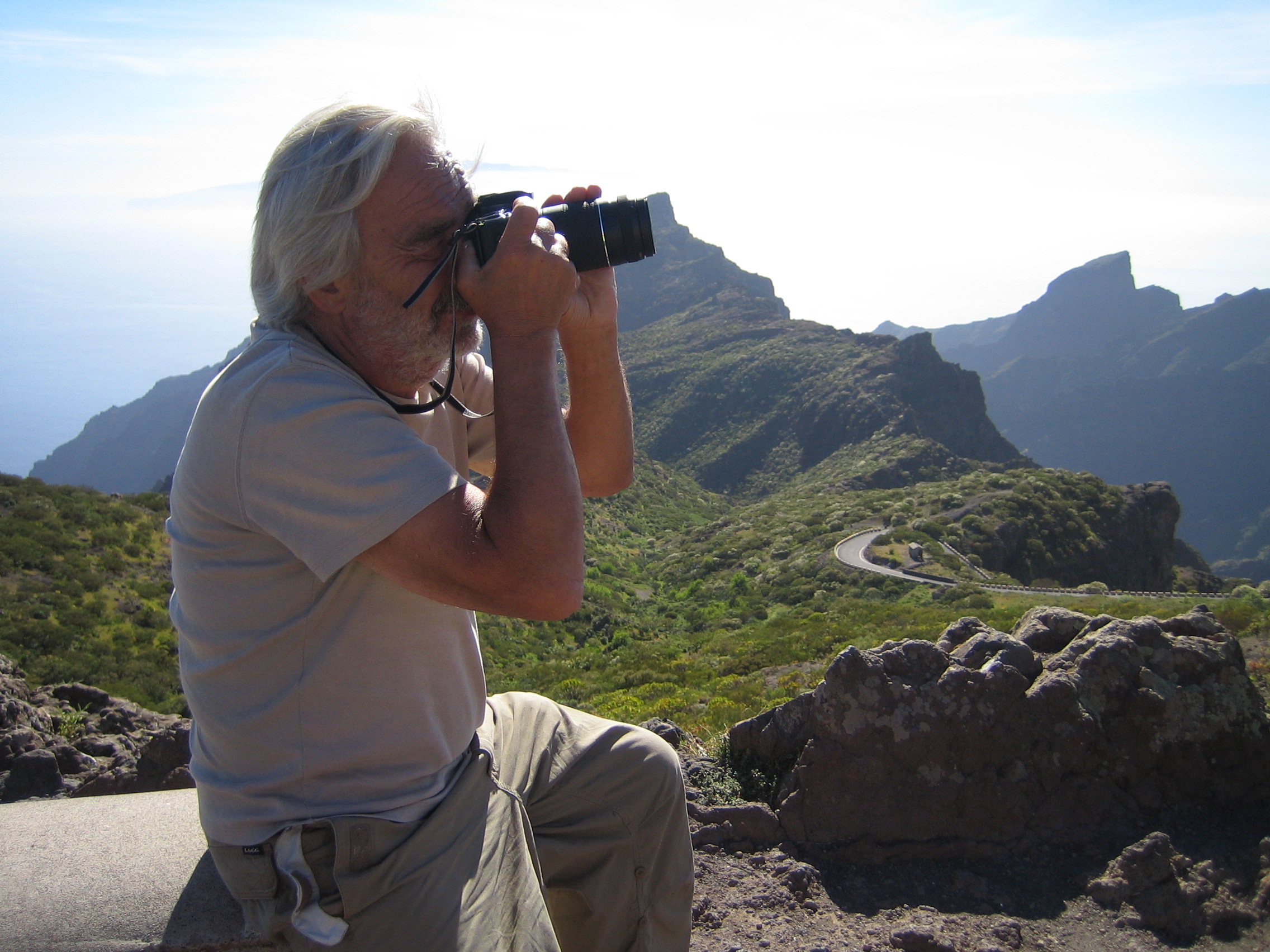
While spending the winter in Tenerife, Rainer ventures into photography. He creates Kanarien, an extensive series of abstract works on paper on a white background, later acrylic on wood. Rainer is awarded the Rhenus-Kunstpreis in Mönchengladbach.
Exhibitions Canova – Rainer at the Museo Correr and Sotto la Croce at the Museo Diocesano d’Arte Sacra in Venice. First exhibition of non-reworked photographs at Galerie Karl Pfefferle in Munich titled Neue Fotoarbeiten (Recent Photographic Work). Galerie 422 in Gmunden shows Nackt durch die Jahrhunderte (Nudes through the Ages) and the Rupertinum in Salzburg shows From Klimt to Rainer.
2004
Awarded an honorary doctorate from the Catholic Theological Faculty of the Westphalian Wilhelms-Universität in Münster. On this occasion, exhibition Arnulf Rainer. Auslöschung und Inkarnation is held at the Westfälischen Landesmuseum für Kunst und Kulturgeschichte in Münster.
Much interest in Japanese No masks and later also in African and Asian masks. Creation of the Masken (Masks) series. Initially, these are works on paper, but later Rainer overpaints masks on wooden boards.
On the occasion of the artist’s 75th birthday, the Kunsthalle Jesuitenkirche in Aschaffenburg organises the retrospective exhibition Arnulf Rainer. Passionen. The Musée National Message Biblique Marc Chagall in Nice presents the exhibition Peintures/Surpeintures 1995–2003.
Takes part in the opening exhibition of the Museum Frieder Burda in Baden-Baden.
2005
Overpainting of bodies, nudes, divas and clowns. In part, the productions are printed on canvas and mounted on wood. From now on, Rainer works on all subjects simultaneously.
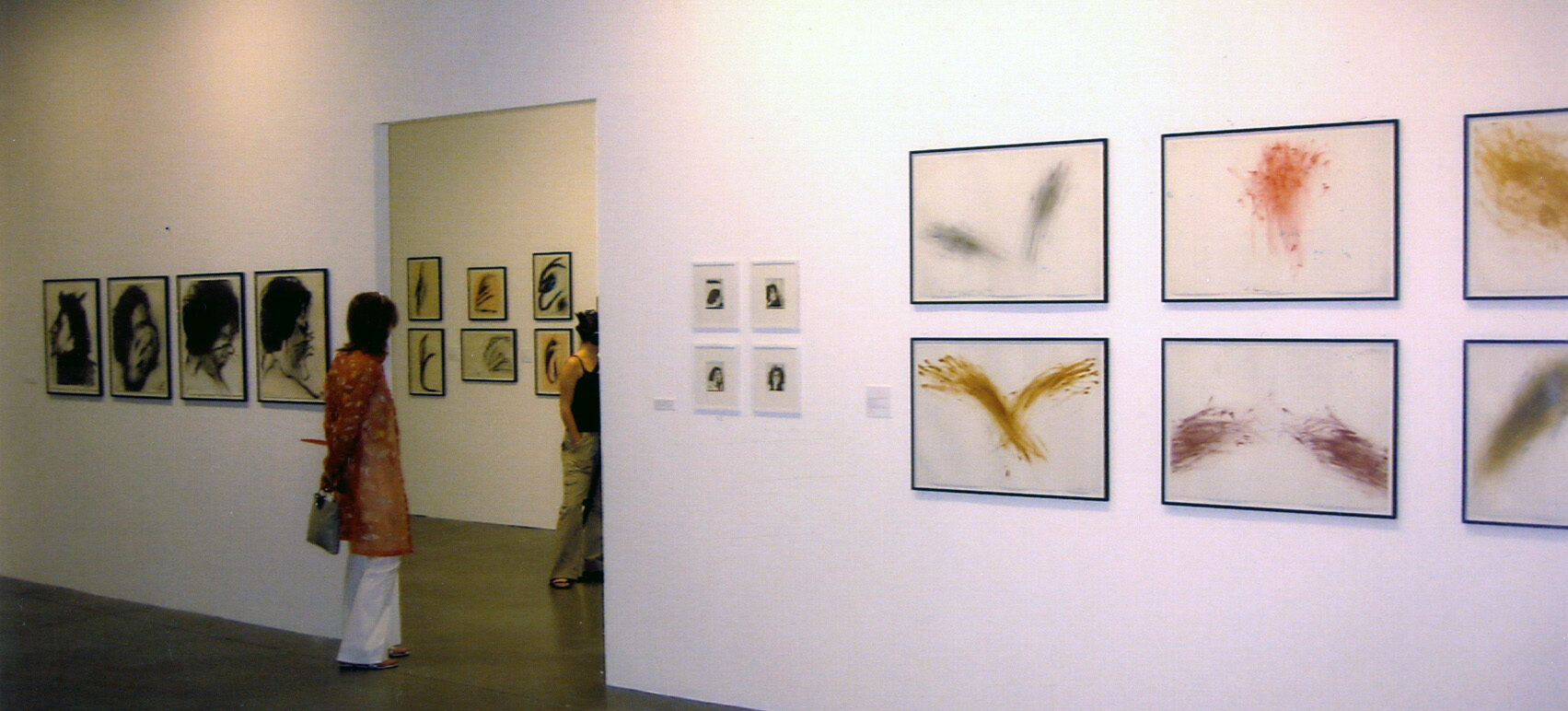
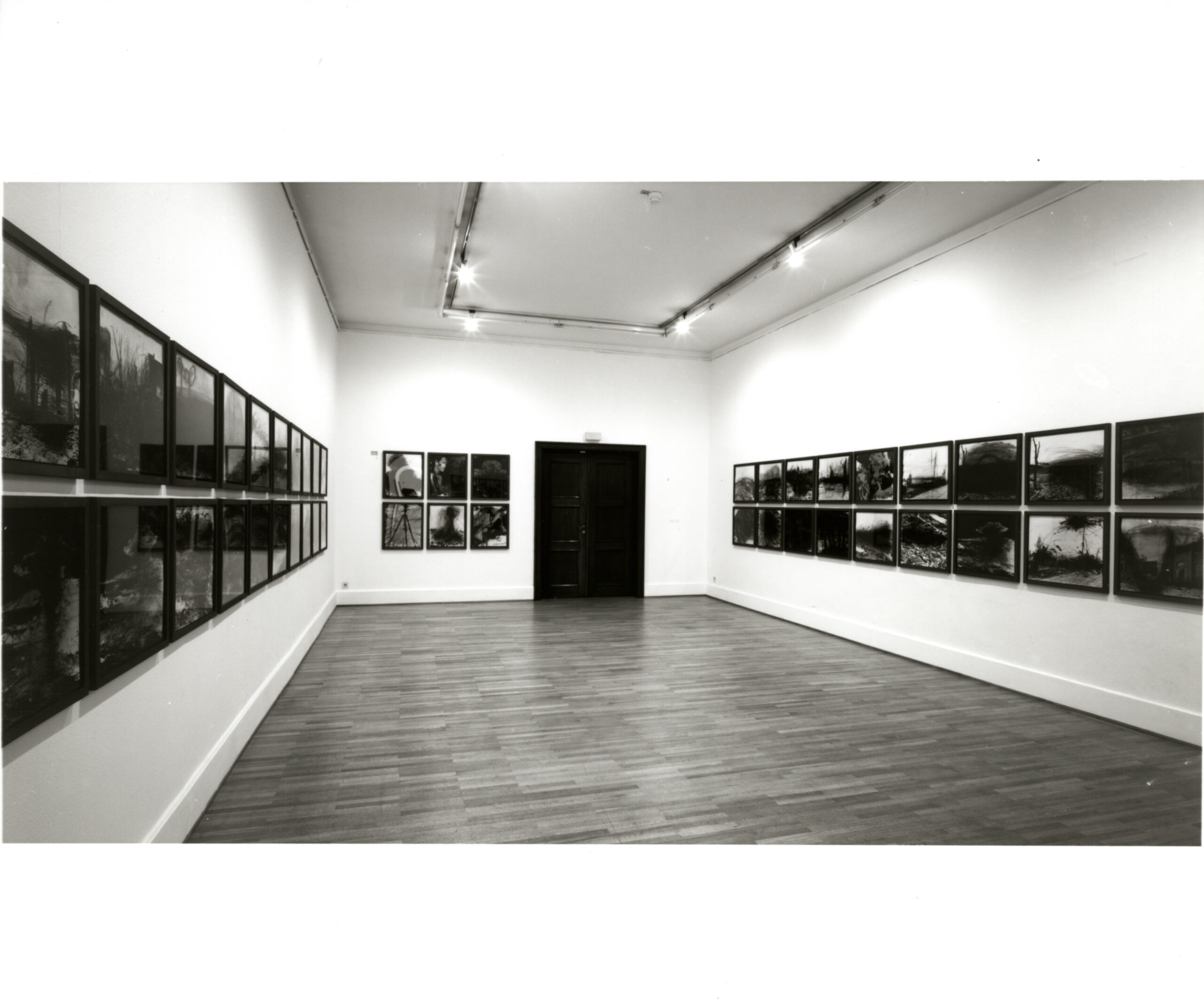
Under the title of Arnulf Rainer et sa collection d’Art brut the Fondation La Maison Rouge in Paris presents a number of series of Rainer’s work from its collection. The Armando Museum in Amersfoort exhibits Ausstellung Körpersprache – Landschaftssprache, and Sammlung Essl in Klosterneuburg presents a confrontation with the work of von Antoni Tàpies: Tàpies – Rainer. Porteurs de secret. In Japan, the Hiroshima series acquired from the Lenbachhaus in Munich, is exhibited at the Akira Ikeda Gallery in Taura.
2006
The Catholic Theological Private University Linz awards Rainer an honorary doctorate in theology.
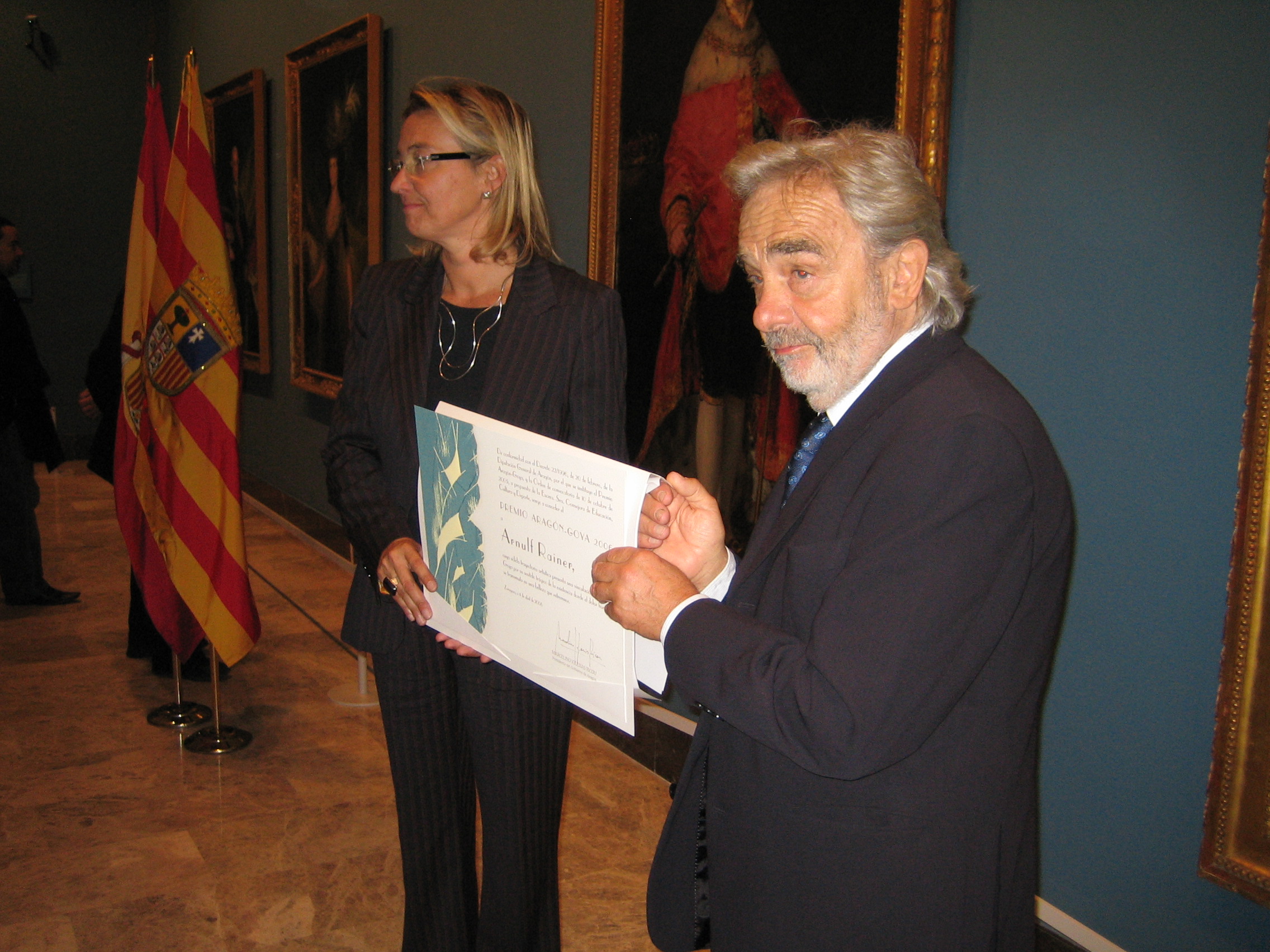
Exhibition Arnulf Rainer – Dieter Roth. Mezclarse y Separarse at the Comunidad de Madrid and at the Centro Atlántico de Arte Moderno (CAAM) in Gran Canaria. Rainer is the first non-Spanish artist to receive the Aragón Goya Prize for his life’s work and because of his artistic affinity with Francisco de Goya. Exhibition of Goya re-workings in the Museo de Zaragoza from the 1980s and from 2005/2006.
The Museum for Applied Art in Vienna shows a selection of original designs for his posters in the exhibition RAINER, sonst keiner! Überschriftungen.
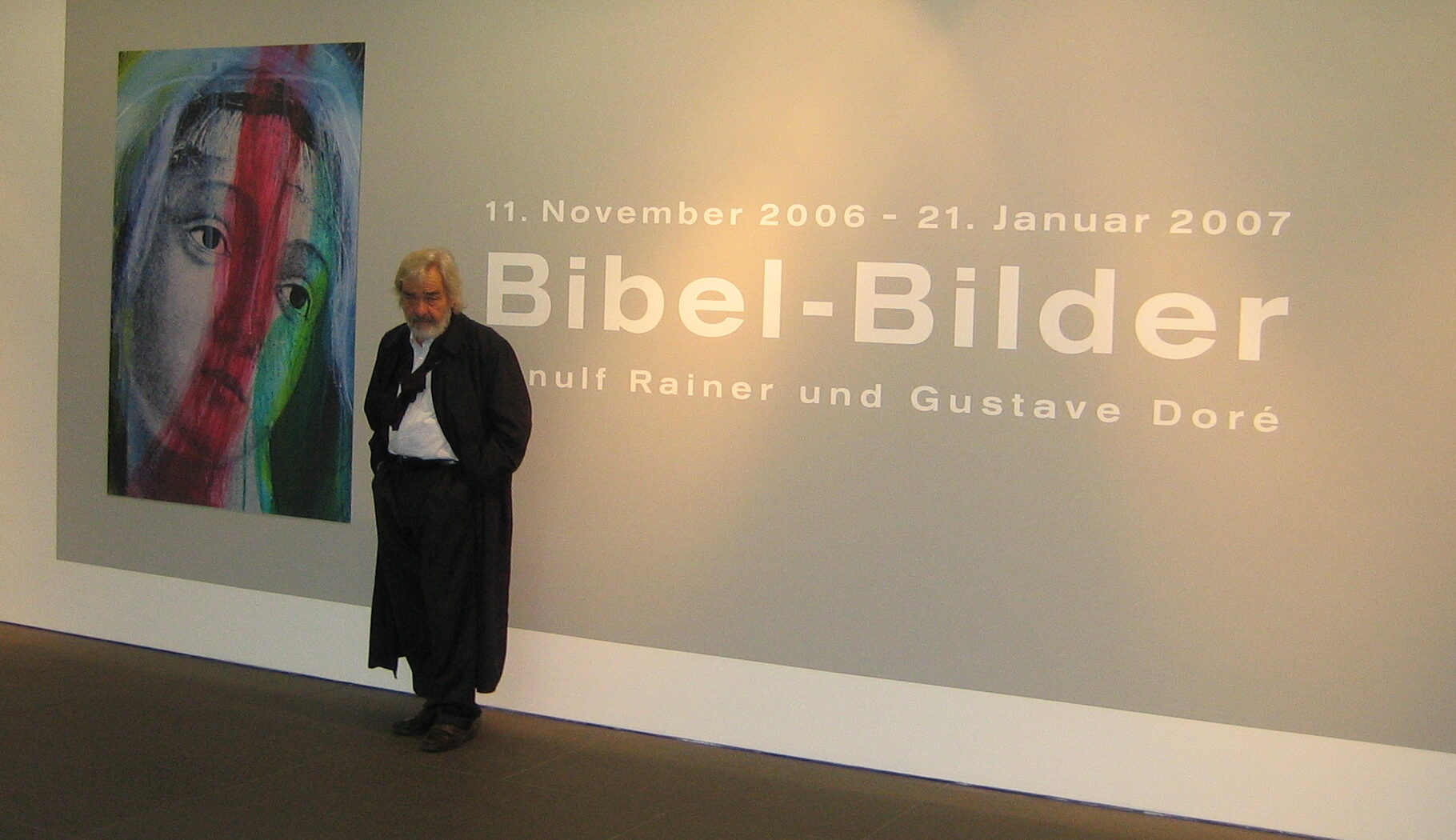
The collector Frieder Burda shows the group of bible overpaintings in his museum in Baden-Baden.
2007
Rainer sticks pictures (landscapes, nudes, women’s heads) not used for enlargement and reworking, on a drawing paper and applies graphic designs to them.
This new work is first shown at the Galerie Heike Curtze in Vienna in the exhibition maltrechas/Fehlfotografie.
The Haus der Photographie/Deichtorhallen in Hamburg takes over the exhibition Arnulf Rainer – Dieter Roth. Misch- und Trennkunst. The MAK Center for Art and Architecture in Los Angeles shows the exhibition of poster designs under the title Arnulf Rainer. Hyper-Graphics.
2008
The Schiller Museum in Weimar, on the occasion of its opening, has an exhibition on Victor Hugo which includes part of Rainer’s Victor Hugo cycle.
The Österreichische Galerie im Belvedere in Vienna shows a major selection of Misch- und Trennkunst (Mixed and Separated Art) by Arnulf Rainer und Dieter Roth at the Orangerie.
2009
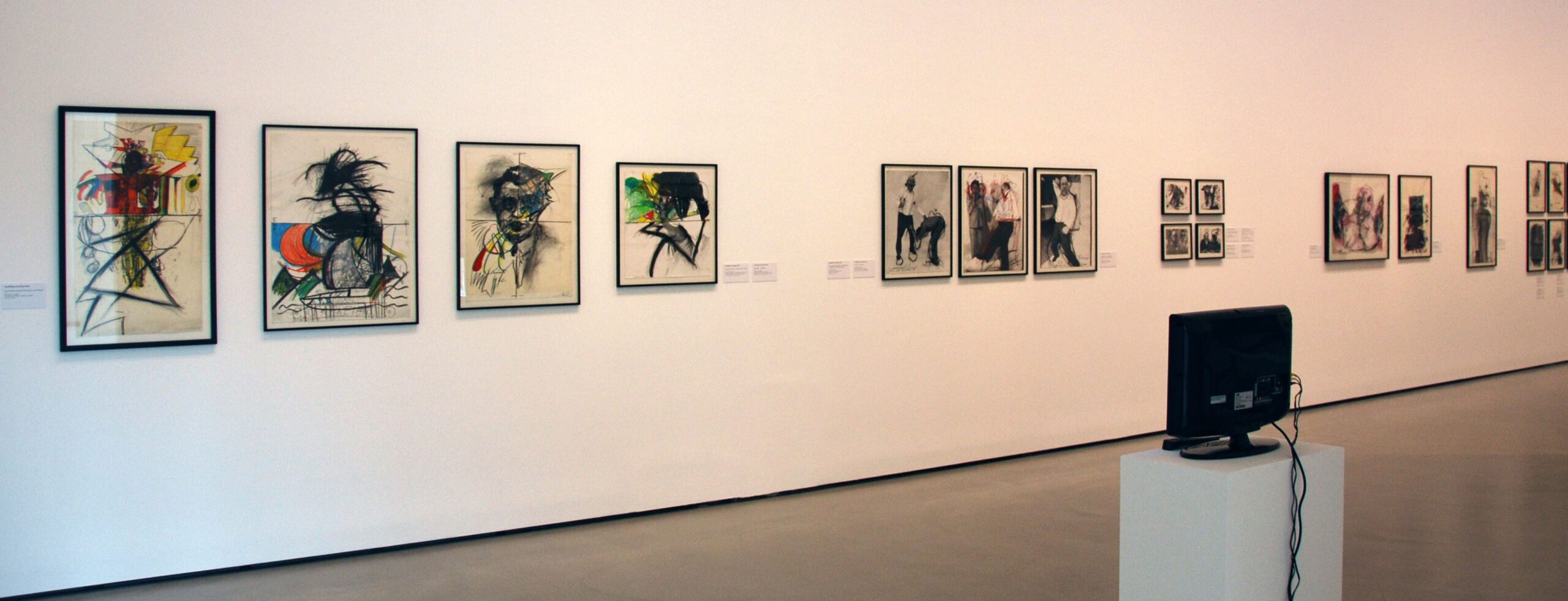
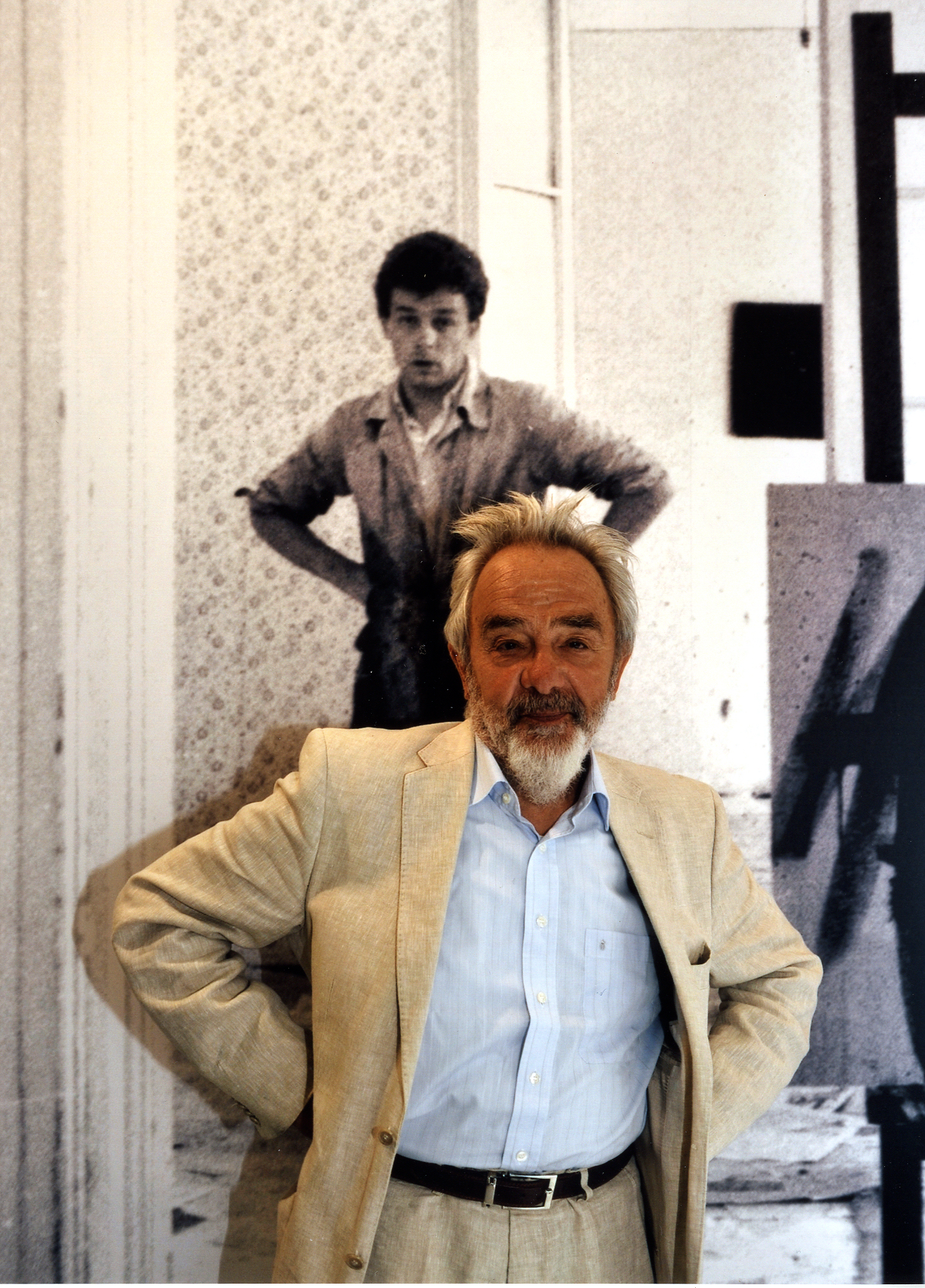
Opening of the Arnulf Rainer Museum in Baden near Vienna with the exhibition Aller Anfang ist schwer (All Beginning is Hard). Renewed collaboration with Günter Brus. The small-format drawings Am Horizont der Sinne – Am Horizont der Dinge (On the Horizon of the Senses – On the Horizon of Things) are presented at the Albertina in Vienna.
The Musée d’Art Moderne de Saint-Étienne Métropole exhibits many graphical works by the artist under the title Arnulf Rainer – Paysages perdus. The Museum of Modern Art in Salzburg shows Female (works on the subject Women over a period of over 30 years).
2010 – 2019
2010
Reinhold Baumstark curates the second exhibition at the Arnulf Rainer Museum in Baden, titled Kreuz – Es ist das Kreuz, das den Sinn ergeben könnte.
Exhibition Arnulf Rainer. Der Übermaler at the Pinakothek der Moderne in the Alte Pinakothek in Munich. Early and later Van Gogh overpaintings are shown at the Vincent van Gogh Huis in Zundert under the title of Over van Gogh. Exhibition Visages at the Arnulf Rainer Museum curated by Jean-Michel Foray. Solo exhibition at the Rogaland Kunstmuseum in Stavanger. Takes part in the Busan Biennale (in South Korea).
Many gallery exhibitions: in Milan Opere 1970–2008; in Paris Arnulf Rainer Pierre Molinier Übermalung in Munich Puppetry, in Reith in Alpbachtal Masken. Takes part in the exhibition Mentalität Zeichnung at the RLB Kunstbrücke in Innsbruck.
2011
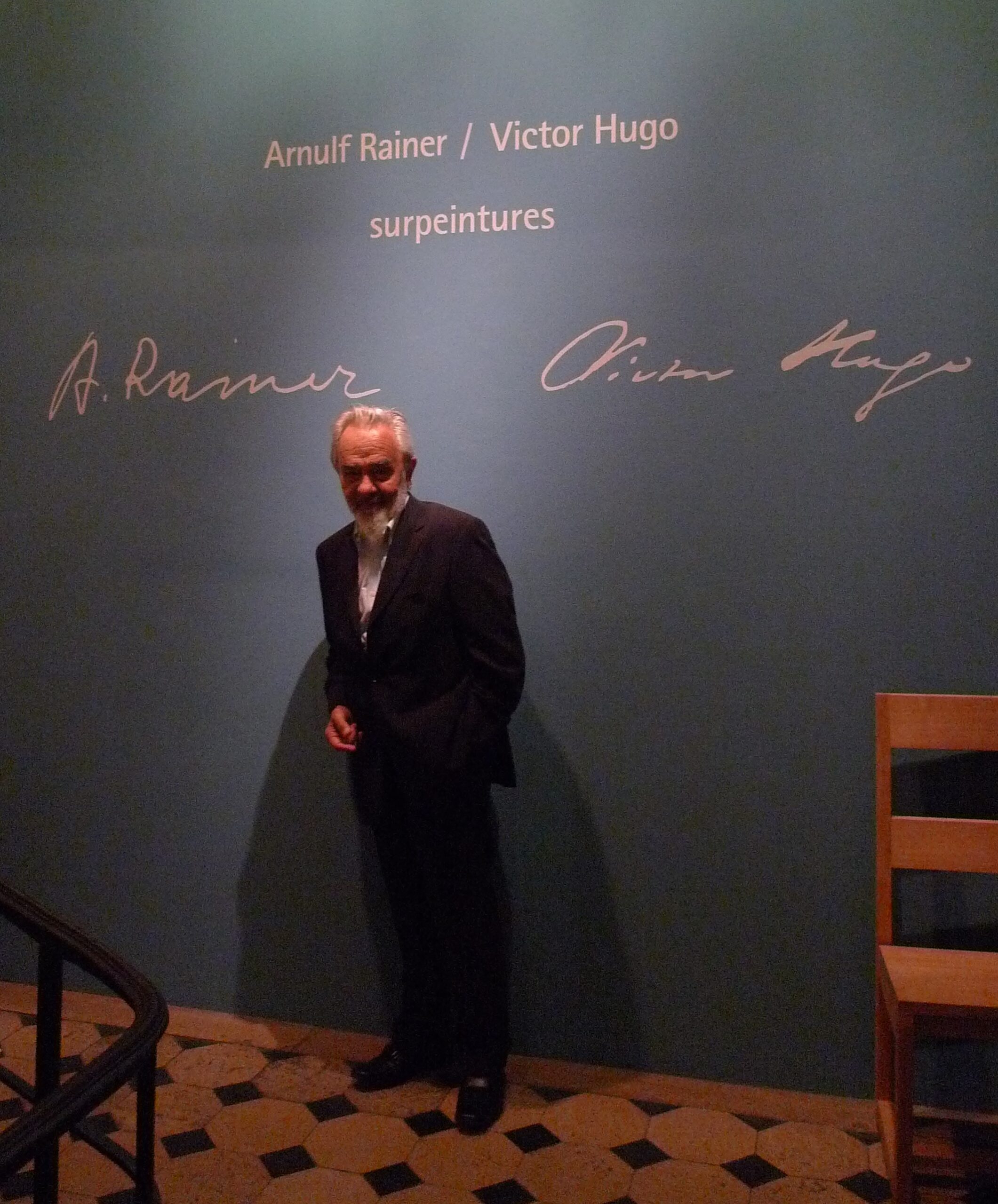
Maison de Victor Hugo in Paris shows Arnulf Rainer/Victor Hugo Surpeintures.
At the Arnulf Rainer Museum in Baden, Rudi Fuchs curates the exhibition Lustspiel-Neues aus dem Atelier, Georg Baselitz/Arnulf Rainer (Comedy-New from the Studio, Georg Baselitz/Arnulf Rainer), in which the very latest works by both artists are juxtaposed.
The Real Academia de Bellas Artes de San Fernando in Madrid shows early and new Goya reworkings in the exhibition Arnulf Rainer sobre Goya.
Takes part in Staging Action: Performance in Photography since 1960 in New York and in the exhibition Incongru. Quand l’art fait rire at the Musée Cantonal des Beaux-Arts in Lausanne.
2012
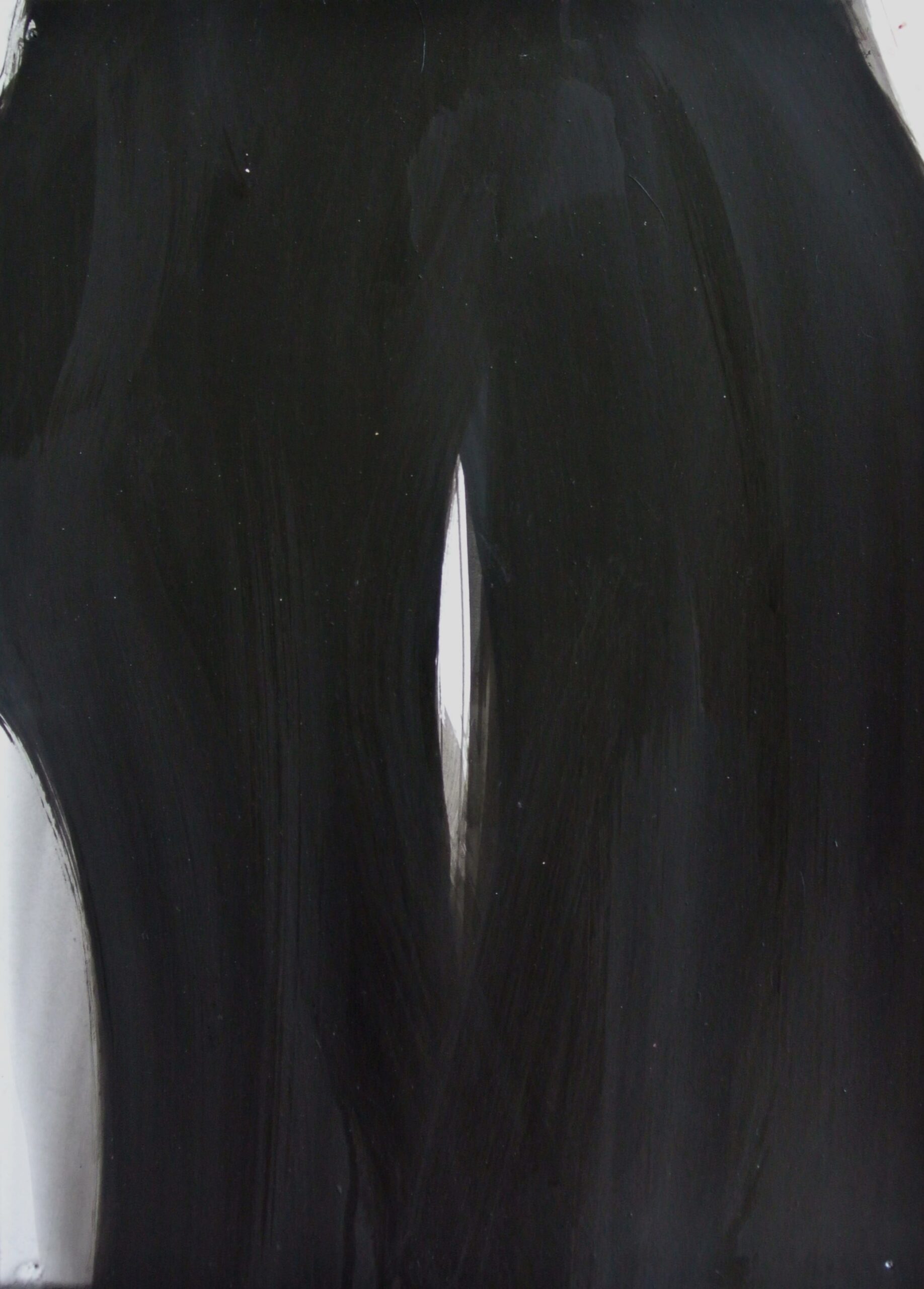
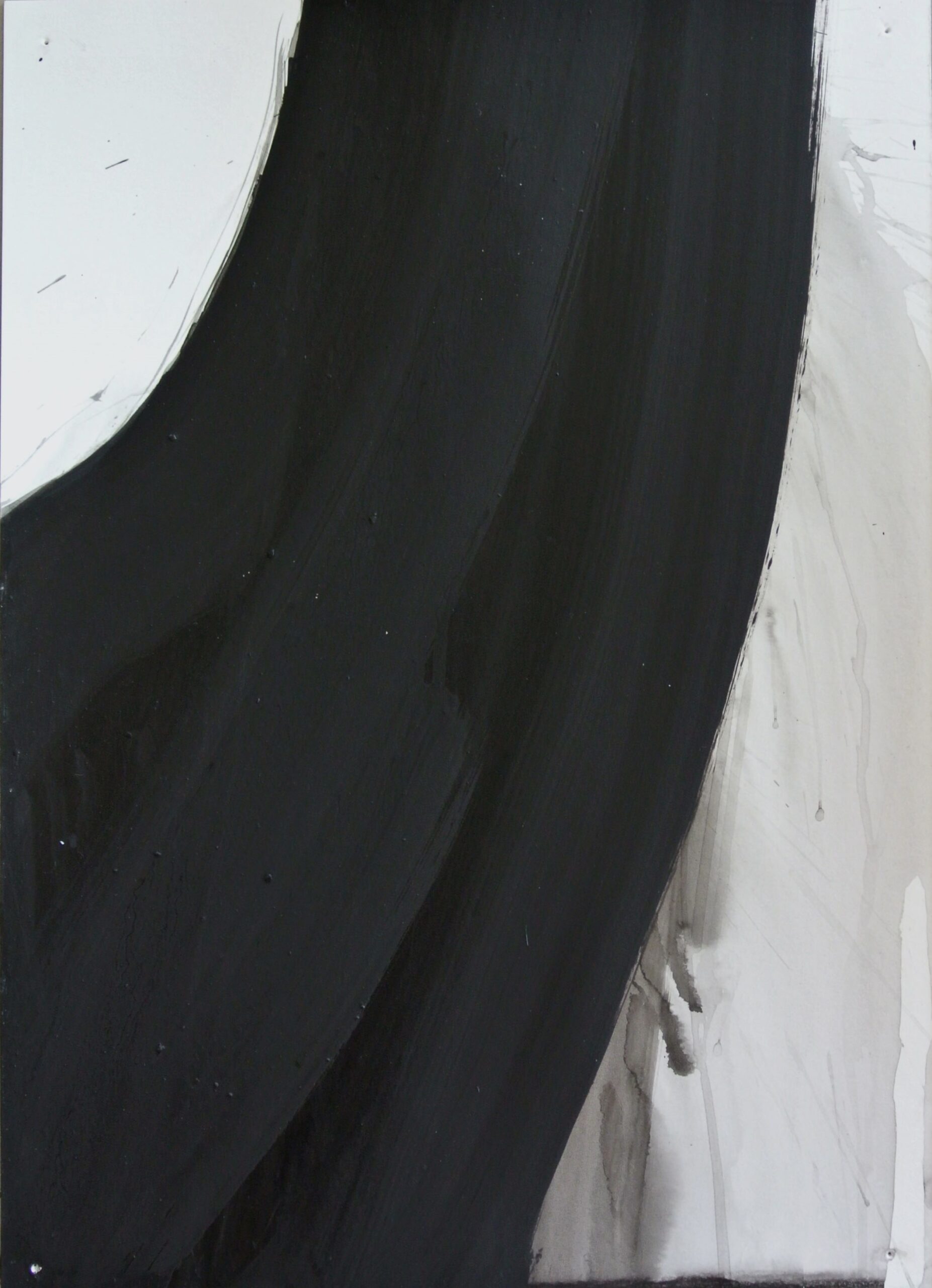
Rainer paints a series of black curves on drawing board, later on wood. He takes photographs of the originals (old, partly coloured postcards, etc.).
Exhibitions at the J. Paul Getty Museum in Los Angeles: Messerschmidt and Modernity. Helmut Friedel curates two exhibitions at the Rainer Museum in Baden on the subject Rainer-Kosmos (second part New, Unfigured and Interesting).
Tate Liverpool presents Tracing the Century. Drawings from the Tate Collection and the Museum of Modern Art in New York shows Exquisite Corpses: Drawing and Disfiguration. Solo exhibition Out of Control! Physical Painting – Paintings by Arnulf Rainer at the Kunsthalle in Rostock.
2013
The TEA Tenerife Espacio de las Artes, Santa Cruz in Tenerife shows work created in Tenerife in the Exhibition Grenzenlose Horizonte – Horizontes sin Fronteras. Exhibition The Grotesque Factor at the Museo Picasso in Malaga.
At the Arnulf Rainer Museum in Baden, Rudi Fuchs curates Mario Merz/Arnulf Rainer Tiefe/Weite: sculptures and paintings by Mario Merz together with crosses and pictures by Rainer never exhibited before. Also at the Frauenbad Arnulf Rainer und die alte Kunst, curated by Peter Weiermair. Galerie Elisabeth und Klaus Thoman in Innsbruck shows Rainer und die Frauen (Rainer and Women).
2014
At the Arnulf Rainer Museum in Baden, Rudi Fuchs curates the exhibition Damien Hirst – Arnulf Rainer. Durcheinander/Commotion. Work from the sixties is shown at the Galerie Michael Haas in Berlin.
On the occasion of Arnulf Rainer’s 85th birthday, an extensive retrospective exhibition is held at the Albertina in Vienna and afterwards at Museum Frieder Burda in Baden-Baden.
2015
Exhibition Arnulf Rainer Übermaler at the COBRA Museum of Modern Art in Amstelveen, Netherlands, later shown in a reduced version at the Arnulf Rainer Museum in Baden (Pinselrausch).
The artist Markus Lüpertz selects a group of Arnulf Rainer’s works on the theme of the “Body” and complements them with his own sculptures for the exhibition Bildende Kunst at the Arnulf Rainer Museum, Baden.
The exhibition Universalis at the Arnulf Rainer Museum, Baden, presents, among other things, a group of “Overpainted Books” for the very first time.
The Museum Frieder Burda in Baden-Baden takes over the retrospective from the Albertina, which curator Helmut Friedel supplements with Rainer works from the Frieder Burda collection.
2016
Early Works 1950–1960 are shown at Galerie Thaddaeus Ropac in Salzburg (followed in 2017 in London and 2019 in Paris).
The Sharjah Art Foundation (UAE) presents Arnulf Rainer – Towards Overpainting in a former old hospital, selected and installed by H.E. Sheikha Hoor Al Qasimi.
At Galerie Ulysses, Vienna, revisions of William Shakespeare’s Comedies and Tragedies.
A collection of recently created works on paper, selected by Rudi Fuchs, are framed as small pictures and shown at the Lentos Kunstmuseum, Linz: Arnulf Rainer – Neue Arbeiten auf Papier.
2017
Inspired by a treatise by Leonardo da Vinci on painting and its six colors (including black and white), Helmut Friedel designs a room for each color at the Arnulf Rainer Museum, Baden: Die Farben des Malers.
2018
Woodcuts by Donald Judd and drypoint etchings by Arnulf Rainer in juxtaposition at the Arnulf Rainer Museum, Baden: Donald Judd – Arnulf Rainer Kanten Winkel Linien Kurven.
2019
On the occasion of the 10th anniversary of the Arnulf Rainer Museum, Baden, Helmut Friedel conceives a retrospective of previous exhibitions in the exhibition REVUE 1.0.
The Albertina, Vienna honors Arnulf Rainer on his 90th birthday with a selection of works from its collection: Arnulf Rainer – Eine Hommage.
MAMCO, Geneva receives numerous works by Arnulf Rainer from the Fonds Michel Foëx collection and presents them in an exhibition.
2020 – 2025
2020
At the Arnulf Rainer Museum, Baden, sculptures by Emilio Vedova are juxtaposed with paintings by Arnulf Rainer in a joint presentation in Emilio Vedova – Arnulf Rainer: >Tizian schaut<. The exhibition is subsequently shown at the Fondazione Emilio e Annabianca Vedova in Venice.
Galerie Gmurzynska, Zurich exhibits for the first time a representative cross-section of the antiquarian books whose illustrations Arnulf Rainer reworked over two decades.
2021
Galleria Poggiali, Florence shows the exhibition Colori nelle Mani, curated by Helmut Friedel.
In autumn, Galerie Ropac, Salzburg presents a selection of works from the Körpersprache series, originally exhibited in the Austrian Pavilion at the 1978 Venice Biennale.
2022
Galerie Lelong, Paris presents late works from 2015–2016: Ex Nihilo.
Exhibition ROSA ROT RAINER HIMMEL BLAU at the Arnulf Rainer Museum, Baden.
During the 59th Venice Biennale, the Fondazione Emilio e Annabianca Vedova shows Rainer – Vedova: Ora.
2023
This year, Arnulf Rainer participated in numerous exhibitions, including at the Albertina and the Leopold Museum in Vienna, the Cobra Museum in Amstelveen/Amsterdam, the Pinakothek der Moderne in Munich, and the Kunsthalle Darmstadt.
Exhibition at Galerie Ulysses, Vienna: Arnulf Rainer. Im Klang der Farbe.
2024
On the occasion of his 95th birthday in December, the Würth Collection shows a fine selection of his works from its extensive holdings at Museum Würth 2.
The Arnulf Rainer Museum in Baden honors his 95th birthday with the exhibition Arnulf Rainer. Das Nichts gegen Alles.
In Madrid, Galería Nieves Fernández shows Arnulf Rainer, Rot, Blau, Gelb.
2025
In April, Arnulf Rainer receives the Grand Decoration of Honour in Gold for Services to the Republic of Austria (Goldenes Ehrenzeichen für Verdienste um die Republik Österreich).
Galerie Ropac, Salzburg presents Landschaften-Goya 1983-1992.
Galerie Lelong, Paris presents a retrospective of works spanning six decades in the exhibition Arnulf Rainer. Reminiszenz 1955 – 2025.
The Arnulf Rainer Museum, Baden presents Arnulf Rainer & Art Brut.
On December 18, shortly after his 96th birthday, Arnulf Rainer passes away surrounded by his family in Upper Austria.